

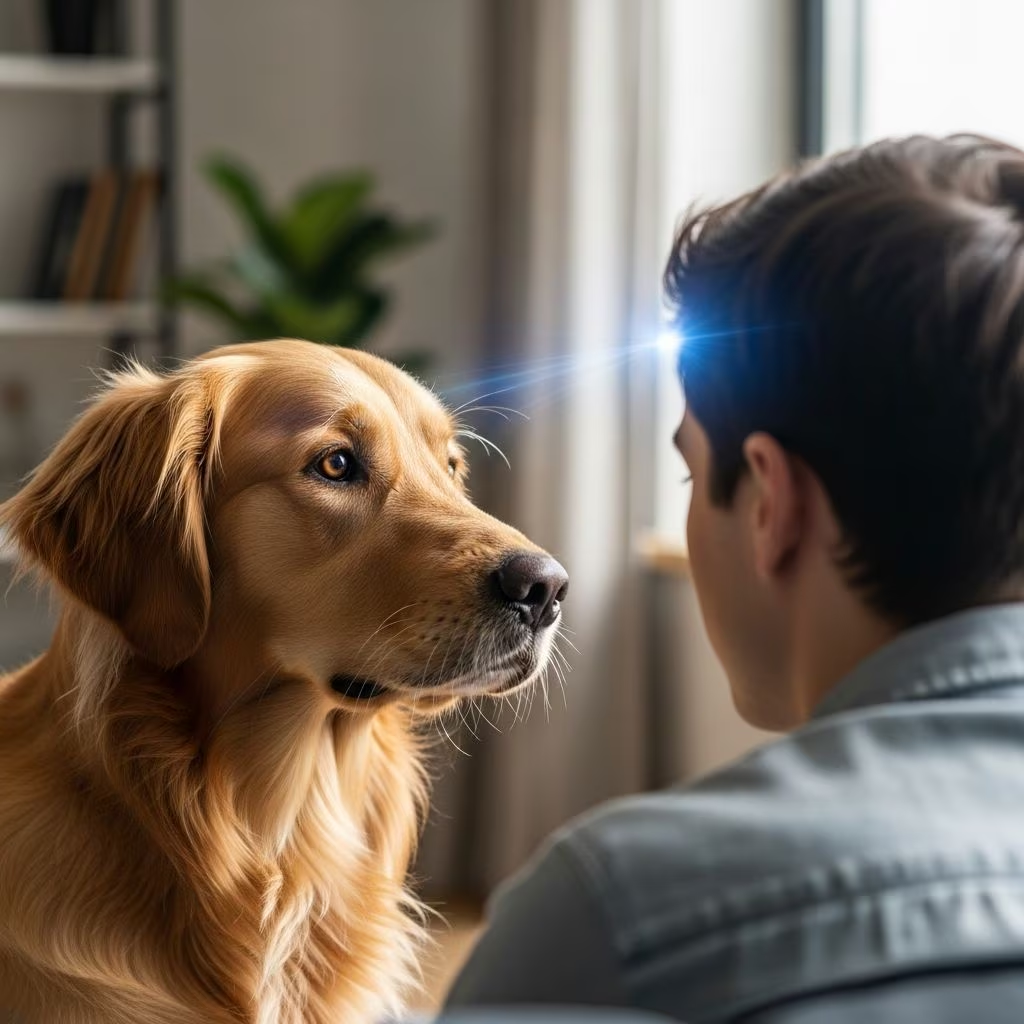
Dogs have an extraordinary knack for seeming to read our thoughts. That knowing glance when you’re sad, the excited wag when you grab the leash—it’s as if they peer into our minds. But is it telepathy, or something more grounded in science? Research shows dogs excel at interpreting human cues, a skill honed by thousands of years of domestication.
This ability stems from their evolution alongside humans, making them uniquely attuned to our gestures, expressions, and even intentions. Studies comparing dogs to wolves and chimpanzees reveal dogs’ superior social intelligence with people. Puppies as young as weeks old follow human pointing without training, outperforming their wild counterparts.
How Dogs \”Read\” Human Cues
Dogs rely on multiple channels to decode human behavior: visual cues like pointing or gazing, auditory signals such as tone of voice, and even scent. Unlike wolves, dogs look to humans for guidance in problem-solving tasks, such as finding hidden food.
In landmark experiments by Brian Hare, dogs consistently followed human points to locate treats, while chimpanzees and wolves did not, even after extensive training. This innate skill appears early; hand-reared wolf pups failed the task, but dog puppies succeeded regardless of human exposure.
- Pointing gestures: Dogs follow a pointed finger to objects 80-90% of the time in studies.
- Gaze direction: They track where we look, anticipating our actions.
- Facial expressions: Happy faces prompt play; angry ones elicit caution.
This \”mind-reading\” isn’t supernatural—it’s cognitive evolution. Dogs that best understood humans survived and reproduced, passing on these traits.
The Science of Canine Social Intelligence
Neuroimaging confirms dogs process human faces in specialized brain areas, similar to how primates handle social info. fMRI scans show activation in regions linked to emotion when viewing human versus dog faces.
Alexandra Horowitz’s research highlights dogs’ gaze-following and cue-reading as key to human-dog bonds. They inspect our faces for reassurance and direction, a trait absent in wolves.
| Species | Success Rate in Human Cue Tasks | Key Study Insight |
|---|---|---|
| Dogs | High (80-95%) | Innate, no training needed |
| Wolves | Low (<20%) | Even hand-raised fail consistently |
| Chimpanzees | Moderate (40-60%) | Require extensive socialization |
These differences underscore domestication’s role: dogs underwent genetic selection for people-pleasing behaviors over 15,000-40,000 years.
Do Dogs Recognize Kinship?
Beyond humans, dogs show kinship recognition, primarily via scent. Puppies prefer their mother’s crate over unfamiliar dogs, and even scent-only blankets elicit the same response. This holds for weeks-old pups.
Littermates are recognized if raised together, but familiarity fades without cohabitation. Mothers remember offspring for years; offspring remember mothers longer than siblings. Sex influences this: females prefer kin of both sexes, males favor male siblings.
- Maternal bonds: Scent-based, lasts 2+ years.
- Sibling recognition: Strong in youth, weakens without contact.
- Paternal: Female pups prefer father’s scent; males less so.
These mechanisms help dogs navigate social groups, mirroring their \”mind-reading\” of humans through familiar cues.
Humans Misread Dogs’ Emotions
While dogs excel at us, we falter at them. A study in Anthrozoös found people guess dogs’ feelings based on context (e.g., environment) over behavior. Participants misjudged emotions, projecting human biases.
Dogs express via tails, ears, eyes—subtle signals we overlook. High tails mean confidence; tucked, fear. Yet, we assume a wagging tail always signals joy, ignoring stiff posture indicating aggression.
Holly Molinaro notes anthropomorphism clouds judgment: \”Assumptions have nothing to do with the dog’s behavior.\” Better observation improves welfare.
Emotional Capacities: Dogs vs. Humans
Dogs feel joy, fear, anxiety, but lack higher cognition for guilt or complex self-reflection. Their limbic system drives impulsive reactions; prefrontal cortex limits control, akin to a toddler’s.
Barking conveys needs: excitement, frustration, alerts. Understanding prevents mislabeling as \”bad behavior.\” Training builds impulse control from puppyhood.
Practical Tips for Better Communication
Enhance your dog’s \”mind-reading\”:
- Use consistent cues: Same word for \”sit\” builds reliability.
- Eye contact: Strengthens bonds, but avoid staring contests.
- Positive reinforcement: Rewards attune them to your approvals.
- Observe body language: Learn their signals to reciprocate.
Games like \”find it\” sharpen cue-following. Socialization exposes them to varied humans, boosting adaptability.
Frequently Asked Questions (FAQs)
Q: Can all dogs read human cues equally?
A: Breeds vary; herding dogs like Border Collies excel due to work history, but all domesticated dogs show the trait innately.
Q: Do dogs feel guilty?
A: No; \”guilty looks\” respond to owner cues, not internal remorse. Punishment post-act confuses them.
Q: How do dogs recognize family?
A: Primarily scent; mothers and close kin for years, siblings if co-reared.
Q: Why do dogs stare at us?
A: To read intentions, seek guidance, or bond via oxytocin release from eye contact.
Q: Can training improve mind-reading?
A: Yes; consistent commands refine their interpretation of your signals.
Deepening the Human-Dog Bond
This interplay fosters profound connections. Dogs’ evolution molded them as companions, reading us better than any other animal. Reciprocating by learning their language elevates welfare and joy.
Ethical training emphasizes positivity; dominance methods erode trust. Modern science supports reward-based approaches, aligning with dogs’ cue sensitivity.
Challenges persist: miscommunications lead to surrenders. Awareness of biases helps; observe without projecting.
In kinship experiments, reciprocal recognition builds packs. Apply this to humans: consistent presence strengthens bonds.
References
- Can dogs recognize their relatives? — Wisdom Panel. 2023. https://www.wisdompanel.com/en-us/blog/can-dogs-recognize-their-relatives
- Do Dogs Understand Humans? — Kinship. 2023. https://www.kinship.com/dog-behavior/do-dogs-understand-humans
- Understanding Our Kinship with Animals — Veterian Key. 2020. https://veteriankey.com/understanding-our-kinship-with-animals-input-for-health-care-professionals-interested-in-the-humananimal-bond/
- Humans Bad at Reading Dog Emotions — Kinship. 2023. https://www.kinship.com/news/humans-bad-at-reading-dog-emotions
- It’s a plea for help and I wish people would be kinder — AOL. 2024. https://www.aol.com/plea-help-wish-people-kinder-114000328.html
- What Does It Mean When Your Dog Barks at You? — Adopt a Pet. 2023. https://www.adoptapet.com/blog/behavior-training/what-does-it-mean-when-your-dog-barks-at-you



