

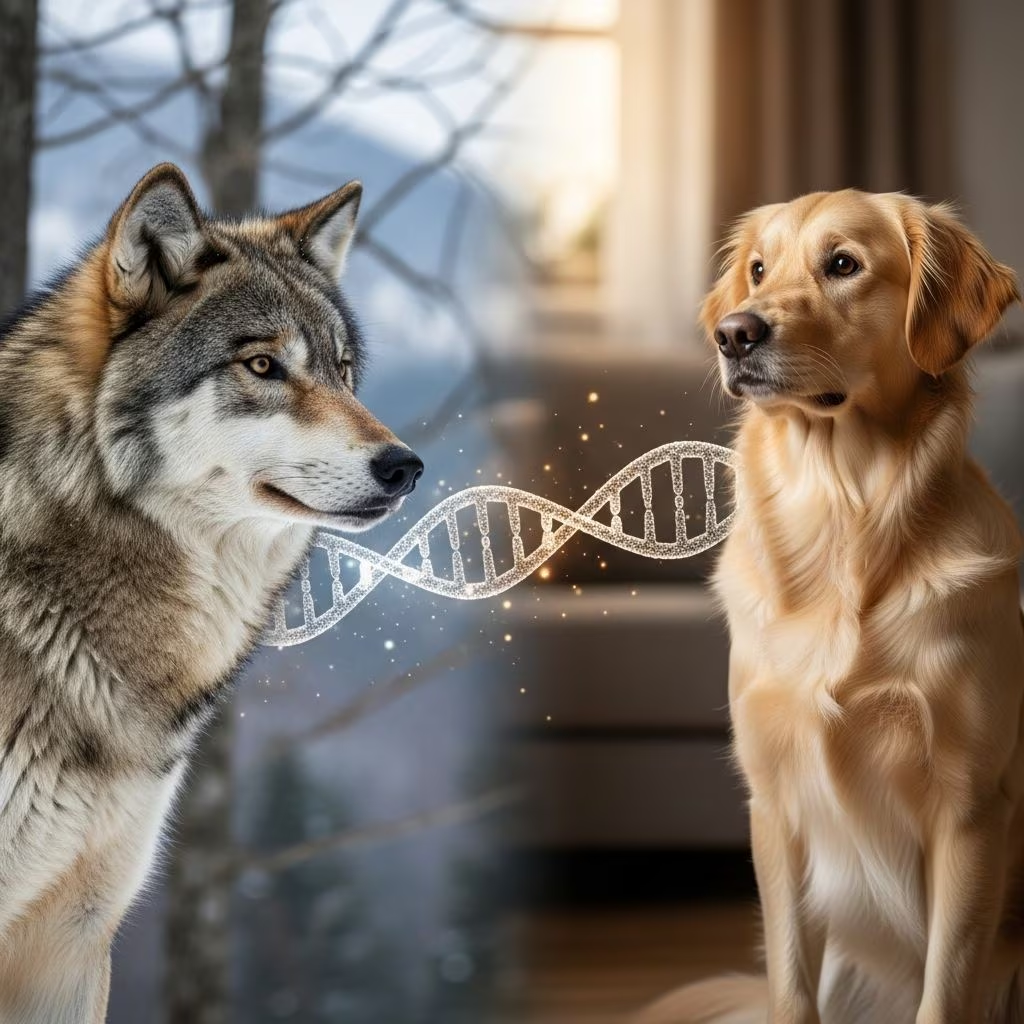
When you watch your beloved dog spin in circles before settling down for a nap or suddenly dig frantically at your garden, you’re witnessing behavior that traces back thousands of years to its wild ancestors. The domesticated dog, despite centuries of selective breeding that has transformed wolves into everything from tiny Chihuahuas to massive Great Danes, still carries the genetic blueprint of its pack-hunting predecessors. This genetic inheritance is neither entirely beneficial nor entirely problematic—it simply is, and understanding it can transform how we interpret and manage our pets’ actions.
The Ancient Connection: From Wild Wolf to Family Pet
Approximately 10,000 to 15,000 years ago, wolves began a remarkable transformation that would eventually create the modern dog. These wild canines, drawn to human settlements by the promise of scavenged food, were gradually incorporated into human society. Over millennia, through both natural selection and deliberate breeding, humans shaped canine genetics to suit their needs and preferences. The process created an entirely new species—one that retained the psychological and behavioral framework of its wild ancestor while developing unprecedented social bonds with humans.
This coevolution represents one of nature’s most successful partnerships, but it came with a unique challenge. The same genetic traits that made dogs useful to humans—their hunting abilities, their pack mentality, their territorial instincts—continue to manifest in modern dogs, sometimes in ways that frustrate or confuse pet owners. A dog that barks incessantly, digs up the yard, or exhibits separation anxiety isn’t misbehaving; rather, these animals are expressing instincts that were essential for survival in their ancestral environment.
Understanding Core Instinctive Drives
Dogs exhibit several fundamental drives inherited from their wolf lineage. These drives represent deep motivational systems that influence behavior across virtually all dog breeds and individual personalities. By recognizing these core instincts, owners can better understand their pets’ needs and design environments that accommodate natural behaviors while maintaining household harmony.
The Predatory Drive and Hunting Behaviors
The most obvious ancestral drive in dogs is their predatory instinct, often called prey drive. This drive manifests as the urge to search, hunt, stalk, chase, capture, and kill moving objects. In wolves, a strong prey drive was literally the difference between survival and starvation—pack members who couldn’t effectively hunt wouldn’t eat. Modern dogs retain this powerful instinct even though most never need to catch their own food.
The prey drive appears in different intensities across breeds and individuals. A Border Collie exhibits an intense herding behavior that represents prey drive with an inhibited killing response. A Beagle’s tendency to follow scent trails stems from prey drive evolution, while a Retriever’s enthusiasm for fetching taps into the natural behavior of capturing and carrying prey. Even a house pet’s fascination with chasing squirrels, pouncing on toys, or running after a tennis ball reflects this ancient genetic programming.
Understanding prey drive helps owners redirect it constructively. A dog with strong prey drive might become a search and rescue dog, a truffle hunter, or an agility competitor. The instinct doesn’t disappear through training, but it can be channeled toward productive activities that satisfy the underlying need while serving human purposes.
The Pack Instinct and Social Bonding
Wolves are intensely social animals living in hierarchical family groups where cooperation determines survival. Dogs inherited this social instinct, which is why they integrate so naturally into human families. This pack mentality makes dogs highly trainable and responsive to family dynamics. A dog’s desire to belong to a social group is the foundation of its amenability to living with humans and following human guidance.
However, this same social instinct can create significant problems. A dog separated from its pack—whether that pack consists of humans, other dogs, or both—may experience profound distress. Separation anxiety, which manifests as destructive behavior, incessant barking, inappropriate elimination, or escape attempts, stems directly from the ancient wolf’s absolute dependence on pack membership for survival. A dog experiencing separation anxiety isn’t being vindictive or stubborn; it’s expressing a primal fear of abandonment.
The Defensive and Territorial Drive
Wolves must defend their territory, their food sources, and their pack members to survive. This defensive instinct remains strong in modern dogs, manifesting as territorial marking, guarding behaviors, and protective aggression. A dog that growls over food, stands stiffly with raised hackles when strangers approach, or defends certain areas of the home is expressing ancient survival mechanisms.
This drive explains why many dogs naturally protect valuable resources. A friendly, affectionate pet may nonetheless guard a favorite bone, shake and thrash squeaky toys, or bark at perceived threats. These behaviors aren’t signs of a dangerous dog; they’re expressions of deep instincts to protect resources and territory that once meant the difference between thriving and dying.
Manifestations of Ancestral Behavior in Modern Dogs
When you observe your dog’s daily behaviors, you’re watching ancestral instincts play out in modern contexts. Several specific behaviors highlight this connection between ancient survival needs and contemporary pet actions.
Pre-Sleep Circling and Nest-Building
That amusing behavior where your dog circles multiple times before finally settling down to sleep represents real ancestral necessity. In the wild, wolves circle to flatten grass, leaves, and debris into a comfortable nest while simultaneously checking for threats in all directions. This behavior served multiple purposes: creating a comfortable sleeping surface, scanning the environment for danger, and establishing a secure space. Modern dogs perform these circles despite having comfortable beds provided by their owners, demonstrating how deeply embedded these behaviors remain in canine neurology.
Curling into a Ball
Many dogs prefer to sleep curled tightly into a ball rather than sprawling out on their comfortable beds. This posture, with the spine facing outward and vulnerable organs tucked inward, protected wolves while they slept in dangerous environments. The position also made a sleeping dog smaller and less visible to predators. This ancient protective configuration persists even in dogs living in secure homes where no threats exist. It’s a behavioral fossil—a remnant of adaptations that no longer serve a survival function but remain encoded in genetic programming.
Digging and Burying Behaviors
Dogs dig for multiple ancestral reasons, and their digging drives frustrate countless gardeners. In the wild, wolves dug to create dens for sleeping and to bury excess food, particularly meat and bones, for later consumption. This food-caching behavior made sense when the next successful hunt might be days away; burying food prevented spoilage and scavenging by competitors. Modern dogs still bury bones, toys, and other valued objects, sometimes in yards, sometimes under blankets. They’re not being destructive for its own sake—they’re expressing the same resource-management behavior that kept their ancestors fed.
Additionally, wolves dug to create cool resting places during hot weather. A dog that digs a hole and settles into it on a summer day is likely expressing this thermoregulation instinct. Understanding the functional reason for digging helps owners provide acceptable outlets, such as designated digging areas filled with sand or soil, rather than simply punishing behavior that serves genuine needs.
Toy Shaking and Kill-Bite Behaviors
The vigorous shaking, thrashing, and biting of toys that many dogs enthusiastically perform reflects ancient hunting techniques. Wolves and wild canines shake prey to break bones, deliver fatal wounds, and disable struggling prey. A dog violently shaking a squeaky toy is rehearsing the killing bite sequence that would have been essential for feeding the pack. This behavior appears particularly intense in toy terriers and other breeds originally selected for hunting small prey. The squeaking noise that dogs find so satisfying mimics the distress sounds of wounded prey, further triggering predatory responses.
Sensory Inheritance: Smell, Sound, and Movement Detection
Dogs perceive the world through sensory systems shaped by millions of years of wolf evolution. Understanding how dogs experience their environment through these ancestral systems provides insight into seemingly mysterious behaviors.
Olfactory Excellence
The canine nose represents one of nature’s most sophisticated sensory organs. Dogs possess roughly 300 million olfactory receptors compared to humans’ 6 million, and the brain areas devoted to smell processing are proportionally much larger in dogs than in humans. This exceptional olfactory ability wasn’t a luxury for wolves—it was essential for tracking prey, identifying pack members, detecting predators, and navigating their territory. Modern dogs utilize this same powerful sense to gather information about their environment during walks, to communicate with other dogs through scent marking, and to perform sophisticated tasks like drug detection or medical alert work.
When your dog stops every few steps to sniff during a walk, they’re not being stubborn or slow. They’re gathering complex information about what other animals have passed through, what food sources might be available, territorial markings from neighboring dogs, and countless other details invisible to human perception. Rolling in grass, dirt, or sometimes less pleasant substances represents another olfactory behavior—by adding scents to their coat or masking their own scent, dogs may be employing camouflage tactics inherited from their wild ancestors.
Vocal Communication
Barking, howling, growling, and whining represent direct continuations of wolf communication systems. While wolves communicate primarily through howling and body language rather than the extensive barking seen in many modern dogs, the vocal capacity exists in both. Different barks serve different functions: alert barks warn of perceived threats, play barks accompany social interaction, and separation-anxiety barks express distress. Howling, which some dogs perform in response to sirens or as a response to other dogs howling, echoes the pack communication methods of wolves maintaining contact across distance.
Individual Variation and Breed-Specific Instincts
While all dogs carry ancestral wolf instincts, thousands of years of selective breeding have amplified certain instincts in particular breeds while diminishing others. A Border Collie’s herding drive, a Bloodhound’s tracking drive, a Retriever’s fetching drive, and a Terrier’s kill-bite drive all represent specialized versions of foundational predatory and hunting instincts shaped by human selection.
This selective breeding means that understanding a dog’s breed or breed mix provides valuable insight into which ancestral instincts are likely to be particularly strong. A dog with strong terrier ancestry will have more intense prey drive and kill-bite responses than a dog bred primarily for companionship. A dog with herding heritage will likely exhibit intense focus on movement and boundary-maintaining behavior. These breed-specific differences don’t change the fundamental instincts, but they do explain why some behaviors appear more prominently in certain dogs.
Practical Applications: Redirecting Instinct Toward Positive Outcomes
Recognizing ancestral instincts isn’t merely academic; it provides practical tools for pet management and training. Rather than attempting to suppress natural drives, effective dog ownership involves channeling these instincts toward acceptable behaviors.
- Prey drive: Utilize through fetch games, agility training, scent work, search and rescue training, or truffle hunting rather than discouraging the behavior entirely.
- Digging drive: Provide designated digging areas, sandbox spaces, or puzzle toys that allow excavation without yard destruction.
- Pack instinct: Establish consistent family routines, maintain predictable social structures, and address separation anxiety through gradual desensitization rather than isolation avoidance.
- Tracking and scenting: Create sniffing opportunities during walks, provide scent-based puzzle toys, or explore nose-work training.
- Protective instincts: Channel defense drive through appropriate alerting behavior rather than aggressive guarding, using training techniques that redirect without eliminating the drive.
Training and Instinct: Compatibility Rather Than Opposition
A common misconception holds that training eliminates instincts. In reality, training works with instincts rather than against them. A Border Collie trained for herding competition still possesses intense predatory drive; training has simply provided a controlled outlet and taught the dog when and where to express that drive. Similarly, a dog trained not to jump still possesses the ancestral drive toward social excitement and pack greeting behaviors; training has redirected the expression into more acceptable forms.
This distinction matters because it explains why punishment-based approaches often fail with strong instinctual behaviors. Punishing a dog for digging, chasing, or exhibiting prey drive is like punishing a person for breathing—the drive exists at a neurological level deeper than behavior modification can reach. Effective training acknowledges the drive and channels it rather than attempting to eliminate it.
FAQ: Common Questions About Ancestral Dog Instincts
- Q: Can training completely eliminate ancestral instincts?
- A: No. Training can redirect instincts and control their expression, but the underlying drives remain. A trained dog and an untrained dog both possess prey drive; training determines how and when that drive manifests.
- Q: Why do some dogs display instincts more strongly than others?
- A: Breed selection, individual genetic variation, early socialization, and environmental factors all influence instinct intensity. A dog bred for hunting will typically display stronger prey drive than one selected primarily for companionship.
- Q: Is it cruel to own a dog with strong hunting instincts in an urban environment?
- A: Not necessarily, provided the owner understands the instinct and provides appropriate outlets. Many urban dogs with strong prey drive thrive with regular exercise, mental stimulation, and structured activities that satisfy ancestral needs.
- Q: Can understanding instincts help with behavioral problems?
- A: Absolutely. Many behavioral issues reflect mismatched environments or unmet ancestral needs. Understanding the drive behind a behavior often suggests solutions that address root causes rather than superficial symptoms.
Conclusion: Living with Ancestral Programming
The dog sleeping on your couch, enjoying your companionship and protection, carries within its genetic structure the mind of a wolf navigating a dangerous wilderness. This inheritance creates both the traits we adore in dogs and the behaviors that sometimes frustrate us. A dog’s loyalty and social adaptability, traits that make them exceptional companions, stem from the same pack instincts that can create separation anxiety. A dog’s enthusiasm and responsiveness to training come from the same prey drive that makes them chase squirrels and shake toys.
When behavior becomes problematic, the solution often lies not in fighting ancestral instincts but in understanding them and creating life conditions that allow their healthy expression. Dogs that dig get designated digging areas. Dogs with strong prey drive get structured hunting games and training. Dogs with intense pack instincts get consistent family routines and gradual tolerance for solitude. By acknowledging that our pets are not miniature humans with animal bodies but rather creatures of a different species with their own legitimate needs and drives, we can create mutually satisfying relationships that honor both human expectations and canine nature.
References
- Dog Psychology Part 4: Dogs Are Descendants Of Wolves — Thriving Canine. Accessed March 2026. https://www.thrivingcanine.com/blog/dog-psychology-part-4-dogs-are-descendants-wolves/
- Understanding Your Dog’s Behavioral Instincts — Pat’s Pack. Accessed March 2026. https://www.patspack.com/dog-training-tips-and-tricks/the-canine-mind-unleashed-understanding-your-dogs-behavioral-instincts
- Understanding Your Dog’s Ancestral Instincts: Vet-Verified Facts — Dogster. Accessed March 2026. https://www.dogster.com/lifestyle/understanding-your-dogs-ancestral-instincts
- Understand Your Dog’s Ancestral Instincts — Whole Dog Journal. Updated January 10, 2019. https://www.whole-dog-journal.com/behavior/instincts-dna/understand-your-dogs-ancestral-instincts/
- The Natural Instincts of Domestic Pets: Understanding Your Dog’s Wild Side — Canadian Kennel Club. October 2024. https://ckcusa.com/blog/2024/october/the-natural-instincts-of-domestic-pets-understanding-your-dog-s-wild-side/
- Many of Your Dog’s Quirky Behaviors Are Inherited Survival Tactics — Earth.com. Accessed March 2026. https://www.earth.com/news/dogs-behaviors-inherited-survival-tactics/



