Wild Cottontail Bunny Turns Out Not to Be
A baby bunny mistaken for wild cottontail reveals surprising truth about domestic rabbits.
Sometimes, determining the true identity of an animal requires more than just a quick glance. This was certainly the case for MacGruber, a young bunny who arrived at Best Friends Animal Sanctuary under the assumption that he was a wild cottontail rabbit. What unfolded was a fascinating discovery that challenged initial assumptions and highlighted the importance of proper animal identification and care. MacGruber’s journey from a presumed wild animal to a confirmed domestic pet provides valuable insights into the differences between wild and domestic rabbits, as well as the critical role of wildlife rehabilitation professionals.
The Initial Assessment: A Cottontail in Need
When MacGruber first arrived at Best Friends Animal Sanctuary as a baby, he was in dire straits. He had been discovered outdoors after apparently being attacked by another animal, and his survival prospects were bleak without immediate professional intervention. Given his appearance and the circumstances of his discovery, the decision was made to bring him to Wild Friends, Best Friends’ state and federally licensed wildlife rehabilitation and education center. The assumption seemed logical: a young rabbit found outside must be a wild cottontail.
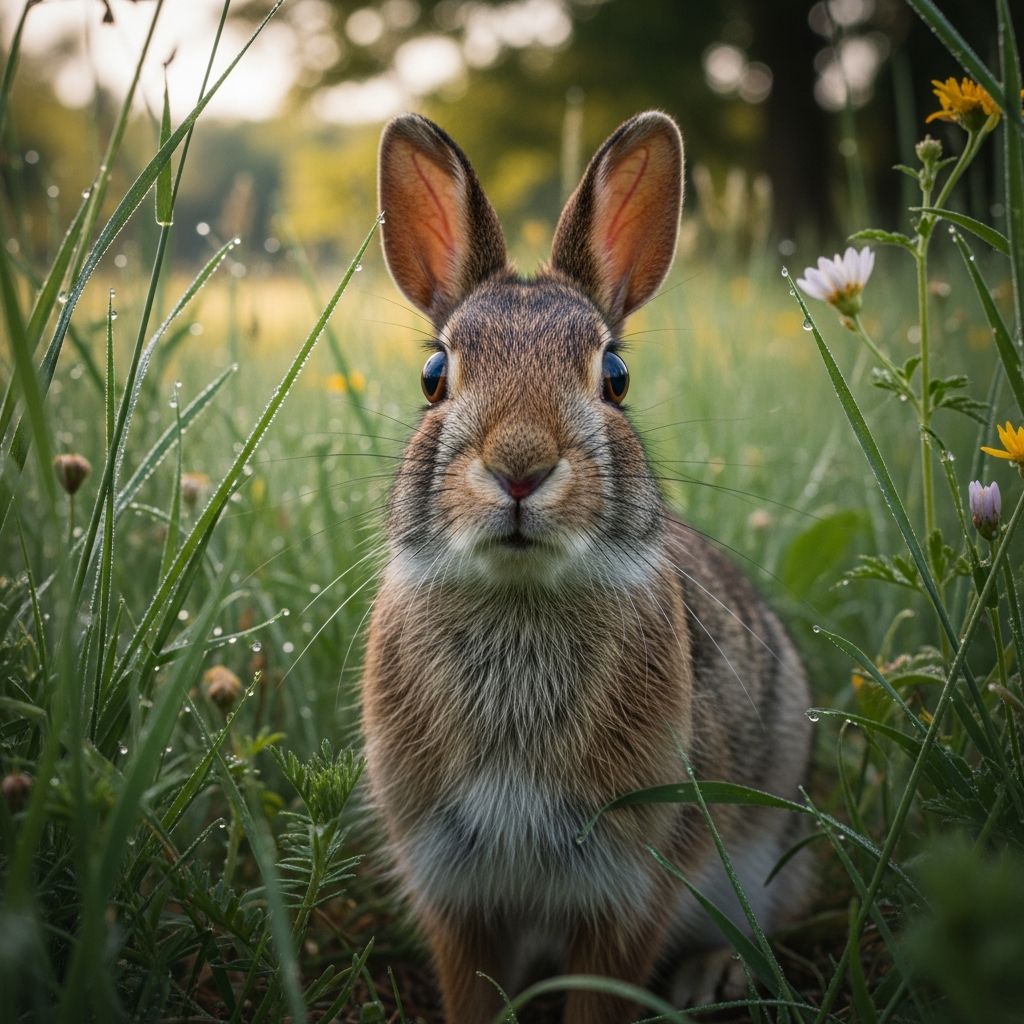
MacGruber’s physical appearance certainly supported this conclusion. He possessed the characteristic grey-brown fur and distinctive puffy white tail that are hallmarks of wild cottontail rabbits. To all observers, including experienced staff members, he looked exactly like what he was supposed to be—a young cottontail in need of rehabilitation and eventual release back into the wild. For several weeks, MacGruber continued to masquerade as a wild cottontail while his injuries healed under the watchful care of Wild Friends caregivers.
The Growing Suspicion: Something Wasn’t Right
Despite the apparent healing of his eye and leg injuries, Wild Friends caregivers began noticing anomalies in MacGruber’s development that didn’t align with typical cottontail growth patterns. Stefanie Rolston, one of the experienced caregivers at Wild Friends, observed that MacGruber was growing to nearly twice the size of a normal cottontail rabbit. His ears continued to elongate far beyond what would be expected in a wild cottontail, and his body size increased in ways that defied the normal developmental trajectory of his presumed species.
These physical discrepancies were troubling, but they weren’t the only red flags. The staff noticed behavioral patterns that were equally unusual for a wild cottontail. According to Rolston’s expertise, wild cottontail rabbits, even those raised by humans from infancy, inevitably experience a phenomenon known as “wilding up.” This natural process involves the animal becoming increasingly fearful and evasive of human contact, eventually reverting to its inherent wild instincts and skittish nature.
Bunny Wasn’t “Wilding Up”
MacGruber, however, was displaying the exact opposite behavior. Rather than becoming frightened or withdrawn from human interaction, he was becoming progressively more curious about people. Instead of hiding or attempting to avoid caregivers, MacGruber seemed genuinely interested in making friends with his human caretakers. This fundamental behavioral difference was perhaps the most telling sign that something fundamental about MacGruber’s identity was incorrect. A wild cottontail simply would not behave this way, regardless of early human socialization.
The combination of his oversized body, unusually long ears, and—most importantly—his lack of the characteristic “wilding up” behavior created an undeniable puzzle. The Wild Friends team recognized that they were dealing with something other than a typical wild cottontail rabbit. Their suspicions grew stronger with each passing day as MacGruber continued to defy the expected development of a wild cottontail.
The Confirmation: A Domestic Rabbit Revealed
Recognizing that they needed expert confirmation of their suspicions, Wild Friends staff contacted Jason Dickman, the manager of the Bunny House at Best Friends Animal Sanctuary. Dickman, with his extensive experience and knowledge of rabbit varieties and behaviors, was brought in to evaluate MacGruber. Upon examination, he quickly confirmed what the caregivers had begun to suspect: MacGruber was not a cottontail at all. He was, in fact, a domestic rabbit.
This revelation fundamentally changed MacGruber’s care plan and future prospects. The identity crisis resolved, Dickman explained that there are indeed rabbits bred specifically to resemble cottontails, creating confusion about their true nature. However, MacGruber’s characteristics clearly distinguished him from a wild cottontail in several ways that went beyond mere appearance.
Distinguishing Domestic From Wild: Key Physical Differences
Understanding the differences between domestic rabbits bred to look like cottontails and actual wild cottontails is essential for proper identification and care. The following characteristics helped confirm MacGruber’s true identity:
- Body Size: MacGruber’s body was substantially larger than a normal cottontail, growing to nearly twice the typical size.
- Ear Length: His ears were considerably longer than those of a wild cottontail rabbit.
- Tail Structure: Despite having the appearance of a classic “cotton ball” tail, MacGruber’s tail was longer and straighter than a typical cottontail’s tail.
- Behavioral Traits: His social nature and lack of skittishness contradicted wild cottontail behavior.
- Fur Coloration: While his brownish-grey fur resembled a cottontail’s coat, his other physical features rendered this similarity superficial.
MacGruber’s Social Nature: The Giveaway
One of the most significant factors in identifying MacGruber as a domestic rabbit rather than a wild cottontail was his temperament. As Jason Dickman noted, MacGruber is “pretty social and not skittish.” This behavioral profile is fundamentally incompatible with wild cottontail rabbits, which are naturally wary of humans and other potential threats. Even cottontails raised by humans from birth will eventually develop the fearful, evasive behaviors characteristic of their wild nature.
MacGruber’s consistent friendliness and curiosity about people, combined with his failure to exhibit any sign of wilding up, provided compelling behavioral evidence supporting the conclusion that he was domestic. His willingness to interact with caregivers and his apparent desire to form social bonds stood in stark contrast to what Wild Friends staff had come to expect from wild cottontails under their care.
A New Beginning: Life in the Bunny House
With MacGruber’s true identity confirmed, his trajectory at Best Friends Animal Sanctuary shifted dramatically. Rather than being released back into the wild once his injuries healed—the standard protocol for wild cottontails—MacGruber was transferred to the Bunny House, where domestic rabbits are cared for and prepared for adoption into loving homes.
This change represented a significant improvement in MacGruber’s prospects and quality of life. While his fur would maintain the brownish-grey coloration resembling his wild cousins, his days of being mistaken for a cottontail were definitively over. The staff’s ability to correctly identify him as a domestic rabbit ensured that he would receive appropriate care suited to his true needs and nature.
The Importance of Proper Identification
MacGruber’s case illustrates the critical importance of accurate animal identification in wildlife rehabilitation and animal care. The ability to distinguish between wild and domestic animals, particularly in cases where they share similar physical characteristics, has profound implications for the animal’s care plan and future. Had MacGruber been released into the wild—a common outcome for animals initially identified as wild cottontails—he would have faced certain death. Without the survival instincts and behaviors of wild rabbits, he would have been defenseless in the natural environment.
The caregivers at Wild Friends demonstrated excellent observational skills and appropriate skepticism when MacGruber’s behavior and development didn’t align with expected patterns. Their willingness to seek expert confirmation and adjust their care approach accordingly exemplifies best practices in animal rehabilitation.
Understanding Wild Versus Domestic Rabbits
The contrast between wild and domestic rabbits extends far beyond physical characteristics. Wild cottontails are adapted through evolution and instinct to survive independently in nature. They possess innate behaviors such as predator avoidance, foraging skills, and territorial instincts that are fundamental to their survival. Domestic rabbits, conversely, have been selectively bred for generations to live in human environments and depend on human care.
Some domestic rabbit breeds have been specifically developed to physically resemble cottontails, which creates the potential for confusion—as demonstrated by MacGruber’s initial misidentification. However, despite superficial similarities in appearance, the behavioral and developmental differences remain consistent and reliable indicators of a rabbit’s true nature.
What MacGruber’s Story Teaches Us
MacGruber’s journey from presumed wild animal to confirmed domestic pet carries several important lessons for anyone working with or encountering young animals:
- Appearance alone is insufficient for accurate animal identification, particularly when multiple species share similar physical characteristics
- Behavioral observation is crucial in determining whether an animal is wild or domestic
- Professional expertise and consultation can prevent misidentification with potentially serious consequences
- Adaptation and flexibility in care approaches are essential when initial assessments prove incorrect
- Domestic animals released into the wild face certain danger and death, making accurate identification a matter of life and death
A Happy Ending for MacGruber
Because Wild Friends staff were able to identify that MacGruber was not a wild animal, he can now look forward to a life as a much-loved pet in a human home. His days of uncertainty are behind him, and his future holds the promise of companionship and care specifically suited to a domestic rabbit. His story, while beginning with uncertainty and confusion, concludes with hope and appropriate placement.
MacGruber’s case remains an excellent example of why professional wildlife rehabilitation is so important. The expertise and careful observation of trained staff members meant the difference between a domestic rabbit spending his life in the wild attempting to survive as a wild creature, and a domestic rabbit finding his way to a forever home. His story continues to help educate people about the important distinctions between wild and domestic animals, and why proper identification and care are paramount.
Frequently Asked Questions
Q: How can you tell if a rabbit is domestic or wild?
A: Key differences include size (domestic rabbits are typically larger), ear length, behavioral traits (domestic rabbits are more social and less skittish), and developmental patterns. Wild rabbits exhibit a “wilding up” behavior, becoming increasingly fearful of humans over time, while domestic rabbits tend to become friendlier.
Q: What should I do if I find a baby cottontail outside?
A: Contact your local licensed wildlife rehabilitator immediately. They have the expertise and legal authorization to properly care for wild animals. Attempting to raise a wild animal yourself is both illegal and harmful to the animal’s well-being.
Q: Can wild cottontail rabbits ever become pets?
A: No. Wild cottontails will always maintain their wild instincts and fearful nature, even if raised by humans from infancy. They cannot be domesticated and should never be kept as pets.
Q: Why was MacGruber’s identity initially missed?
A: MacGruber’s grey-brown fur and white tail closely resembled those of a wild cottontail, and he was found outdoors in distress. However, continued observation revealed his unusual size, ear length, and particularly his lack of wilding-up behavior indicated he was domestic.
Q: What happens to domestic rabbits found in the wild?
A: Domestic rabbits found outdoors face grave danger as they lack the survival skills and instincts of wild rabbits. They should be brought to animal shelters or rescue organizations where they can receive proper care and be placed in homes.
References
- Wild Cottontail Bunny Turns Out Not to Be — Best Friends Animal Society. 2024. https://bestfriends.org/stories/features/wild-cottontail-bunny-turns-out-not-be
- Rewilding Wild Animals — Best Friends Animal Society. 2024. https://bestfriends.org/stories/features/rewilding-wild-animals
- Wildlife Rehabilitation Program — Best Friends Animal Sanctuary. 2024. https://bestfriends.org
Similar Articles







Read full bio of medha deb