

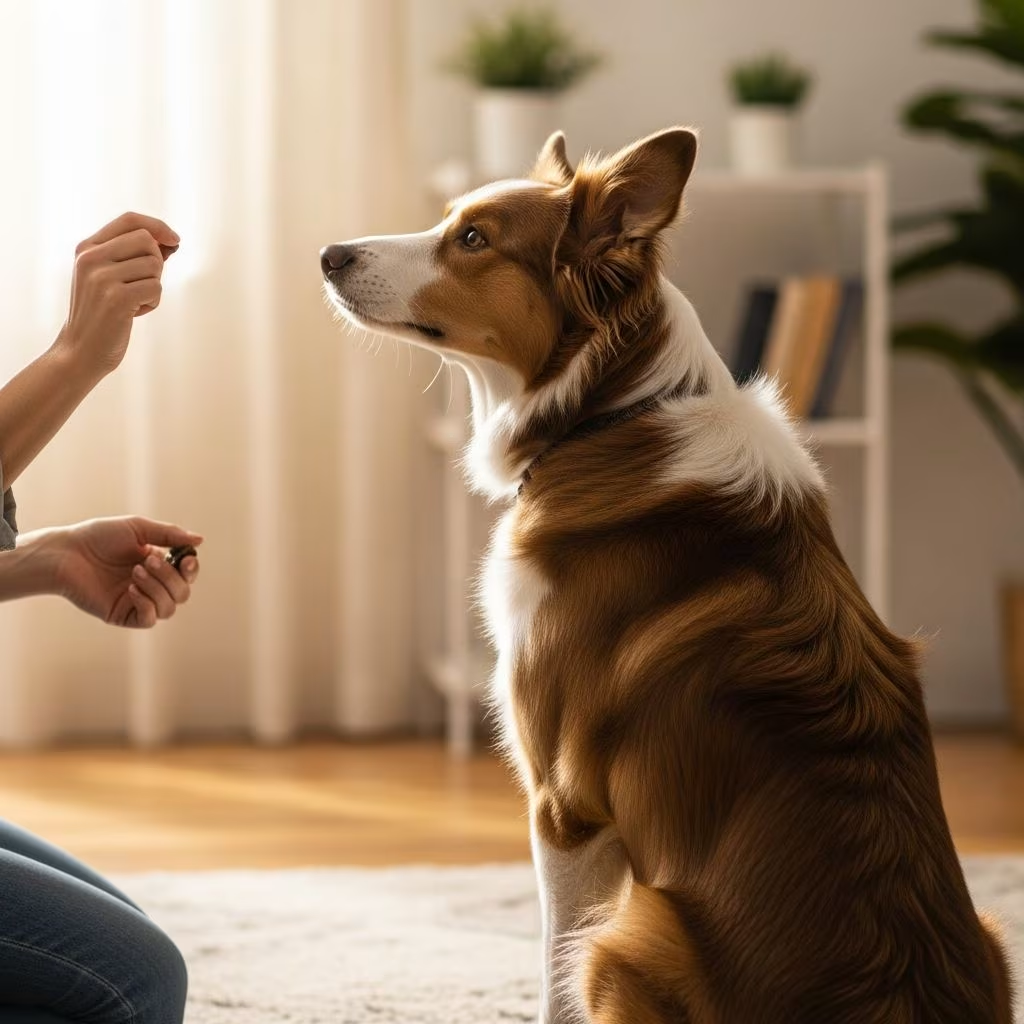
If you feel like you’re talking to a brick wall every time you call your dog, you are not alone. Many loving dog parents struggle with a pup who seems to tune them out, listen only when it’s convenient, or respond perfectly at home but ignore cues outdoors. The good news is that this is usually not stubbornness or spite—it is a training and communication problem you can fix with the right approach.
This guide breaks down the most common reasons a dog doesn’t listen, what your dog is actually experiencing, and step-by-step strategies to build better focus, cooperation, and trust.
Is Your Dog Really Ignoring You?
Before you label your dog as “stubborn,” it helps to understand how dogs learn and what listening looks like from a canine perspective. Dogs are constantly taking in smells, sights, sounds, and social information. To them, your words are just one small part of a very noisy world.
Research on dog cognition shows that dogs can learn to respond consistently to human verbal and visual cues, but their performance is strongly influenced by context, prior training, and motivation. That means your dog’s ability to “listen” is not a fixed trait; it changes with the environment and your training history.
Common Signs Your Dog Isn’t Really Being Defiant
- Your dog responds well indoors but not at the park or on walks.
- Your dog seems confused—looking back and forth, freezing, or offering random behaviors.
- Your dog responds when you have treats or toys but not without them.
- Your dog listens to one family member better than others.
All of these point to incomplete training or unclear communication, not a “bad” dog.
Why Dogs Don’t Listen: Core Reasons
There are several overlapping reasons your dog may not listen to you in day-to-day life. Understanding them helps you choose the right training strategy instead of just repeating the same cue more loudly.
1. The Environment Is Too Distracting
Dogs are experts at picking up environmental cues: other dogs, people, food scraps, wildlife, and smells you cannot even detect. A busy environment can easily overpower your voice, especially if your dog is young or not thoroughly trained around distractions.
- High-arousal situations: Dog parks, busy streets, and open fields with wildlife all compete heavily with your cues.
- Novel places: New locations require extra sniffing and exploring, which leaves fewer “mental resources” for listening to you.
- Triggering stimuli: Squirrels, skateboards, or unfamiliar dogs may make it almost impossible for your dog to focus at first.
2. The Cue Isn’t Fully Learned Yet
Hearing a word does not automatically mean your dog understands it. To a dog, “sit” is only meaningful if it has been clearly and consistently paired with the action and reward in many different contexts.
Behavior research repeatedly shows that dogs need multiple, consistent repetitions with clear feedback in a variety of environments before a cue becomes reliable. If your dog only practiced “sit” in the kitchen, they may not realize “sit” means the same thing at the park.
3. Confusing or Inconsistent Human Cues
Dogs are very sensitive to patterns. If different people use different words, tones, or body language for the same behavior, your dog may not know what you want.
- One person says “come,” another says “here,” another whistles.
- Sometimes the dog is rewarded for jumping up (with attention), other times scolded.
- Body language contradicts the cue—leaning over the dog and reaching can feel threatening while you say “come.”
From your dog’s point of view, the rules keep changing.
4. Low Motivation: What’s In It For The Dog?
Dogs repeat behaviors that are rewarding. If coming when called ends the fun every time (like leaving the park) and your rewards are bland or inconsistent, ignoring you might feel like a better deal.
- Weak rewards: Dry kibble may not compete with chasing a squirrel.
- Predictable outcomes: If “come” always means “we go home now,” your dog may avoid it.
- Stress or fear: A stressed dog may be more focused on safety than food or play.
5. Stress, Fear, or Overwhelm
In stressful situations, dogs often go into “survival mode.” Their brains prioritize scanning for threats rather than engaging in trained behaviors. Studies on dog welfare show that anxiety and fear reduce dogs’ ability to perform learned tasks and respond to social cues.
Signs your dog is too stressed to listen include:
- Panting when it’s not hot
- Tucked tail, pinned ears, or cowering
- Refusing food or turning away from you
- Lunging or barking at triggers
6. Underlying Medical or Sensory Issues
Hearing loss, chronic pain, or other health issues can make your dog slower to respond or less willing to move. Research on aging dogs shows that hearing deficits and cognitive decline can significantly affect responsiveness to familiar cues.
If your dog suddenly stops listening or seems confused by familiar cues, especially in older age, a veterinary check is essential.
Training Foundations: How Dogs Actually Learn
To improve your dog’s responsiveness, it helps to work with the learning systems we know dogs use, based on decades of behavioral science.
Positive Reinforcement and Reward-Based Training
Reward-based training—reinforcing desired behaviors with food, toys, or social rewards—is strongly supported as effective and welfare-friendly by veterinary and animal behavior organizations. Dogs repeat behaviors that have good outcomes for them.
Key principles:
- Reward the exact behavior you want, as soon as it happens.
- Use rewards your dog truly values (not just what you think they should like).
- Set up training in small, achievable steps so your dog can succeed often.
Consistency and Clarity
Reliable behavior comes from clear, consistent cues and consequences over time. Every family member should:
- Use the same word for each behavior.
- Reward the behavior the same way, especially in the early stages.
- Avoid sometimes allowing, sometimes correcting the same behavior (like jumping up).
Generalization: From Living Room to Real Life
Dogs are not naturally good at “generalizing” cues from one context to another. A behavior learned indoors must be practiced in multiple locations, with gradually increasing distractions, before you can expect reliability everywhere.
| Stage | Environment | Distraction Level | Goal |
|---|---|---|---|
| 1 | Quiet room at home | Very low | Dog understands the cue and performs it reliably. |
| 2 | Different rooms & backyard | Low | Dog responds in new but familiar spaces. |
| 3 | Quiet outdoor areas | Moderate | Dog responds with some distractions. |
| 4 | Busier parks & sidewalks | High | Dog responds even when excited or distracted. |
Step-by-Step: Teaching Your Dog to Listen Better
The following step-by-step approach mirrors the main topics in the original article: understanding the problem, building communication, practicing key cues, and troubleshooting challenges.
Step 1: Start in a Low-Distraction Environment
Begin training in the quietest, simplest location you have—often your living room.
- Have a supply of small, soft, high-value treats.
- Keep sessions short: 3–5 minutes, several times a day.
- End the session before your dog gets bored or frustrated.
Step 2: Build Name Recognition and Attention
Your dog cannot listen to a cue they do not notice. First, teach your dog that their name means “look at you.”
- Say your dog’s name once in a neutral tone.
- As soon as they glance at you, mark it with a cheerful “yes!” or a click (if you use a clicker) and give a treat.
- Repeat several times until your dog quickly looks at you when they hear their name.
This simple exercise builds a habit of checking in—critical for later training.
Step 3: Teach or Refresh Core Cues
Focus on a few core cues that make daily life easier and safer:
- Sit – for calm behavior before meals, doors, or petting.
- Stay – to prevent bolting through doors or into unsafe areas.
- Come – for recalls away from distractions.
- Leave it – to prevent grabbing unsafe or unwanted items.
Teach each cue in small steps. For example, for “come”:
- In a quiet room, gently move away a few steps, say your dog’s name + “come” once.
- Encourage with open arms or moving backward.
- When your dog moves toward you, mark and reward heavily—multiple small treats and praise.
- Gradually increase distance and add mild distractions only when your dog’s response is strong.
Step 4: Gradually Add Distractions
Once your dog responds well at home, repeat the same exercises in:
- Different rooms
- Hallways and stairwells
- Backyard or a quiet outdoor area
If your dog struggles, lower the difficulty: shorten distance, simplify the task, or move to a calmer location.
Step 5: Use Real-Life Rewards
Food is a powerful training tool, but everyday things your dog loves can also become rewards:
- Access to sniffing a tree or lamppost
- Getting to greet a friend or dog (if safe and appropriate)
- Being let off leash in a secure area after responding to a cue
Pairing cues with meaningful, real-life outcomes makes listening worthwhile for your dog in the long term.
Troubleshooting Common Listening Problems
Even with good training, you may hit roadblocks. Here are some common scenarios and how to adjust.
Problem: “My Dog Listens at Home but Not Outside”
This usually means your dog has not generalized the cue to more distracting environments yet.
- Go back a step: Practice in a slightly more distracting place, not the busiest park.
- Use higher-value rewards outdoors than indoors.
- Keep your dog on a leash or long line so you can prevent self-rewarding behaviors like running off.
Problem: “My Dog Only Listens When I Have Treats”
If your dog responds only when they see a treat, they may have learned that the presence of the treat—not the cue—predicts the reward.
- Keep treats hidden in a pouch or pocket instead of in your hand.
- Give the cue first, then reach for the treat after your dog performs the behavior.
- Gradually shift to a variable schedule: sometimes food, sometimes play, sometimes praise or access to something fun.
Problem: “My Dog Does the Opposite of What I Ask”
In many cases, this is a sign of confusion or conflicting cues.
- Make sure all family members are using the same words and rules.
- Check your body language; leaning over or reaching toward a dog can feel threatening, especially for shy dogs.
- Record a video of your training sessions to spot patterns you may not notice in the moment.
Problem: Sudden Change in Responsiveness
If your previously responsive dog suddenly stops listening, seems disoriented, or reacts differently than usual, contact your veterinarian. Medical issues, including pain, neurological changes, or sensory loss, can alter behavior and attention.
Setting Realistic Expectations
Different dogs have different temperaments, energy levels, and genetic backgrounds. Herding breeds, for example, may have strong movement and chase instincts, while companion breeds may be more people-focused. These traits influence how challenging certain environments or tasks will be for your individual dog.
However, across breeds, research supports that reward-based training and good management improve responsiveness and welfare. Instead of expecting instant perfection, aim for steady progress:
- Better focus in slightly challenging situations
- More frequent and faster responses to cues
- Fewer meltdowns or “tuned out” moments
When To Seek Professional Help
If your dog’s lack of listening is tied to aggression, fear, or severe anxiety, or if you feel stuck despite consistent practice, a qualified professional can make a big difference.
Look for:
- Certified trainers or behavior consultants who use force-free, reward-based methods.
- Professionals who are comfortable working alongside your veterinarian.
- A clear training plan you understand and can follow at home.
Behavior problems that involve fear or aggression often benefit from a combination of behavior modification and, in some cases, medical support.
Frequently Asked Questions (FAQs)
Q: Is my dog being stubborn when they don’t listen?
A: It’s far more likely that your dog is distracted, confused, under-trained for that environment, or not sufficiently motivated than that they are being willfully stubborn. Adjusting training and rewards usually improves responsiveness.
Q: How long does it take to train a reliable recall?
A: Building a recall that works in most real-life situations typically takes weeks to months of consistent, structured practice in gradually more distracting environments. The more you practice correctly, the stronger it becomes.
Q: Should I punish my dog for ignoring me?
A: Punishment can damage trust and may increase fear or anxiety, which often makes listening worse, not better. Reward-based methods are strongly recommended by behavior experts and veterinary organizations.
Q: What if my dog doesn’t care about treats?
A: Many dogs will work for food if you adjust timing, treat type, or feeding schedule. You can also use toys, play, praise, or access to favorite activities as rewards—whatever your dog genuinely enjoys.
Q: My older dog isn’t listening like they used to. Is that normal?
A: Aging can bring hearing loss, cognitive changes, and physical discomfort that affect responsiveness. A veterinary exam can rule out medical issues, and you may need to adapt training using visual cues and lower physical demands.
References
- Back to the Future: A Glance Over Wolf Social Behavior to Understand Dog–Human Relationship — Cafazzo S, Cordoni G, et al. 2019-12-05. https://www.ncbi.nlm.nih.gov/pmc/articles/PMC6912837/
- Genomic evidence for behavioral adaptation of herding dogs — Morrill K, Friedenberg SG, et al. 2024-03-15. https://www.science.org/doi/10.1126/sciadv.adp4591
- Understanding Canine Social Hierarchies — Kinship. 2020-08-10. https://www.kinship.com/dog-behavior/understanding-canine-social-hierarchies
- Does Your Dog Have a Unique Personality? — Kinship. 2020-09-02. https://www.kinship.com/dog-behavior/dogs-personalities



