

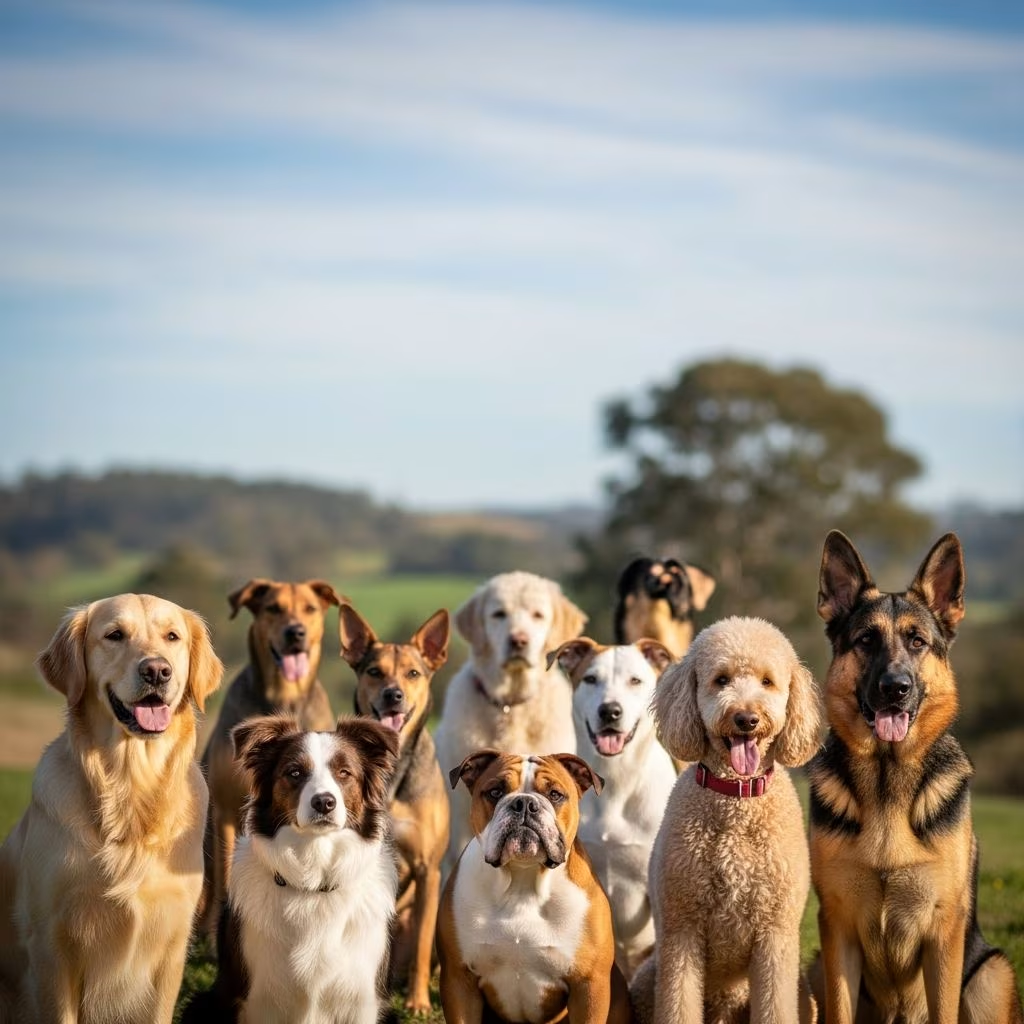
Dogs exist in countless types—or breeds—due to thousands of years of human selection for specific traits, roles, and aesthetics, transforming wolves into versatile companions through coevolution and selective breeding.
The Origins of Dog Diversity
The story of dog types begins with domestication around 15,000–40,000 years ago, where wolves coevolved with humans, developing unique social skills and physical traits like reduced snouts and enhanced human-reading abilities, unlike closer primate relatives. This ‘convergent evolution’ allowed dogs to complement human weaknesses, such as smell, while humans provided food and protection, fostering deep kinship.
Early dogs were not ‘owned’ but free-living, sharing spaces with humans. Genetic studies reveal extreme inbreeding in modern breeds, with effective population sizes as low as 40–80 for most, except greyhounds, due to closed breeding pools. Pedigree analyses show popular sires dominating reproduction, leading to high kinship coefficients and inbreeding levels up to 10% or more in breeds like collies.
How Breeds Were Created
Modern dog types emerged from 19th-century kennel clubs standardizing breeds for function and form. Hunters needed scent hounds like Beagles; herders required intelligent shepherds like Border Collies. This artificial selection amplified traits: sight hounds for speed, terriers for vermin hunting.
Population structure reveals subpopulations within breeds, like in springer spaniels, with distinct ancestry lines doubling mean kinship to 0.034, indicating fragmented breeding practices. Greyhounds stand out with lower inbreeding due to racing lines maintaining broader genetics.
Different Types of Dog Types
- Working Dogs: Bred for labor like herding (e.g., Australian Shepherds) or guarding (e.g., Great Pyrenees), showing linear hierarchies with strict deference in studies of juveniles.
- Sporting Dogs: Pointers and retrievers for hunting, with golden retrievers showing even mating despite popular sires (10% of males).
- Hound Dogs: Scent (Bloodhounds) vs. sight (Salukis), evolving from ancient pariah dogs resilient in diverse environments.
- Terriers: Feisty ratters like Jack Russells, often small and bold.
- Non-Sporting/Companion: Modern types like Bulldogs, shifted from utility to aesthetics.
- Mixed Breeds: Retaining hybrid vigor, defying purebred inbreeding risks.
Why Breed Standards Matter
Breed standards preserve type-specific traits for health and function, but closed registries increase genetic diseases. Studies show negative correlation between breed size and inbreeding; larger Labradors have lowest rates. Kinship metrics guide ethical breeding to avoid subpopulations.
| Breed | Type | Mean Inbreeding (f) | % >0.1 f | Effective Pop Size |
|---|---|---|---|---|
| Labrador Retriever | Hunting | Low | Low | Large |
| Rough Collie | Shepherd | High | High | ~50 |
| Greyhound | Racing | Moderate | 0% | ~80 |
| Golden Retriever | Hunting | Low | Low | Large |
Table derived from pedigree data showing inbreeding patterns.
The Science Behind Dog Types
Genomics confirms breeds as ‘cultivated subspecies,’ with DNA tests revealing ancestry even in mixes. Social hierarchies are linear in dog groups, not dominance-based aggression; higher ranks signal with tails/ears, subordinates defer without conflict. Juvenile-led ladders in observed packs challenge alpha myths.
Owners often resemble their dogs in looks and behavior, per 15-study review, reinforcing type selection biases.
Modern Implications of Dog Types
Today, types influence training: hierarchy-aware methods over dominance theory. Ecoexpansive kinship expands family concepts to include dogs across ecologies. Cultural shifts from free-living to pets question human exceptionalism.
Frequently Asked Questions
What caused the diversity in dog types?
Human selective breeding over millennia for roles like herding, hunting, and companionship, amplified by 19th-century standardization.
Are all dog breeds highly inbred?
Most yes, with effective sizes 40–80; exceptions like greyhounds avoid extremes via open lines.
Do dogs have strict social hierarchies like wolves?
Observed groups show linear ‘ladders’ with deference, not aggression; varies by age, breed, size.
Why do people and dogs look alike?
Owners subconsciously choose similar types; behaviors converge through cohabitation.
Is breed still relevant for mixed dogs?
Yes, genomics identifies type influences for health, behavior in mixes.
How do free-living dogs fit into types?
Pariah dogs show resilience, basal to many breeds, embodying ancient kinship.
References
- Co-Becoming: The Human-Dog Kinship — Coonoor & Co. 2023. https://coonoorandco.com/journal/co-becoming-the-human-dog-kinship
- Understanding Canine Social Hierarchies — Kinship. 2024. https://www.kinship.com/dog-behavior/understanding-canine-social-hierarchies
- Population Structure and Inbreeding From Pedigree Analysis — PMC (NIH). 2008-05-13. https://pmc.ncbi.nlm.nih.gov/articles/PMC2390636/
- Applied Dog Genomics: Breed Analysis, Origin — Humanimalia. 2023. https://humanimalia.org/article/view/19204
- People And Their Dogs Really Do Look Alike, New Research Finds — Kinship. 2024. https://www.kinship.com/news/people-and-dogs-look-alike-study



