

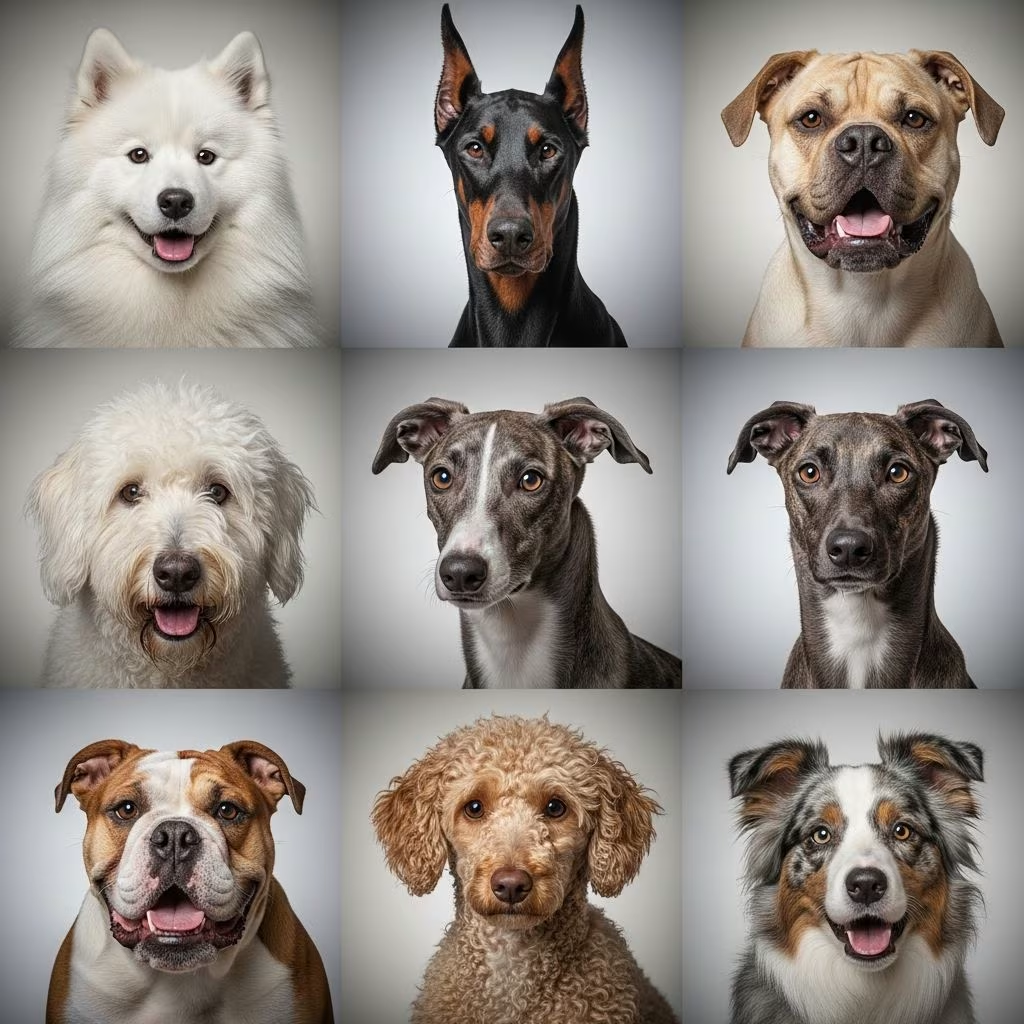
Dogs exist in hundreds of distinct types—or breeds—each with unique appearances, behaviors, and purposes, shaped by thousands of years of human-dog coevolution, selective breeding for specific jobs, and genetic clustering into clades.
The Ancient Origins of Dog Diversity
The story of dog types begins not with deliberate domestication but through coevolution, where humans and dogs mutually adapted over millennia. Unlike other animals, dogs’ entanglement with humans involved shared traits through convergent evolution, such as enhanced social skills for reading human cues. Genetic studies reveal that ancient dogs diverged from wolves into regional types based on human lifestyles: herding in pastoral societies, hunting in forested areas, and guarding in villages.
Archaeological evidence shows dogs accompanying humans as far back as 15,000 years ago, initially as free-living companions rather than owned pets. These early dogs filled complementary roles, like scent detection to offset humans’ reduced olfactory sense after snout shortening for speech. This kinship—defined as sharing characteristics and origins—led to dogs mirroring human social complexities and resilience.
Functional Breeding: Jobs That Shaped Breeds
Medieval Europe formalized dog types around practical functions, creating the foundation for modern breeds. Hounds tracked by sight or scent, herders managed livestock with diverse strategies (e.g., eye-stalkers vs. heelers), and terriers pursued vermin underground. Gun dogs retrieved game, while mastiffs guarded property.
Victorian England refined these into standardized breeds. Pointers, setters, and spaniels formed tight genetic groups with minimal variation, originating from specific English lines for bird hunting. Herding dogs, conversely, arose independently in multiple regions, explaining their varied techniques. This era’s kennel clubs codified types, emphasizing purity despite underlying genetic diversity.
Genetic Clades: The Science of Dog Types
Modern genomics confirms dogs cluster into about 23 clades, grouping breeds by shared ancestry and traits, not just appearance. For example:
- Hound clade: Sighthounds like Afghan hounds, Salukis, and Beagles excel in pursuit.
- Mastiff clade: Boxers, Bulldogs, Boston Terriers—built for strength and guarding.
- Herding clades: Multiple subgroups reflect independent origins, like Border Collies (eye) vs. Australian Shepherds (heel).
- Gundog clade: Pointers, Retrievers, Spaniels—tightly linked genetically from Victorian breeding.
A landmark study of over 2.1 million pedigreed dogs across 10 breeds revealed extreme inbreeding, with effective population sizes of 40-80 in most breeds (except Greyhounds). Popular sires dominate reproduction, leading to high kinship coefficients and inbreeding levels up to 5-10% on average.
| Breed | Group | Total Dogs | Mean Inbreeding (f) | % f > 0.1 | Effective Pop Size (Ne) |
|---|---|---|---|---|---|
| Rough Collie | Shepherd | 83,864 | ~0.05 | High | ~50 |
| Golden Retriever | Hunting | 317,527 | Low | ~5% | ~70 |
| Greyhound | Shepherd | 1,060 | High but even | Low | 81 |
| Labrador Retriever | Hunting | ~700,000 | Lowest | Low | Largest |
This table summarizes pedigree data from a key study, showing how smaller populations inflate inbreeding except in Greyhounds, where even mating keeps diversity higher. Population structure analysis detects subpopulations, like in Springer Spaniels, with distinct ancestry lines doubling mean kinship.
Modern Breeding and Health Implications
Today’s purebreds face challenges from closed gene pools. Pedigree analysis shows dams often younger than sires, with prolific individuals skewing genetics—10% of Golden Retriever males as popular sires despite only 5% reproducing. Breeds like Collies exhibit consanguineous mating patterns, elevating inbreeding despite moderate kinship.
Genomic tools now enable breed analysis even for mixed dogs, emphasizing function over purity. This shifts kinship from pedigree exclusivity to inclusive care, recognizing all dogs’ value.
Human-Dog Kinship: Why Types Resonate
People select dogs matching their personalities, leading to convergence: extroverted owners have playful dogs, open ones have trainable pups. Studies using Big Five traits confirm this bidirectional influence—neurotic owners foster anxious dogs, and vice versa. Anthropological views frame pets as family, expanding kinship across species.
Free-living dogs, like India’s Pariah dogs, embody resilient kinship, thriving without ownership and challenging colonial biases. Ecoexpansive models validate diverse family forms, including multispecies bonds.
Breed Standards and Cultural Shifts
Kennel clubs define types by exaggerated traits, but genomics reveals fluidity. Mixed breeds benefit from hybrid vigor, countering purebred health risks like those in inbred lines. Owners increasingly prioritize behavior and health over labels, fostering broader kinship.
Frequently Asked Questions (FAQs)
What caused the diversity in dog types?
Dog types arose from coevolution with humans, regional adaptations, and selective breeding for jobs like herding, hunting, and guarding.
How many genetic clades do dogs have?
Most breeds fall into 23 clades, grouping by ancestry and function, such as hounds or mastiffs.
Are purebred dogs highly inbred?
Yes, pedigree studies show effective population sizes of 40-80, with average inbreeding 5%+, except outliers like Greyhounds.
Do owners and dogs become similar?
Research shows personality convergence: extroverted owners have outgoing dogs, influenced mutually over time.
What is human-dog kinship?
It’s shared evolution, traits, and bonds, from social skills to complementary senses, extending to modern family roles.
Choosing the Right Dog Type for You
Match lifestyles: active families suit herders, apartments favor compact companions. DNA tests reveal hidden types, aiding informed adoption. Ultimately, dog types celebrate our 40,000-year partnership.
References
- Co-Becoming: The Human-Dog Kinship — Coonoor & Co. 2023. https://coonoorandco.com/journal/co-becoming-the-human-dog-kinship
- Population Structure and Inbreeding From Pedigree Analysis of… — PMC (NIH). 2008-05-14. https://pmc.ncbi.nlm.nih.gov/articles/PMC2390636/
- Origins of the Dog Family Tree — Kinship. Recent. https://www.kinship.com/dog-behavior/origins-dog-family-tree
- Applied Dog Genomics: Breed Analysis, Origin… — Humanimalia. Recent. https://humanimalia.org/article/view/19204
- People And Their Dogs Really Do Look Alike, New Research Finds — Kinship. Recent. https://www.kinship.com/news/people-and-dogs-look-alike-study



