

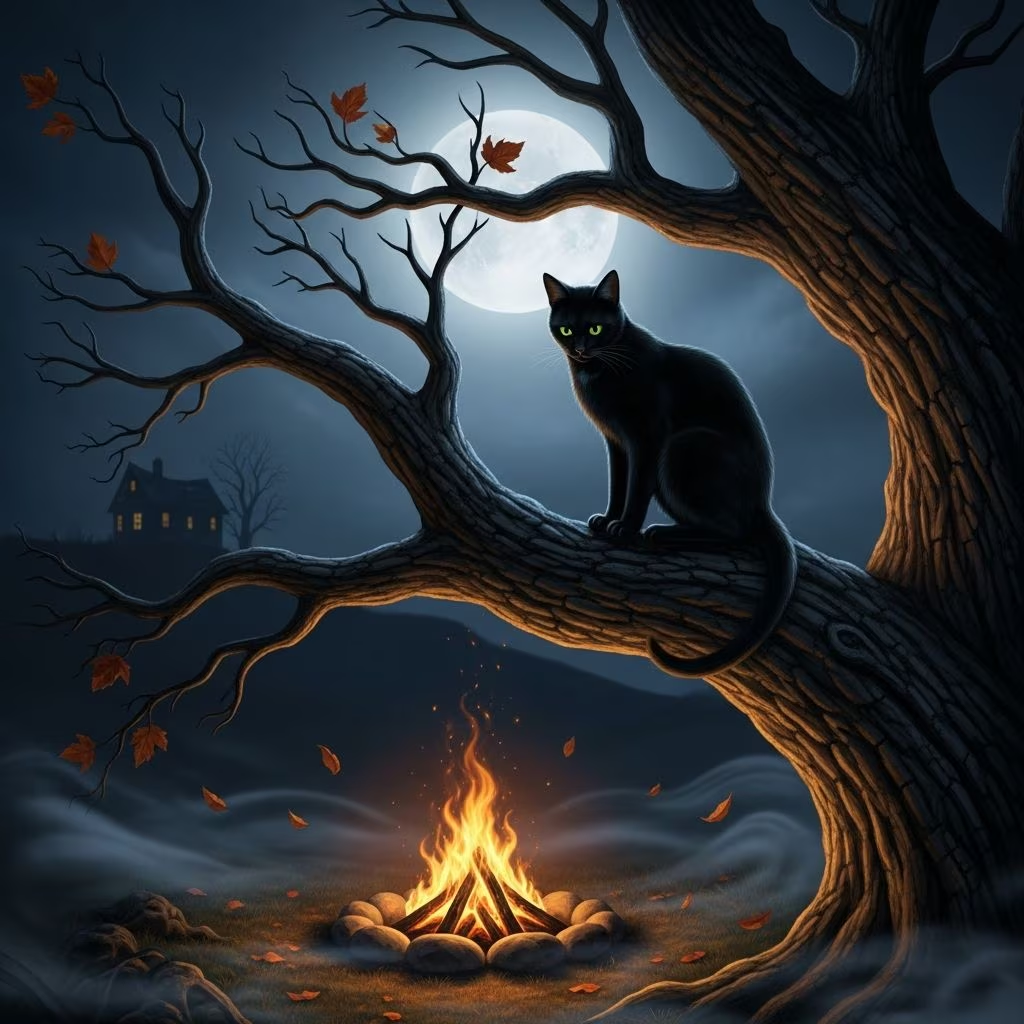
Why We Associate Cats With Witches
The image of a witch with a black cat perched beside her has become an iconic symbol in popular culture, featured in countless films, television shows, and Halloween decorations. Yet this enduring association between felines and witchcraft is far more than entertainment folklore—it has deep historical roots that changed the course of both human and animal history. The connection between cats and witches, particularly black cats, emerged from a dark period in European history: the witch trials of the 16th and 17th centuries. During this time of fear, superstition, and religious fervor, cats became unwilling participants in a persecution that would have lasting consequences for centuries to come.
The Dark Origins: When Cats Became ‘Evil’
Cats first became associated with witchcraft and even the devil during the witch trials of the 16th and 17th centuries. Despite Hollywood’s eager adoption of the cat-and-witch combination as light entertainment, the idea of a witch and her familiar is particular to English witchcraft. The concept of a familiar—a spirit or animal that aided witches in their magical practices—became central to witch trial accusations.
By 1604, English law specifically made the invocation or conjuration of an evil spirit punishable by death, including the feeding and rewarding of such evil spirits. This legal framework transformed owning a cat from a practical household practice into potential evidence of witchcraft. A 17th-century English Puritan cleric named John Gaule, now remembered for his partially skeptical views on witchcraft, sardonically observed that “Every old woman… a dog or cat by her side, is not only suspect but pronounced for a witch.”
The persecution during this period was brutal and widespread. Between the 14th and 17th centuries, particularly in England, Germany, and Scotland, the fear of cats became so intense that merely owning a cat could be seen as direct evidence of witchcraft or a pact with the devil. While dogs managed to shake off these sinister associations, cats have never fully recovered from the stigma attached during this dark chapter of history.
Why Cats Specifically?
Understanding why cats became the primary target of witchcraft accusations requires examining their unique characteristics in the eyes of medieval and early modern Europeans. Several factors combined to make felines ideal candidates for demonization.
First, cats possessed qualities that made them seem inherently mysterious and potentially dangerous. Many visual representations of devils during the witch trial period depicted them in animal terms, often with fur, and cats fit this description perfectly. As one scholar explains, cats could be considered wild and savage creatures—they were carnivorous predators that blended domestication with hunting instinct, and their nocturnal nature was itself thought to be connected to diabolism.
Second, cats occupied an ambiguous position in medieval society. They lived in two realms simultaneously: they were both wild and domestic animals. This duality made them logical scapegoats for medieval moralists seeking to explain evil and misfortune. Unlike dogs, which were typically associated with loyalty and protection, cats maintained an air of independence and mystery that invited suspicion.
Third, cats had ancient pagan associations that conflicted with Christian doctrine. In pre-Christian European traditions, particularly among Celtic peoples, cats held magical significance. The ancient Celts believed that during Samhain (now Halloween), the spirits of the dead could walk among the living, and certain animals like cats could freely wander between both worlds. For them, black cats possessed a kind of magical power, as evidenced by figures in their folklore such as the Cat Sith, Cailleach and her black cats, and Grimalkin.
Historical Examples: The Famous Witch Trials
The connection between cats and witchcraft accusations is not merely theoretical—it is documented in actual historical records. One of the first widely documented witchcraft trials involved a cat that would become infamous in witch trial history.
The Case of Sathan
The first widely documented witchcraft trial was that of Elizabeth Francis, Agnes Waterhouse, and her daughter Joan, tried in 1566. In this case, Elizabeth Francis was accused of witchcraft allegedly aided by a cat named Sathan—a clear allusion to Satan. According to trial records, Elizabeth’s grandmother had given her this cat, which Elizabeth carried around in a basket, feeding it bread, milk, and even her own blood while practicing black arts.
Interestingly, Sathan was a white spotted cat, not the black cat we commonly associate with witches today. This detail reveals how the witch-cat association transcended color during the initial stages of persecution. Joan Waterhouse was accused of witchcraft alongside her mother and Elizabeth Francis, though it is likely that Agnes confessed under duress or to spare her daughter from the death sentence (which Joan was spared, though Elizabeth Francis was executed).
The Evolution of the Black Cat Stigma
While cats of all colors were initially targeted during the witch craze, black cats eventually became the primary focus of superstition and fear. The transformation of the black cat into a symbol of witchcraft was gradual but persistent.
By the 13th century, fear of cats—especially black ones—was unmistakably real. In 1233, Pope Gregory IX issued a papal bull that contributed to the negative perception of cats, though the exact nature of this declaration has been debated by historians. The association between witches, the devil, and black cats only grew stronger over time, becoming so deeply embedded in European consciousness that it would shape cultural beliefs for centuries.
In medieval times, black cats became associated with symbolic connotations of evil, death, the devil, witchcraft, and heresy. Medieval theologians and friars contributed to this association. For example, in the early 14th century, Arnold of Liège, a Dominican friar, explained that a cat playing with a mouse was a metaphor for the Devil toying with a human soul. Even earlier, in the 12th century, the French theologian Alan de Lille made spurious etymological connections between the Cathars (a heretical group) and cats, claiming that Cathars worshipped a black cat who was the Devil in disguise.
The Larger Context: Medieval and Early Modern Beliefs
The association of cats with witchcraft did not exist in isolation—it was part of a broader worldview that divided the world into realms of civilization and wilderness, good and evil.
In Puritan society, particularly in early Salem, the “civilized” society of towns and villages was believed to be blessed by God, while the wild woods were understood as places where witches danced with the devil. All cats and animals could be regarded as sources of fortune, misfortune, or familiar spirits that aided in supernatural practices.
Women and cats had a special connection for centuries, both positive and negative. Before the witch trials, this connection was often positive: in Egyptian mythology, the goddess Bastet was represented as a cat and was a major protector deity; in Norse tradition, the goddess Freyja rode a chariot pulled by cats; and in Roman mythology, Diana was said to have transformed herself into a cat to escape danger. However, these positive associations were eclipsed during the witch trial period, which targeted vulnerable women living alone or with few social connections.
The Impact on Cat Populations and Human Health
The persecution of cats during the witch trials had consequences that extended far beyond individual animals. Historical records suggest that the mass extermination of cats, particularly those accused of being witches’ familiars, had catastrophic ecological and public health effects.
In British folk tradition, the black cat was originally viewed as lucky and as a symbol of the dark night—they could shadow their witches during night-time rituals. However, during the 16th and 17th centuries, cats who were seen as familiars of witches were persecuted alongside the women they belonged to and were exterminated in large numbers. This mass killing decimated cat populations and increased rat populations, which is believed to have caused the plague to spiral out of control during these times.
Black cats were particularly vulnerable. Unlike their lighter-colored counterparts, black cats attracted more intense scrutiny and fear, making them targets for torture and killing during this period. The irony is profound: in attempting to rid themselves of witchcraft and demonic influence, European societies inadvertently created conditions that allowed disease-carrying rodents to flourish, leading to greater suffering and death.
Why The Association Persists Today
Nearly four centuries have passed since the major witch trials ended, yet the association between cats—particularly black cats—and witchcraft remains remarkably strong. This persistence reveals much about how cultural narratives become embedded in collective memory.
The image has been reinforced repeatedly in literature, film, and popular culture. From children’s stories to adult entertainment, the witch with her black cat has become an archetypal figure that defines how many people imagine witchcraft. This cultural reinforcement means that black cats continue to face discrimination in real life, including lower adoption rates from animal shelters, particularly around Halloween.
Modern understanding recognizes that the witch trials were not about actual witchcraft but about social anxiety, religious fanaticism, and the scapegoating of vulnerable people, especially women living outside traditional family structures. Yet the symbolic connection between cats and witchcraft persists, demonstrating how deeply historical trauma can shape cultural narratives across centuries.
Frequently Asked Questions
Q: Were all cats accused of being witches’ familiars black?
A: No. While black cats became strongly associated with witchcraft, cats of all colors, including white and spotted cats like Sathan from the 1566 trial, were initially targeted during the witch craze. Black cats eventually became the primary focus of superstition, but the persecution was not exclusively limited to them.
Q: Why do black cats still face discrimination today?
A: Black cats continue to face lower adoption rates and Halloween-related dangers because the historical association between black cats and witchcraft has been deeply embedded in Western culture through centuries of stories, literature, and media. This cultural narrative persists despite modern understanding that it has no factual basis.
Q: Did cat persecution during the witch trials really contribute to plague spread?
A: Historical evidence suggests that the mass extermination of cats during the witch trials did increase rat populations significantly. Since rats are primary vectors for plague-carrying fleas, the reduction in natural predators likely created conditions that allowed plague to spread more rapidly, though the plague’s spread was multifactorial.
Q: What made cats seem more suspicious than other animals?
A: Cats were considered suspicious because they were both wild and domestic, nocturnal (associated with diabolism), carnivorous predators, and had pagan associations from pre-Christian traditions. Their independence and mysterious nature made them ideal scapegoats for medieval fears about evil and the supernatural.
Q: Is the “familiar” concept unique to witchcraft trials?
A: The concept of a familiar—a spirit or animal aiding in magical practices—is particular to English witchcraft traditions. While familiars appear in other magical traditions, the specific use of this concept to prosecute witches was a distinctive feature of English witch trial law, particularly after 1604.
References
- The Cat in Magick: Familiars of Witches & Priestesses — Setjataset. 2020-07-15. https://setjataset.wordpress.com/2020/07/15/the-cat-in-magick-familiars-of-witches-priestesses/
- Cats, Symbolism and the 16th Century Witch Craze — Cheshire & Wain. https://www.cheshireandwain.com/en-us/blogs/journal/cats-and-the-16th-century-witch-craze
- Here’s Why We Associate Cats With Witches — Kinship. https://www.kinship.com/uk/cat-lifestyle/why-we-associate-cats-with-witches
- The Bewitched History of Black Cats — Valhalla Cats. https://valhallacats.com/the-bewitched-history-of-black-cats/
- Halloween: Black Cats and Witches in Medieval Times — Academic Cat Lady. 2017-10-31. https://academiccatlady.wordpress.com/2017/10/31/halloween-black-cats-and-witches-in-medieval-times/
- Cats and the Salem Witch Trials — Cunning Folk Magazine. https://www.cunning-folk.com/read-posts/the-cats-of-old-salem
- Why Are Black Cats Unlucky? The History Behind the Superstition — HistoryExtra. https://www.historyextra.com/period/medieval/why-black-cats-unlucky-witches-halloween/



