

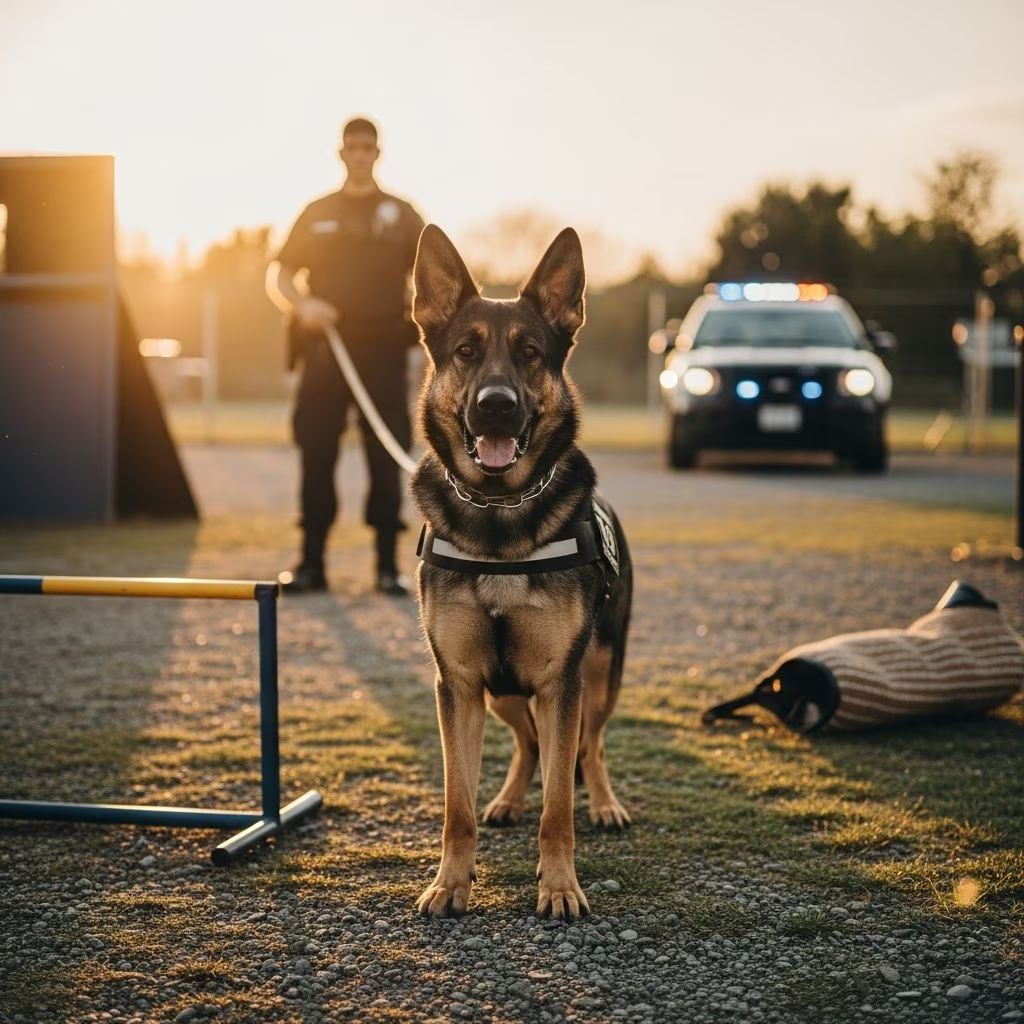
The designation **K9** for police dogs stems directly from the English word “canine,” which refers to anything related to dogs. The “K” represents the phonetic “c” sound, and “9” stands for the syllable “nine,” creating a concise military-style code that’s easy to use in radio communications and official documentation. This naming convention emerged in the early 20th century within law enforcement and military contexts, standardizing references to working dogs across units.
The Linguistic Roots of the K9 Term
“Canine” originates from the Latin canis, meaning dog, a term used in scientific classification for the family Canidae, which includes domestic dogs, wolves, and foxes. In police work, **K9** became shorthand to distinguish service canines from other animals or personnel. This phonetic spelling avoids confusion over radio transmissions where “C” and “K” sounds can blend, and numbers are clearer than spelled words. For instance, military branches adopted similar codes post-World War I, influencing civilian police forces.
By the mid-1900s, **K9 units** were formalized in departments worldwide, with the U.S. seeing widespread use after World War II when surplus military dogs were repurposed for civilian policing. The term’s efficiency made it enduring, appearing in training manuals, vehicle markings, and badges today.
Historical Development of Police Canine Programs
Police dogs trace back to 19th-century Europe, where Belgian Malinois and German Shepherds were first deployed in cities like Paris and Ghent for night patrols. The modern K9 unit model solidified in the U.S. during the 1920s, with Detroit’s pioneering program in 1921 marking the first organized effort. These early dogs focused on guarding and basic apprehension.
World War II accelerated advancements, as the U.S. Military’s Dogs for Defense program trained over 18,000 canines, many transitioning to police work afterward. Post-war, the **K9** label proliferated, symbolizing disciplined, purpose-bred partners integral to crowd control, searches, and suspect pursuits.
Primary Roles and Responsibilities of K9 Teams
Modern **K9 units** handle diverse tasks, leveraging dogs’ superior senses—up to 100,000 times more olfactory receptors than humans—for detection beyond human capability. Key roles include:
- Patrol and Apprehension: Dogs trained to subdue fleeing suspects non-lethally, using controlled bites to hold until officers arrive.
- Tracking and Search: Following human scents over miles, even in adverse weather, to locate missing persons or evidence.
- Detection: Identifying narcotics, explosives, or cadavers through specialized scent work.
- Public Safety: Crowd management and building searches during emergencies.
These roles demand dogs with high drive, intelligence, and physical stamina, paired with handlers who undergo joint certification.
Selecting the Ideal Breeds for K9 Service
Not all dogs suit police work; selection prioritizes breeds with genetic predispositions for focus, agility, and resilience. Top choices include:
| Breed | Key Traits | Common Roles |
|---|---|---|
| German Shepherd | Intelligent, versatile, strong work ethic | Patrol, tracking, detection |
| Belgian Malinois | High energy, agile, intense drive | Apprehension, narcotics/explosives |
| Dutch Shepherd | Loyal, adaptable, lower profile | Patrol, search and rescue |
| Labrador Retriever | Calm temperament, exceptional nose | Detection (drugs, bombs) |
Puppies are often sourced from working lines, vetted at 8-12 weeks for temperament via tests assessing nerve stability, play drive, and fight instinct. Health screenings ensure longevity in demanding careers lasting 8-10 years.
Core Components of K9 Training Programs
K9 training is rigorous, spanning 12-20 weeks for basics, with ongoing maintenance. Programs emphasize positive reinforcement, building handler-dog bonds through rewards like toys or praise. Core areas mirror patrol dog curricula: obedience, force application, tracking, searches, and specialty skills.
Building Foundational Obedience
Training begins with advanced obedience: heel, sit, down, recall under distraction. Positive methods shape behaviors, rewarding approximations until precision is achieved. Consistency across sessions prevents confusion, using operant conditioning where dogs learn actions yield rewards.
Mastering Scent Detection and Tracking
Tracking differentiates **footstep tracking (FST)**—precise foot-by-foot follows—from **tracking through drive (TTD)**, emphasizing natural scent pursuit. Initial sessions use short tracks with buried toys every 5-10 steps, progressing to aged trails up to 300 yards in varied terrains. Scent discrimination teaches ignoring distractions like other animals or weather. Cool, misty conditions optimize early learning.
Apprehension and Use of Force Training
Dogs learn controlled bites via “bite and hold” over “bark and hold” for handler control. Shaping prevents self-rewarding errors; leashed setups ensure calm approaches before engagement. Simulated assaults during traffic stops test real-world response.
Specialized Detection Skills
Cross-training for narcotics or explosives pairs nose work with toy association, starting in low-distraction areas before real buildings. Regular drills maintain proficiency amid distractions.
Positive Reinforcement: The Gold Standard in K9 Methods
Contemporary K9 training rejects compulsion, favoring rewards to promote welfare and performance. Shaping lets dogs “teach themselves” via environment management, outperforming lures long-term.
| Method | Advantages | Challenges |
|---|---|---|
| Shaping | Strong retention, independent problem-solving | Requires skilled timing |
| Luring | Quick behavior acquisition | Risk of dependency if prolonged |
Handlers over-train for fluency against street distractions, like remote toys simulating chaos.
Daily Life and Challenges Faced by K9 Handlers
K9 teams live as families, with dogs retiring home with handlers. Challenges include injury risks, burnout from high-stakes calls, and balancing family time. Veterinary care is specialized, covering bite wounds and joint stress. Community outreach builds trust, showcasing demos.
Future Innovations in K9 Technology and Training
Emerging tech like GPS collars and drone-assisted tracking enhances capabilities without replacing canine senses. Genetic research refines breeding for hypoallergenic detectors, while VR simulations accelerate scenario prep. Positive methods evolve, integrating data analytics for personalized schedules.
Frequently Asked Questions (FAQs)
What does K9 stand for in police dogs?
K9 is a phonetic spelling of “canine,” using K for the C sound and 9 for “nine.”
Which breeds make the best police dogs?
German Shepherds, Belgian Malinois, and Labs excel due to drive, intelligence, and scent ability.
How long does it take to train a police dog?
Basic training takes 12-20 weeks, with lifelong maintenance.
Are police dogs treated as officers?
Yes, many departments issue badges and include them in honors.
Can any dog become a K9?
No, rigorous temperament and health tests select from working breeds only.
References
- Training Tracking Dogs for Police: Effective Techniques and Best Practices — Bullock’s K9 Kennels. Accessed 2026. https://www.bullocksk9kennels.com/post/training-tracking-dogs-for-police-effective-techniques-and-best-practices
- Training Police Dogs and Military Dogs Using Positive Methods — Whole Dog Journal. Accessed 2026. https://www.whole-dog-journal.com/training/training-police-dogs-and-military-dogs-using-positive-methods/
- Basic Police Dog Training — PolamK (Finnish Police). Accessed 2026. https://polamk.fi/en/dog-basic-training
- Training Police Tracking Dogs – Tracking Through Drive vs. Foot Step Tracking — Leerburg. Accessed 2026. https://leerburg.com/ttd.htm
- All About the Different Types of K9 Training Methods — 3DK9 Detection. Accessed 2026. https://www.3dk9detection.com/news/all-about-the-different-types-of-k9-training-methods
- Basic Police Working Dog Training Academy — USPCA K9. 2020-09-23. https://www.uspcak9.com/index.php?day=23&id=15%3Abasic-police-working-dog-training-academy-things-that-should-be-considered-before-making-your-choice&month=09&option=com_dailyplanetblog&view=entry&year=2020
- Bite & Hold vs Bark & Hold Techniques — RS Eden / PoliceK9. Accessed 2026. https://policek9.com/bite-&-hold-v-bark-&-hold



