

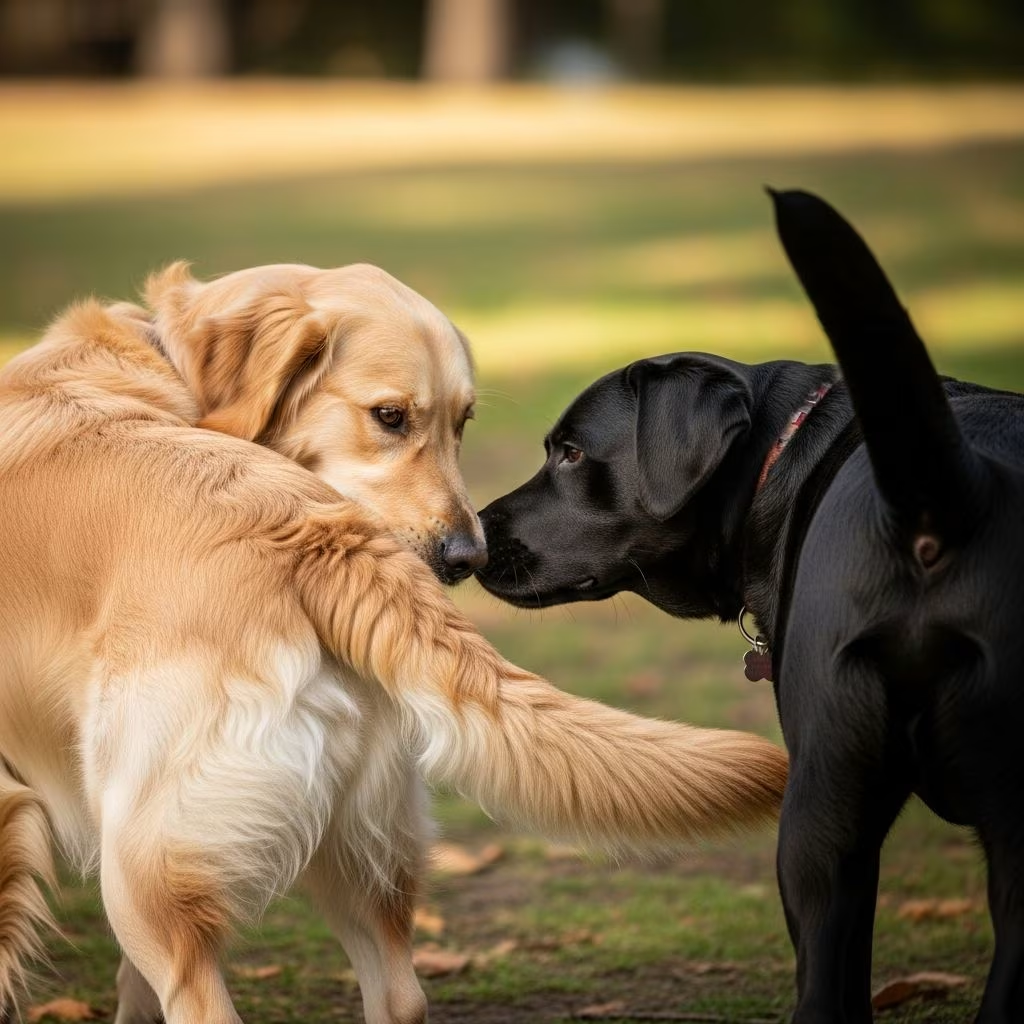
Why Dogs Sniff Rear Ends: Understanding Canine Communication
If you’ve ever observed two dogs meeting for the first time, you’ve likely witnessed one of the most common canine behaviors: rear-end sniffing. While this behavior might seem odd or even embarrassing to humans, it’s actually a sophisticated form of communication that provides dogs with essential information about each other. Understanding why dogs engage in this behavior offers insight into how they perceive and interact with the world around them.
The Anatomy Behind the Behavior
To understand why dogs sniff rear ends specifically, we need to examine the anatomical structures involved. Inside the rectum are two small sacs called anal glands, which secrete a distinctive-smelling substance into the rectum through tiny openings. These glands are emptied naturally when the rectal sphincter muscles contract during a bowel movement. Pet owners are often unaware of this occurrence since the odor of the anal glands is typically masked by the odor of the dog’s stool; however, dogs can easily distinguish between the two scents.
The anal glands produce a noxious-smelling substance that serves as a chemical calling card for each dog. This secretion contains a complex mixture of compounds that communicate important biological information. The substance has a characteristic fishy smell due to compounds like trimethylamine, along with pungent propionic acid and butyric acid. These chemical compositions vary from dog to dog, creating a unique olfactory signature for each individual.
How Dogs Perceive Scents
Dogs possess an extraordinarily powerful sense of smell—far superior to that of humans. While humans are predominantly visual creatures, dogs rely heavily on olfactory information to understand their environment and social interactions. The canine nose contains millions more scent-detecting cells than the human nose, and their olfactory bulb—the part of the brain that interprets smell—occupies a significantly larger portion of their brain compared to humans.
In fact, dogs can detect one or two particles of odor in one trillion particles of air. This incredible sensitivity allows them to extract detailed information from scents that humans would completely miss. Additionally, dogs possess a specialized sensory structure called the Jacobson’s organ, also known as the vomeronasal organ, located above the roof of their mouth. This separate scent-detection system allows dogs to detect pheromones—chemicals used in communication. While humans also have a vomeronasal organ, it is thought to have no functional purpose.
The Role of the Jacobson’s Organ
The Jacobson’s organ plays a crucial role in canine social behavior and reproductive communication. This specialized sensory structure communicates directly with the part of the brain that deals with mating and social recognition. By identifying pheromones, the Jacobson’s organ provides male and female dogs with the information they need to determine if a member of the opposite sex is available for mating.
Beyond mating, this organ serves additional important functions. In newborn puppies, the Jacobson’s organ enhances their sense of smell in ways that are vital for survival. Puppies use this heightened olfactory ability to find their mother’s milk and identify her among other nursing mothers. Puppies placed between two nursing mothers will move to the one that gave birth to them based entirely on pheromone recognition. This demonstrates how essential the Jacobson’s organ is for early development and survival.
What Information Dogs Gather
When one dog greets another with a nose to the rear end, they’re essentially receiving a complete biography of their new acquaintance, written in scent molecules and pheromones. The information available through anal gland secretions provides insights into multiple aspects of another dog’s identity and status:
- Health status and overall physical condition
- Reproductive status and whether they’re available for mating
- Recent diet and eating habits
- Emotional state and mood
- Gender of the individual
- Age and life stage
- Territory and social standing
Male dogs, particularly unneutered males, may spend additional time sniffing females to gather information specifically about their reproductive status. This allows them to determine if a female is in estrus and therefore a potential mate. The anal gland secretions essentially provide a chemical resume that enables dogs to make rapid social and mating decisions.
Anal Glands and Territory Marking
The anal glands serve another important function beyond providing greeting information: territory marking. When a dog has a bowel movement, the anal glands naturally empty, coating the feces with anal gland fluid. This scents the poop with a unique chemical signature that may play a significant role in marking territory. Dogs can involuntarily empty their anal glands if they’re frightened or stressed, which is why anxious or nervous dogs sometimes produce a distinctive fishy smell.
Feces thus becomes a form of chemical communication for dogs. Sniffing feces can tell the sniffer considerable information about the defecator—essentially reading the equivalent of a scent-based message board. This explains why dogs are so interested in sniffing other dogs’ droppings and why they seem fascinated by certain spots in parks or neighborhoods. They’re gathering crucial information from the chemical messages left behind.
Scientific Research on Anal Gland Secretions
Scientists have long believed that dogs can learn about sex, reproductive status, health, and more from sniffing another dog’s behind, though historically there has been limited research substantiating these theories. However, recent scientific studies have begun to provide concrete evidence supporting these observations.
A study published in Veterinary Research Forum examined the composition of anal sac secretions between male and female dogs. Using secretions from five intact male and five female dogs, researchers conducted advanced analysis using gas chromatography–mass spectrometry to break down the chemical composition of each dog’s anal gland fluid. The results were fascinating: researchers detected a total of 64 different compounds among the samples. While some compounds were common to all dogs examined, others were found only in the samples of certain individuals.
The research discovered clear differences in the anal sac secretions of male and female dogs, as well as between different individual dogs. This means that every dog potentially has a unique scent profile made up of different chemical compounds. Given that dogs can distinguish individual components in complex mixtures—as demonstrated by studies on explosive detection dogs—they possess the olfactory capability to detect these individual variations in anal gland secretions.
Comparing Dogs to Other Species
Dogs aren’t the only creatures who get to know each other in this intimate fashion. Several other animal species rely on anal gland secretions for communication. Cats, for example, also have active anal glands that produce strong-smelling secretions intended to send chemical signals about identity to other animals. Both male and female cats utilize scent to identify social partners and communicate with them.
In 2023, researchers at the University of California, Davis, unveiled important findings through a study of 23 domestic cats. They discovered that a cat’s anal glands are home to a bustling community of bacteria, which are likely involved in producing the smelly anal gland secretions. Different cats had different bacteria in their anal glands, and the types of bacteria varied with each cat’s age and weight status. The research authors believe these bacteria help cats communicate with each other. Other carnivores, including dogs, are thought to communicate through secretions of gland-inhabiting bacteria in similar ways. Supporting this hypothesis, studies in hyenas found that bacteria living in their scent glands produce components of chemical signals that hyenas use to communicate.
Why Rear Ends Specifically?
A question that often perplexes pet owners is: why do dogs sniff rear ends rather than other body parts like ears or feet? The answer is anatomical simplicity. The anal glands are located precisely where other dogs can easily access them during natural greeting behaviors. This placement makes the rear end the ideal location for chemical communication. Dogs have evolved to understand that the rear end is where the most relevant and concentrated chemical information resides.
In contrast, humans are designed differently, and our chemical communication mechanisms aren’t located in the same places. We rely on different sensory systems for social interaction, primarily visual and auditory communication. This fundamental difference in anatomy and sensory preference explains why butt sniffing is essentially an animal-to-animal behavior rather than something that extends to human-animal interactions.
Greeting and Social Functions
Rear-end sniffing serves as a critical greeting ritual for dogs. It’s truly the best way for two dogs to get to know each other quickly and efficiently. When dogs meet, this behavior allows them to answer essential questions: Is this a friend or foe? Is this a potential mate? What does this dog’s recent diet consist of? What is their health status? All of these questions are answered through a few seconds of olfactory investigation.
The behavior demonstrates the sophisticated nature of canine communication. What appears to humans as a simple sniff is actually a complex information exchange that establishes social hierarchy, determines compatibility, and communicates mood and status. Dogs can even determine the mood of another dog through butt sniffing, similar to how humans might notice another person’s mood by observing their facial expression or body language.
Normal vs. Problematic Anal Gland Behavior
While sniffing is normal canine behavior, sometimes anal gland issues can cause problems. When anal glands become impacted or infected, they can produce an overwhelming fishy smell. In these cases, the smell becomes so strong that even humans can detect it, indicating a potential health issue that may require veterinary attention. If your dog is excessively licking their rear end or scooting along the ground, it may indicate anal gland problems that warrant a veterinary evaluation.
Frequently Asked Questions
Q: Is butt sniffing normal dog behavior?
Yes, butt sniffing is completely normal and natural dog behavior. It’s a primary method dogs use to communicate with each other and gather important social information.
Q: What can dogs learn from sniffing another dog’s rear end?
Dogs can determine another dog’s health status, reproductive status, diet, mood, gender, age, and territorial information from anal gland secretions.
Q: Why do anal glands produce such a strong smell?
The strong smell is intentional—it ensures that the chemical signals from anal gland secretions are potent enough for other dogs to detect and interpret from a distance.
Q: Can humans use anal gland information to understand dogs better?
While humans cannot directly interpret anal gland scents as dogs do, understanding that dogs use this information to make social decisions can help us better appreciate their greeting behaviors and social interactions.
Q: What is the Jacobson’s organ and why is it important?
The Jacobson’s organ (vomeronasal organ) is a specialized sensory structure located above the roof of a dog’s mouth that detects pheromones. It’s crucial for mating behavior, identifying mothers in newborn puppies, and overall olfactory communication.
Q: Do all mammals have anal glands?
Many mammals have anal glands or similar scent-marking glands, but not all. Dogs, cats, hyenas, and many other carnivores use anal gland secretions for communication, while other species rely on different scent-marking mechanisms.
References
- Why Do Dogs Sniff Each Other’s Butts? — American Kennel Club. 2024. https://www.akc.org/expert-advice/training/why-do-dogs-sniff-butts/
- Why do dogs sniff each other’s butts? — Live Science. 2024. https://www.livescience.com/animals/dogs/why-do-dogs-sniff-each-others-butts
- Why Dogs Sniff Rear Ends — VCA Animal Hospitals. 2024. https://vcahospitals.com/know-your-pet/why-dogs-sniff-butts
- Anal Sac Secretions Reflect Individual Signatures in Domestic Dogs — Veterinary Research Forum. 2021. https://doi.org/10.30466/vrf.2021.98505.2716
- Bacterial communities of cat anal glands vary with age and body condition — University of California, Davis. 2023. https://www.ucdavis.edu/
- Why Do Dogs Sniff Each Other’s Butts? — Hill’s Pet Nutrition. 2024. https://www.hillspet.com/dog-care/behavior-appearance/why-do-dogs-sniff-each-others-butts



