

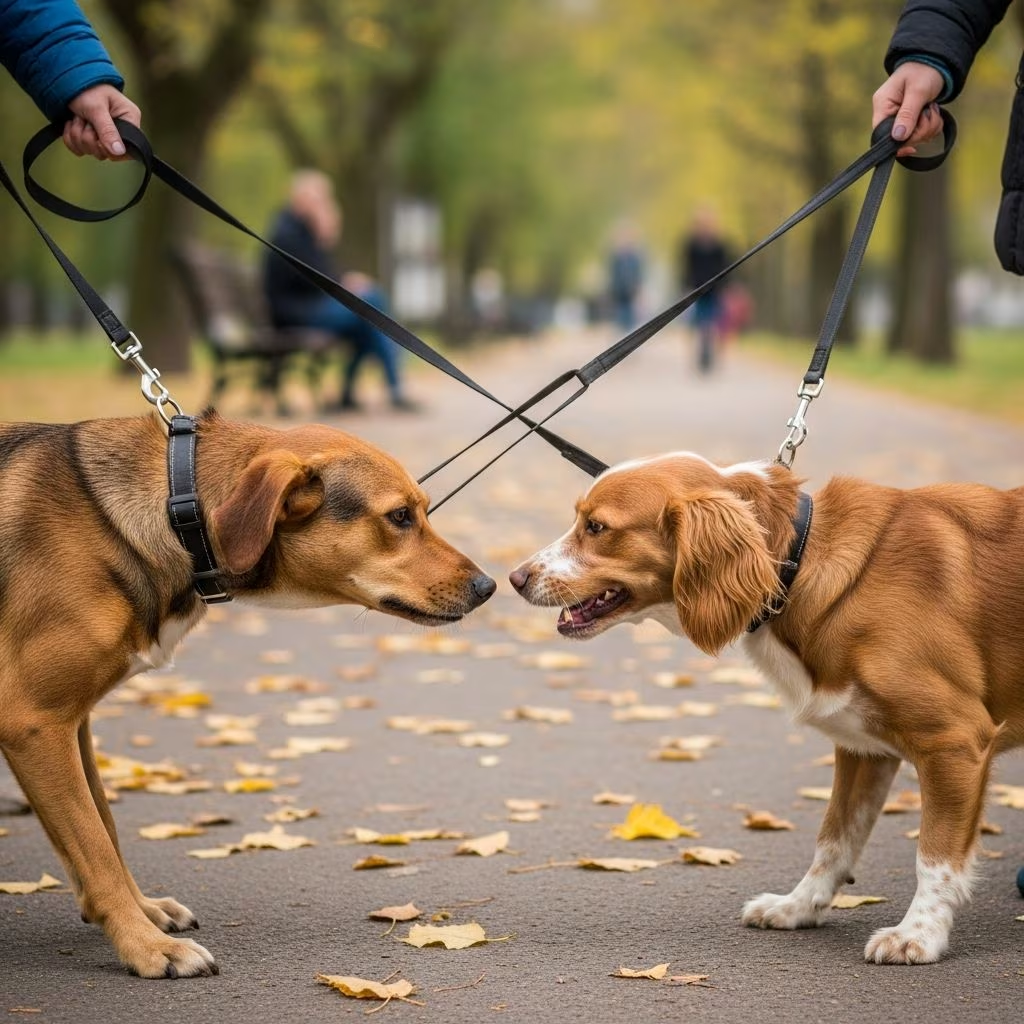
Letting two dogs rush up nose-to-nose on tight leashes may seem friendly, but it is one of the most common ways to create fear, frustration, and reactivity in otherwise social dogs. This guide explains why on-leash greetings are risky, what they do to your dog’s behavior over time, and how to handle introductions in safer, more natural ways.
Why On-Leash Dog Meet-and-Greets Are a Big Problem
In everyday life, many dogs are allowed to walk directly toward unfamiliar dogs on a sidewalk, then collide nose-to-nose while their humans hold leashes tight. To people, this can look like polite socialization. In dog body language, though, this setup is the opposite of a calm, respectful introduction.
Research shows that conflict is significantly more likely when dogs interact while restrained. A study of dog interactions in public places found that threats and aggressive signals occurred about twice as often when at least one dog was on leash compared with off-leash interactions. On a leash, dogs have limited ability to turn away, move in an arc, or diffuse tension with normal social signals, which can quickly escalate stress.
How Dogs Prefer to Greet Each Other
When dogs are free to move, their greetings follow a predictable pattern.
- They approach in a loose arc rather than straight on.
- Eye contact is usually brief or indirect, not a hard stare.
- They circle and sniff the other dog’s shoulders, sides, and rear.
- One or both dogs may pause, shake off, or move away to release tension.
- If both are comfortable, play or relaxed exploration may follow.
These movements are subtle but critical. They help each dog signal, “I am not a threat,” and give each animal options to disengage if they feel unsure.
What Happens When Dogs Meet Face-to-Face on Leash
On a typical sidewalk greeting, the opposite happens:
- Both dogs walk head-on, a posture that often means challenge in canine body language.
- The leashes shorten and tighten, pushing dogs closer and lifting their posture.
- Dogs cannot easily circle to sniff or move away without tangling leashes.
- Subtle calming signals get blocked or misread because of restricted movement.
From a dog’s perspective, they are locked into a high-pressure interaction with no clear escape route. For some dogs this may trigger fear; for others, explosive excitement. Either way, the risk of barking, lunging, snapping, or full fights increases.
The Problem With On-Leash Greetings
Allowing frequent on-leash greetings does more than create awkward moments. It can reshape your dog’s expectations and emotional responses whenever they see another dog outside.
| On-Leash Greeting Factor | Why It’s a Problem |
|---|---|
| Face-to-face approach | Often reads as threatening or confrontational to dogs. |
| Tight leash | Increases body tension, restricts movement, and distorts body language. |
| No escape options | Triggers fight-or-flight; when flight is blocked, dogs may choose fight. |
| Overexcitement | Teaches dogs to pull and surge toward every dog they see. |
How Your Leash Habits Affect Your Dog
Humans unintentionally add more pressure to these meetings. Many people instinctively grip the leash tighter as another dog approaches. That tighter leash:
- Conveys your tension to the dog through the leash.
- Can raise the dog’s head, chest, and tail, making them look stiffer and more confrontational.
- Prevents your dog from turning their body or choosing more polite angles of approach.
Over time, dogs learn that seeing another dog predicts physical restraint and emotional stress, not calm, positive interactions.
Behavioral Risks of On-Leash Greetings
Common fallout from repeated on-leash greetings includes:
- Leash reactivity – barking, lunging, or growling at other dogs on walks.
- Frustration – pulling harder or whining when they cannot greet every dog they see.
- Fear-based responses – avoiding certain routes, freezing, or cowering when dogs appear.
- Confused social skills – dogs that behave calmly off leash but explode when on leash.
How On-Leash Greetings Affect Dogs in the Long Term
Repeatedly forcing dogs into face-to-face, high-arousal meetings can have lasting emotional and training consequences.
Increased Anxiety and Reactivity
When a dog repeatedly feels trapped or overwhelmed around other dogs, they may start to associate any sight of another dog with danger or frustration. Over time, this can show up as:
- Scanning the environment nervously on walks.
- Barking or lunging as soon as another dog is visible, not just when close.
- Struggling to calm down even after the other dog is gone.
Behavior experts note that on-leash tension and restricted movement commonly contribute to the development of leash-directed aggression, especially in dogs who are otherwise socially competent off leash.
Damage to the Dog–Guardian Relationship
On-leash greetings also influence how your dog sees you in tough situations.
- If you repeatedly put them into interactions that feel unsafe, they may learn that you will not protect their boundaries.
- If you allow them to drag you to every dog, they may learn that ignoring your cues is rewarding.
- If you jerk the leash or scold them when they react, they may associate the presence of other dogs with punishment, not safety.
This erosion of trust can make training more difficult. A dog that feels they must manage threats on their own is more likely to escalate quickly or disregard your instructions around other dogs.
Learned Patterns That Are Hard to Undo
Dogs are excellent at forming habits. When repeated often, on-leash greetings can teach your dog that:
- Other dogs are either overwhelming or hugely exciting.
- Pulling toward dogs is the only way to say hello.
- Barking or lunging will push other dogs away (which can feel relieving).
Changing these patterns later usually requires systematic training: controlled distances, reward-based alternatives, and careful avoidance of surprise greetings.
The Ideal Way for Dogs to Meet: Off-Leash in Neutral, Controlled Spaces
When safe and appropriate, the least risky way for unfamiliar dogs to meet is off leash in a neutral, enclosed area under supervision.
Key Elements of a Safer Dog Introduction
- Neutral territory: Choose a space that neither dog considers “theirs,” such as a fenced yard that belongs to neither party or a secure training field.
- Secure enclosure: Use fencing or barriers so neither dog can bolt into unsafe areas if startled.
- Low-distraction environment: Avoid crowded parks, busy sidewalks, or off-leash dog parks where multiple unknown dogs mix with high excitement.
- No high-value triggers: Remove food bowls, chews, and favorite toys that might spark resource guarding.
- Calm timing: Choose a time away from meals and intense exercise so neither dog is overly tired, hungry, or aroused.
Role of a Professional Trainer or Behavior Specialist
For dogs with any history of reactivity, fear, or aggression, having a qualified professional guide introductions is strongly recommended.
- They can read early stress signals and adjust distance before problems erupt.
- They can design gradual parallel-walking and desensitization plans.
- They can coach guardians on handling skills, reinforcement timing, and exit strategies.
Many certified trainers and veterinary behaviorists base their recommendations on evidence-supported behavior science, emphasizing positive reinforcement and careful management rather than punishment.
When You Must Let Dogs Meet on Leash
Sometimes an on-leash meeting is unavoidable: narrow trails, apartment hallways, or city streets leave little room, or local rules require leashes at all times. In these cases, the goal is to reduce risk and pressure as much as possible.
Preparing Before the Dogs Get Close
- Ask the other guardian, “Is your dog friendly, and are you okay with them saying hello?”
- If either dog appears stiff, fearful, or overly excited, calmly increase distance instead.
- Keep leashes loose and use equipment that gives you control without pain (e.g., well-fitted harness or flat collar).
Parallel Walking: A Safer First Step
Many trainers recommend starting with a short parallel walk rather than an immediate nose-to-nose greeting.
- Walk both dogs in the same direction with several feet of space between them.
- Allow them to look and sniff at each other from the side, while you keep the leashes slack.
- Gradually reduce the distance only if both dogs’ bodies stay loose (soft eyes, relaxed tails, easy movement).
- Optionally let one dog briefly fall behind to sniff the other’s rear, then switch.
This setup mimics a more natural, side-oriented greeting and lets both dogs adjust without immediate, intense pressure.
Short, Low-Pressure Sniffing
If both dogs still seem relaxed, you can allow a brief sniff:
- Step toward an open area so leashes do not tangle.
- Keep leashes loose but short enough that you can smoothly guide your dog away.
- Count to three seconds as they sniff; then cheerfully call your dog away and reward them for following you.
Very short interactions prevent arousal from spiking and give you a chance to end things on a neutral or positive note before tension builds.
What to Avoid During On-Leash Greetings
- Do not let leashes become tight, crossed, or wrapped around the dogs.
- Do not drag or jerk your dog away mid-sniff unless safety demands it; sudden tension can startle or frustrate them.
- Do not linger; if conversation with the other person continues, step back so the dogs are no longer in close contact.
- Do not ignore early signs of discomfort such as freezing, lip-licking, tucked tail, or growling.
Practical Tips to Protect Your Dog From Risky On-Leash Greetings
You can significantly reduce problems by changing what “seeing another dog” means to your dog.
Teach an Alternative Behavior Around Other Dogs
- Train a strong “watch me” or name-response that you reward generously when dogs appear at a safe distance.
- Practice moving to the side of the path and having your dog sit or walk by your leg as other dogs pass by.
- Pair the sight of other dogs with calm praise and high-value treats when your dog stays relaxed.
This shifts the dog’s expectation from “I run up to every dog” to “I check in with my person and we get good things.”
Set Clear Greeting Rules
- Decide that your dog will only greet by invitation, not by dragging you to other dogs.
- Use a consistent verbal cue (e.g., “go say hi”) for the relatively rare times you allow a greeting.
- Calmly turn away and reward your dog for coming with you whenever you choose not to greet.
Advocate for Your Dog in Public
You are allowed to say no. If another dog is rushing toward you or a guardian insists their dog is “friendly,” you can:
- Hold up a hand and say, “No greetings, please, my dog needs space.”
- Step off the path behind a parked car, tree, or bench to create distance.
- Use a harness or leash wrap labeled with phrases like “Needs Space” if appropriate.
Frequently Asked Questions (FAQs)
Q: My dog loves other dogs. Is it still bad to let them greet on leash?
A: Even very social dogs benefit from limits on on-leash greetings. Regularly rushing up to other dogs can teach them to pull, ignore your cues, and become frustrated when they cannot say hi. Over time, that frustration can tip into barking or lunging, especially in tight spaces.
Q: Are off-leash dog parks a better solution?
A: Not automatically. While dogs can move more naturally off leash, crowded dog parks often combine unfamiliar dogs, high arousal, and limited supervision, which can also lead to fights or fear. Controlled, small-group introductions in neutral fenced areas are usually safer than large, open dog parks.
Q: What if my city requires leashes everywhere?
A: You can still support healthy behavior by avoiding casual on-leash greetings, using parallel walks, and focusing on teaching your dog to stay relaxed at a distance. Many guardians in dense urban areas rely on structured training classes or rented secure fields for off-leash social time.
Q: Can on-leash greetings ever be completely safe?
A: No interaction is risk-free, but you can greatly reduce problems by choosing calm, compatible dogs; keeping leashes loose; using very brief sniffing periods; and ending the interaction before arousal spikes. Watch both dogs’ body language closely and be prepared to calmly guide your dog away.
Q: My dog is already leash-reactive. Is it too late to change?
A: It is not too late, but you will likely need a structured training plan and professional support. Evidence-based behavior modification usually combines distance management, counterconditioning (pairing the sight of other dogs with rewards), and careful avoidance of surprise greetings. A certified trainer or veterinary behaviorist can tailor this plan to your dog’s history.
References
- Why Dogs Should Never Meet Face-to-Face on Leash — Kinship. 2023-08-10. https://www.kinship.com/dog-behavior/face-to-face-leash-meetings
- Do Dogs Really Want to Say Hello? The Pros and Cons of On-Leash Greetings — Hunter Mill Retrievers. 2023-04-18. https://www.huntermillretrievers.com/post/do-dogs-really-want-to-say-hello-the-pros-and-cons-of-on-leash-greetings
- 9 Reasons to Say No to On-Leash Greetings + What to Do Instead — Long Haul Trekkers. 2022-06-15. https://longhaultrekkers.com/on-leash-greetings/
- LETTING DOGS MEET: THE THREE SECOND RULE – Part 2 — Thriving Canine. 2014-09-01. https://www.thrivingcanine.com/blog/letting-dogs-meet-three-second-rule-part-2/
- Why You Should Not Allow Dogs to Greet On Leash — McCann Dogs. 2017-03-22. https://www.mccanndogs.com/blogs/articles/why-you-should-not-allow-dogs-to-greet-on-leash



