

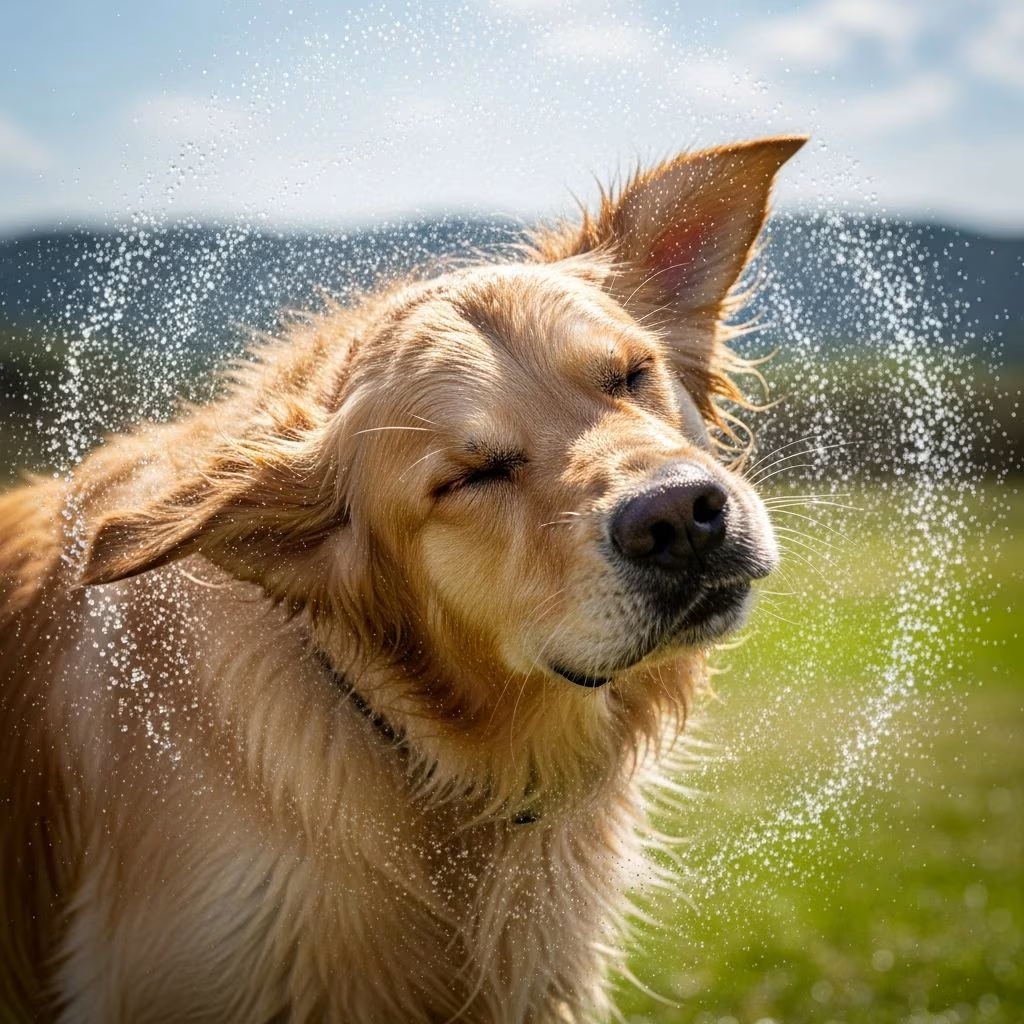
Dogs shake their bodies vigorously for multiple reasons, primarily to remove water, dirt, or irritants from their fur, but also to signal transitions in activity or manage emotional states. This instinctive behavior, observed across mammals, involves specialized sensory neurons and neural pathways that trigger rapid whole-body movements.
The Evolutionary Purpose of the Shake
The shake serves a critical survival function by quickly expelling moisture and debris that could weigh down a dog or promote infections. Research shows dogs can remove nearly 70% of water from their fur in just four seconds through high-speed oscillations reaching up to four times per second. This efficiency stems from evolutionary adaptations shared among mammals, where shaking hard-to-reach areas like the back and neck prevents prolonged discomfort from wetness or contaminants.
In wild ancestors, staying dry conserved energy and reduced predation risk by maintaining agility. Modern dogs retain this trait, shaking after baths, swims, or rain to restore their coat’s natural insulating properties.
Neurological Mechanisms Driving the Shake
Recent breakthroughs reveal the precise neural circuitry behind the \”wet dog shake.\” Sensory signals begin with C-LTMRs (C-fiber low-threshold mechanoreceptors), highly sensitive neurons wrapped around hair follicles that detect subtle skin movements or water droplets.
- These receptors activate via the Piezo2 ion channel when fur shifts from moisture or light touch.
- Signals travel from skin to spinal cord, then to the parabrachial nucleus in the brainstem, triggering motor neurons for shaking.
- Optogenetic studies in mice confirm activating C-LTMRs alone evokes shakes, while muting them reduces the response.
Harvard researchers mapped this pathway using advanced genetic tools, isolating single neurons and tracing signals with light stimulation. This uncovered how mechanical stimuli on the upper back—areas dogs can’t groom—prompt shakes via spinoparabrachial neurons. The parabrachial nucleus processes these inputs alongside pain and itch signals, explaining the vigor of the response.
Shaking Beyond Wetness: Behavioral Signals
Not all shakes involve water. A peer-reviewed study of domestic dogs found shakes mark transitions between activities or postures in 107 of 120 observed instances, occurring significantly more than by chance (χ²(1, n=120) = 73.63, p=0.01). Most (79/120) were not triggered by external contact, ruling out simple itch responses (χ²(1, n=120) = 12.03, p=0.01).
Shakes often follow rising from rest, exiting rooms, or switching from play to calm, suggesting a role in resetting tension or signaling context changes. While prior research linked shakes to stress from restraint or novelty, everyday observations show neutral or positive uses, challenging the stress-only view.
| Context | Pre-Shake Behavior | Post-Shake Behavior | Frequency |
|---|---|---|---|
| Activity Switch | Lying down | Walking | 45% |
| Post-Play | Running | Resting | 30% |
| Environmental Change | Indoors | Outdoors | 15% |
| Other | Various | Various | 10% |
This table summarizes common transitions from the study, highlighting shakes as behavioral punctuation rather than mere reflexes.
When Shaking Signals Emotions or Discomfort
Dogs may shake from excitement, like after greetings, or anxiety in new settings. Cold temperatures prompt shivers via muscle contractions for warmth, distinct from full-body shakes. Older dogs or puppies adjusting to homes might tremble from fear, while attention-seeking shakes mimic play bows.
Distinguish normal shakes: Wet fur triggers rapid, full-body twists; emotional ones are subtler tremors. Persistent shaking without moisture warrants veterinary checks for pain, neurological issues, or toxicity.
Breed and Physical Factors Influencing Shakes
Coat type affects shake dynamics. Long-haired breeds like Golden Retrievers甩出 more water volume but slower, while short-coated ones like Labradors achieve higher speeds. Body size matters too—larger dogs generate centrifugal force from greater mass, expelling water farther.
Health impacts include arthritis limiting shake amplitude in seniors or skin allergies intensifying irritant responses. Regular grooming reduces debris buildup, minimizing unnecessary shakes.
Helping Your Dog During and After Shakes
Post-bath, use towels or low-heat dryers to assist drying, reducing shake intensity indoors. Provide safe shake zones like grassy yards to avoid slips on tile. For anxious shakers, desensitization training with positive reinforcement calms nerves.
- Observe patterns: Note triggers via journal.
- Environment tweaks: Warm baths for cold-sensitive dogs.
- Vet consult: If shakes accompany lethargy or appetite loss.
- Enrichment: Toys redirect excited energy.
FAQs: Common Questions About Dog Shaking
Is shaking always a sign of happiness?
No, it often indicates drying or transitions, though excitement can trigger it. Context like tail wagging helps interpret.
Why do puppies shake more?
Puppies lack full coat insulation and explore novel stimuli, amplifying sensory responses via developing C-LTMRs.
Can I train my dog not to shake indoors?
Partially, with commands like \”stay\” post-bath, but suppressing instincts risks stress. Redirect to outdoor areas.
What if my dog shakes excessively without water?
Check for cold, pain, or nausea. Persistent cases need vet evaluation for underlying conditions.
Do all mammals shake like dogs?
Yes, it’s conserved; mice, horses, and cats exhibit similar neural-driven shakes for irritant removal.
Training Tips to Manage Shaking Behaviors
Teach \”shake off\” on cue outdoors using treats, then generalize to baths. For stress shakes, counter-condition with calm cues like deep-pressure vests. Consistency builds reliability, harmonizing instincts with home life.
References
- Ever wonder why your dog does this? — Harvard Gazette. 2024-11. https://news.harvard.edu/gazette/story/2024/11/ever-wonder-why-your-dog-does-this/
- Wet dogs don’t choose to ‘shake it off’ – it’s in their genes — New Atlas. 2024. https://newatlas.com/biology/dog-shake-water-science/
- Shake It Off: Investigating the Function of a Domestic Dog Behavior — PMC (PubMed Central). 2024. https://pmc.ncbi.nlm.nih.gov/articles/PMC11591167/
- The science behind your dog’s most annoying behavior — Science Magazine. 2024. https://www.science.org/content/article/science-behind-your-dog-s-most-annoying-behavior
- Science Looks at Why and How Wet Dogs Shake — Psychology Today. 2012-09. https://www.psychologytoday.com/us/blog/canine-corner/201209/science-looks-why-and-how-wet-dogs-shake



