

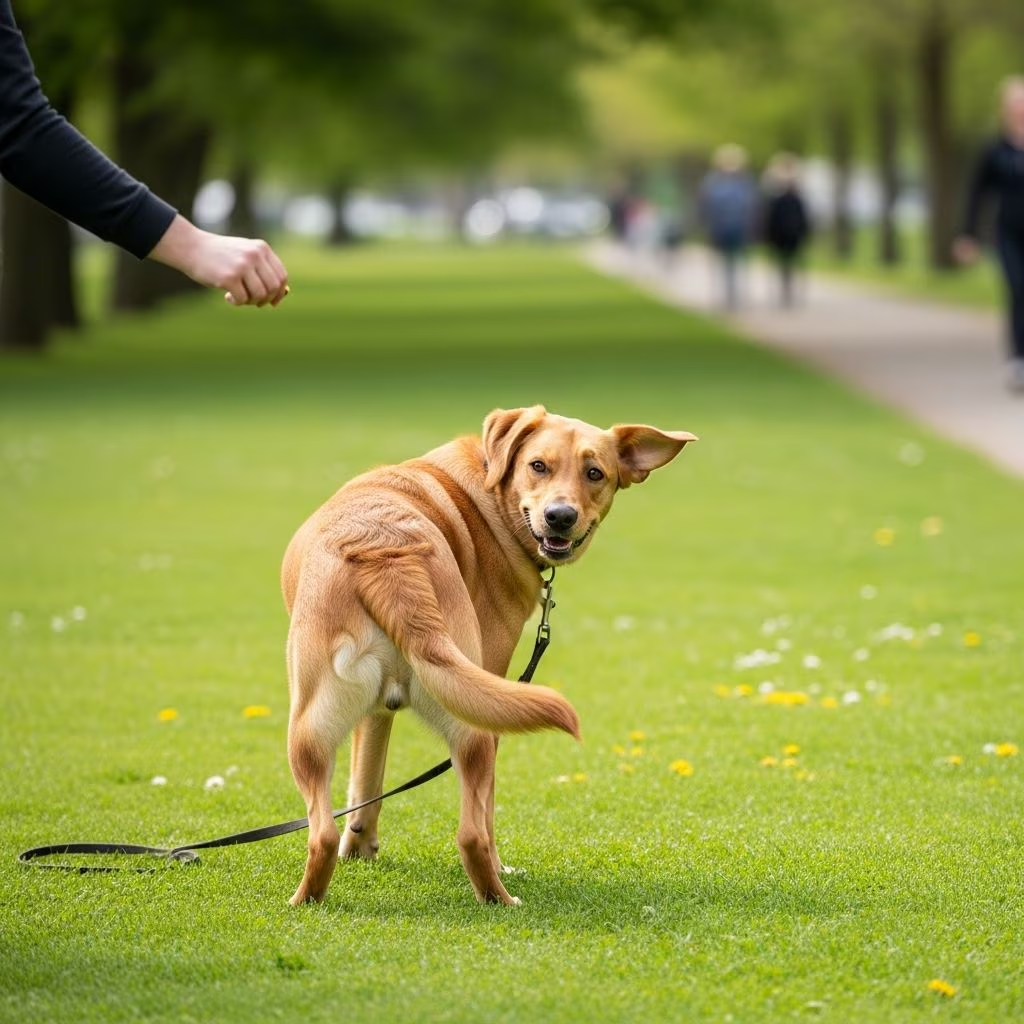
Dogs often appear to ignore their owners’ commands due to misunderstandings in communication, inconsistent reinforcement, or improper timing of responses. Addressing these issues through clear signals, steady practices, and precise feedback can transform training outcomes and foster a deeper connection between dog and owner.
Decoding the Communication Gap Between Humans and Dogs
Humans and dogs operate on fundamentally different communication systems, leading to frequent misinterpretations. Dogs primarily rely on non-verbal cues such as body language, facial expressions, and tone variations rather than complex verbal instructions. For instance, a dog jumping on guests might interpret the owner’s excited talking as encouragement because attention equates to approval in canine terms.
To bridge this gap, owners must prioritize visual and auditory consistency. Hand signals paired with single-word commands help dogs associate specific actions quickly. Trainers emphasize that dogs process gestures and posture more effectively than lengthy sentences, making succinct, repeated cues essential for learning.
Establishing Consistency in Everyday Training Routines
Inconsistency from owners confuses dogs, resulting in unreliable obedience. When family members use different tones or commands for the same behavior, dogs receive mixed messages, fostering anxiety and hesitation. Research highlights that erratic responses create neural conflicts, making dogs view handlers as unpredictable.
Building reliability starts with unified household rules. Everyone should use identical phrasing, like “sit” with the same hand motion and upbeat voice. Positive reinforcement, such as treats delivered immediately after compliance, solidifies associations without ambiguity. Over time, this uniformity reduces stress and boosts confidence.
- Agree on core commands across all household members.
- Use the same rewards for successes to avoid favoritism perceptions.
- Practice daily short sessions to reinforce patterns without overwhelming the dog.
The Critical Role of Timing in Rewarding Behaviors
Timing directly impacts a dog’s ability to link actions with consequences. Rewards given seconds after a behavior still connect loosely, while immediate delivery captures the precise moment. Similarly, corrections must align exactly with undesired actions to prevent reinforcing the wrong response.
Dogs live in the present, with short memory windows for events. A delay in praise for sitting might reward a subsequent sniff instead. Trainers recommend clickers or markers to “bridge” these instants, signaling the exact rewarded behavior. Mastering this precision turns sporadic compliance into habitual obedience.
| Timing Mistake | Impact on Dog | Correct Approach |
|---|---|---|
| Late reward | Confuses correct action | Deliver treat within 1 second |
| Delayed correction | Reinforces wrong behavior | Use calm interrupt at exact moment |
| Inconsistent intervals | Creates uncertainty | Maintain steady reward schedule |
Reading and Responding to Canine Body Language
Overlooking a dog’s emotional signals leads to ignored commands, as stressed or fearful dogs prioritize self-preservation over obedience. Subtle signs like lip licking, yawning, or averted gazes indicate discomfort, signaling the need to adjust training pressure.
Effective trainers scan for these “cutoff” behaviors, which aim to de-escalate interactions. Ignoring them risks escalation to growls or snaps. Instead, pause sessions, offer space, and resume with lower intensity to rebuild trust. Service dog programs exemplify this by teaching handlers to recognize distress cues for tailored support.
Voice Tone and Volume: Tools for Clear Instructions
Dogs distinguish tone and volume before words, associating high pitches with play and low ones with seriousness. Shouting often excites rather than corrects, while soft, firm commands convey authority without fear.
Practice varying tones deliberately: cheerful for invitations, steady for stays. Word associations build over time, but initial responses stem from vocal nuances. Consistent application prevents misfires, like a “down” sounding like permission to romp.
Overcoming Common Training Pitfalls with Positive Methods
Blending punishment with rewards creates confusion, as dogs struggle with conflicting pathways. Positive reinforcement alone builds reliable responses by focusing on what to do, not avoid. This approach minimizes anxiety, enhancing focus and retention.
Owners skeptical of gentle methods may revert to old habits, but evidence shows consistency in positivity yields faster, lasting results. Track progress with journals to visualize improvements and adjust as needed.
Practical Exercises to Strengthen Command Response
Implement targeted drills to address disregard. Begin in low-distraction environments, gradually increasing challenges.
- Sit-Stay Progression: Command once, reward instant compliance. Add distance, then duration.
- Recall Game: Use joyful tones, high-value treats. Practice in enclosed yards before open areas.
- Leave-It Challenge: Place treats out of reach, reward ignoring them on cue.
These build success layers, turning ignores into eager executions.
Building Long-Term Trust Through Daily Interactions
Beyond sessions, routine bonds amplify training. Walks with loose leashes reinforce cues naturally. Mealtimes offer chances for “wait” practices. Emotional connections via play deepen responsiveness.
Handlers of working dogs maintain proficiency through ongoing reinforcement, a model for pets. Daily consistency ensures cues remain fresh, preventing regression.
FAQs on Improving Dog Obedience
Why does my dog obey at home but not outside?
Distractions overwhelm practiced cues. Retrain in varied settings, starting mildly.
How long until consistency shows results?
Typically 2-4 weeks with daily 5-10 minute sessions.
What if my dog is fearful during training?
Reduce intensity, use counter-conditioning with high-reward treats.
Can older dogs learn new responses?
Yes, adaptability persists; patience and positivity are key.
Should I use tools like clickers?
They excel for precise timing, especially beginners.
Advanced Strategies for Persistent Issues
For stubborn cases, analyze environments for triggers. Video sessions reveal overlooked signals. Professional input clarifies complex behaviors. Management tools like leashes prevent rehearsal of ignores during retraining.
Integrate play-based learning; games embedding cues make compliance fun. Track metrics: success rates per cue, to refine approaches objectively.
References
- The Power of Clear Communication in Dog Training — Destination Dog Training. 2023. https://www.destinationdogtraining.com/the-power-of-clear-communication-in-dog-training
- How to Effectively Communicate with Your Dog — Off The Beaten Trail. 2022. https://www.otbtvt.com/how-to-effectively-communicate-with-your-dog
- The Silent Communicators: How Service Dogs Understand and Respond — ECAD. 2024. https://www.ecad1.org/index.php/resources/blog/238-the-silent-communicators-how-service-dogs-understand-and-respond
- Canine Communication and Social Behavior — Pet Professional Guild. 2023. https://www.petprofessionalguild.com/barks/barks-magazine-blog/canine-communication-and-social-behavior/
- Unleashing Success: The Importance of Communication in Dog Training — Positive Pets Boise. 2023. https://www.positivepetsboise.com/unleashing-success-the-importance-of-communication-in-dog-training/
- Human-Canine Communication: Tone vs. Volume — VCA Animal Hospitals. 2024. https://vcahospitals.com/know-your-pet/humancanine-communication-tone-vs-volume



