

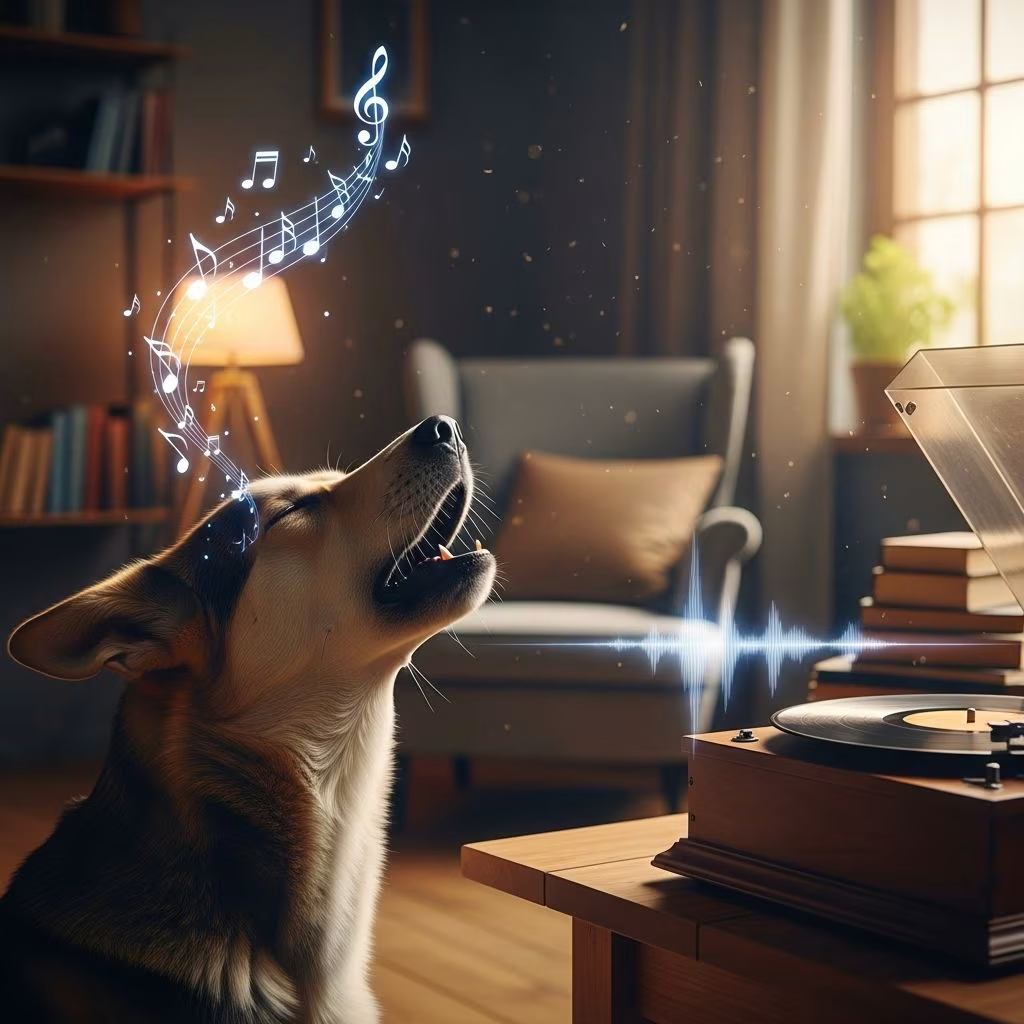
Why Do Dogs Howl to Music—And Can They Really Match Pitch?
Dogs have captivated us for thousands of years with their remarkable behaviors, and one of the most intriguing is their tendency to howl along to music. Whether your dog joins in during a piano concerto or sings along to your favorite pop song, this behavior raises fascinating questions about canine cognition, evolution, and communication. Are our dogs genuine musical enthusiasts, or are they simply responding to auditory stimuli? Do they truly possess the ability to match pitch, or are they merely making noise? Understanding the science behind why dogs howl to music reveals insights into their ancient ancestry and their modern relationship with humans.
Understanding Canine Howling: Communication and Connection
Howling serves multiple purposes in the canine world. Dogs howl for several distinct reasons, each reflecting their complex emotional and social lives. Some dogs howl to capture human attention, a behavior that becomes reinforced when they receive the desired response. Others use howling to express irritation or frustration at particular stimuli, such as loud sirens or alarming noises. Additionally, dogs experiencing emotional distress, particularly separation anxiety from being left alone for extended periods, may howl as a coping mechanism.
According to canine cognition experts, when dogs howl in response to music, they are communicating a specific message to their human companions. Dr. Zachary Silver, professor of psychology and director of the Canine Intelligence Lab at Occidental College, explains that dogs are essentially saying, “I’m aware of what’s going on, and either I want to be involved, or I want this noise to stop.” This interpretation suggests that dogs are not passively reacting to sound but are actively engaging with their environment and attempting to communicate their preferences and desires.
Dogs utilize their vocalization abilities—whether through barking, whining, or howling—as fundamental tools for communicating thoughts and ideas to humans. This vocal communication strengthens the social bond between dogs and their human families, creating a deeper connection beyond mere companionship.
The Ancient Roots: Pitch-Matching as an Evolutionary Behavior
The behavior of dogs howling to music and matching pitch represents a fascinating application of an ancient survival mechanism. In the wild, wolves rely heavily on howling as a crucial communication tool. They howl to establish long-distance contact with pack members, create social cohesion within their groups, and mount territorial defenses against rival packs. Throughout their evolution, wolves have developed and refined the ability to match pitch, a skill that serves specific strategic purposes.
Sophie Barton, a researcher at the Canine Brains Project at Harvard Hecht Lab and PhD candidate in human evolutionary biology, explains the sophisticated nature of wolf pitch-matching behavior. Wolves will deliberately match pitch to create the illusion of a larger group, making rival packs believe they face greater numbers than they actually do. Conversely, wolves modulate their pitch to distinguish themselves as individuals within the pack structure. This nuanced vocalization strategy demonstrates the evolutionary importance of pitch control in canine species.
However, an important distinction exists between wolves and domestic dogs. While wolves have evolved this pitch-matching ability through millions of years of natural selection, wolves in their natural habitat are never exposed to recorded music or musical instruments. Domesticated dogs today, by contrast, regularly encounter these modern auditory stimuli. The ability of domestic dogs to apply their ancestral pitch-matching behavior to contemporary musical contexts represents a fascinating convergence of ancient instinct and modern environment.
Breed Differences and Evolutionary Disposition
Howling is not equally common across all dog breeds. Research indicates significant variation in howling behavior depending on a dog’s genetic lineage. Among today’s dogs, howling is considerably more common in ancestral or ancient breeds, including Hounds, Huskies, Shiba Inu, and Saluki. These breeds are genetically more similar to wolves than modern or Victorian breeds like Terriers and Retrievers, which were developed through artificial selection for different behavioral traits.
This variation suggests that the tendency to howl to music represents an evolutionary disposition deeply embedded in certain bloodlines. Dogs from ancient breeds are tapping into genetic predispositions that have been preserved from their wolf ancestors. Modern breeds, developed over relatively short timescales through selective breeding, have had these ancestral traits substantially diminished. Dr. Silver notes that this pattern of breed-specific howling behaviors demonstrates how domestication and artificial selection have profoundly shaped canine communication styles, with some breeds favoring ancestral behaviors like howling while others have evolved to rely more on barking and other modern forms of communication.
Current Research on Pitch-Matching Abilities
Scientists are actively investigating the precise mechanisms and prevalence of pitch-matching in dogs. Since 2020, researchers at Harvard Hecht Lab’s Canine Brains Project have been conducting comprehensive studies on whether dogs can deliberately adjust their howl pitch in response to varying stimuli. This ongoing research represents one of the most systematic efforts to understand canine vocal capabilities.
The methodology of this research is innovative and participatory. Researchers recruited owners of dogs that already howl naturally. These participants completed detailed surveys about their dog’s breed, the contexts in which their dog howls, and the specific stimuli that trigger howling episodes, whether sirens, songs, or other sounds. Following this baseline data collection, researchers sent participants upshifted (higher) or downshifted (lower) versions of the original howling triggers. Dog owners then recorded their pets’ responses to determine whether the dogs could adjust their pitch to match the modified stimuli.
Results from analyzing 700 surveys have provided valuable insights into canine howling behavior. The data has informed researchers about which dog types are most likely to howl and match pitch, the most common triggers for howling, and how the domestication process has fundamentally altered this ancient behavior.
Evidence of Pitch-Matching: What the Research Shows
Sophie Barton’s research team has indeed identified evidence of pitch-matching capabilities in dogs, though this ability is not universal across the canine population. The survey results reveal a clear pattern: “We noticed that ancient breeds tend to howl more: Hounds, Huskies, Shiba Inu, Saluki, while dogs more distant than wolves are engaging less in it.”
These findings indicate that howling has been profoundly shaped by the domestication process and artificial selection over centuries. As humans selectively bred dogs for specific purposes and traits, they inadvertently altered their communication preferences and capabilities. Modern breeds have shifted away from ancestral behaviors and invested more heavily in short-distance communication methods like barking rather than long-distance howling.
The research also uncovered interesting nuances in how dogs respond to auditory stimuli. Survey results showed that more dogs howled in response to being separated from their human than in response to auditory stimuli like music. Among dogs that did howl to auditory triggers, they demonstrated particular preferences and selectivity. Some dogs only howled to live music performed in their presence but refused to howl to recorded music. In one remarkable case, a dog would only howl along when its human was physically playing the piano, refusing to respond to pre-recorded piano music.
This selectivity suggests that social motivation plays a significant role in whether dogs choose to howl. The presence of their human companion, the live nature of the performance, and the interactive element of the experience appear to matter considerably to dogs, indicating that their howling behavior serves social and emotional purposes beyond merely responding to sound frequencies.
Why Not All Dogs Howl to Music
The variation in howling behavior among individual dogs reflects the complexity of canine communication. Not all dogs possess the same predisposition to howl, and even within breeds known for howling, individual dogs show remarkable differences. Several factors influence whether a dog will howl to music:
- Genetic heritage: Dogs with genetic lineage closer to wolves are more likely to howl
- Individual personality: Some dogs are naturally more vocal than others
- Environmental experiences: Early exposure to music and positive associations with musical stimuli can influence howling behavior
- Social context: The presence of their human, the type of performance (live vs. recorded), and the dog’s emotional state all play roles
- Auditory preferences: Individual dogs develop preferences for certain types of music or sounds
Musical Preferences in Dogs
Research has demonstrated that dogs, much like humans, exhibit distinct musical preferences. Deborah Wells, a psychologist at Queens University in Belfast, conducted groundbreaking research exposing shelter dogs to different musical genres and observing their behavioral responses.
Wells tested three distinct categories of music with surprisingly different results. Pop music, including artists like Bob Marley and Britney Spears, produced minimal noticeable effects on the dogs. Heavy metal music, such as songs by Metallica, created significant canine agitation and increased barking behavior. Classical music, including pieces by Beethoven (“Ode to Joy”), Vivaldi (“The Four Seasons”), and Grieg (“Morning”), had the opposite effect—dogs became calm, stopped barking, and settled in place.
These findings align with broader understanding of how music influences emotional states. Classical music is well-established to reduce stress levels in both humans and animals, while heavy metal and grunge music can promote feelings of hostility, sadness, and tension. According to Wells, “It is well established that music can influence our moods. Classical music, for example, can help to reduce levels of stress, whilst grunge music can promote hostility, sadness, tension, and fatigue. It is now believed that dogs may be as discerning as humans when it comes to musical preference.”
The Difference Between Howling and Singing
An important scientific distinction exists between what most people call “singing” and the howling behavior dogs display. Dr. Doug Mader, a Florida veterinarian and author of “The Vet at Noah’s Ark,” clarifies this distinction. Howling is fundamentally a form of canine communication, particularly used for long-distance communication, where dogs attempt to reach other dogs or express emotions such as hunger, fear, or anxiety.
“Singing,” by contrast, requires specific qualities inherent to music: harmony, pitch, melody, and tempo. A recent study by researchers from the University of Vienna, published in the Royal Society of Biological Sciences, indicated that dogs modulate their vocalizations in ways extraordinarily similar to how humans sing along to music. This strongly suggests that dogs appearing to “sing” may actually be engaging in a genuine form of musical vocalization rather than simply noise-making.
However, Dr. Mader notes an important caveat: while dogs can apparently sing and modulate their vocalizations, they do not appear to possess perfect pitch. “Limited data exists that supports a dog’s ability to perceive and interpret melodies,” he explains. “Recordings of dogs ‘singing’ with their owners or to instruments clearly demonstrate that they can change their vocals. Whether or not this is deliberate or just random is not known.”
Understanding Pitch and Tone Perception in Dogs
Dogs possess sensory capabilities that extend beyond human perception, influencing how they experience and respond to music. Research demonstrates that dogs can differentiate between pitch and tone with remarkable precision. In the wild, as additional wolves join a howling session, each individual changes its tone to a different note, creating a complex harmonic arrangement.
Your dog’s hearing abilities surpass human capabilities in significant ways. Dogs pick up higher frequencies than the human ear can detect, meaning they are often howling along to sounds and frequencies beyond human perception. When your dog appears to join in at a completely different pitch or note than you hear, they may deliberately be individualizing their howl to stand out within the acoustic space, much as their wolf ancestors did.
A common misconception suggests that dogs howl because the music hurts their ears or causes them pain. However, veterinary experts note that if a dog experienced genuine pain from a sound, they would exhibit completely different behaviors: running away from the source, hiding, or covering their head. The voluntary, engaged behavior of howling along to music contrasts sharply with pain avoidance responses.
Beyond Individual Howling: Social and Territorial Aspects
Additional research from multiple countries published in the scientific journal Behavioural Processes reveals that wild canine species including coyotes, jackals, and red wolves deliberately modulate their howling in response to specific situations. This suggests that canine species possess the capacity to use specific types of vocalizations based on their social context and the animals they are around.
Dogs may also employ even more sophisticated vocal strategies. Research published in 2021 in the scientific journal Current Zoology found that dogs may utilize ultra-high frequency vocalizations to communicate privately with preferred pack members while avoiding detection by outsiders. These specialized vocalizations appear designed for intimate “tête-à-tête” conversations rather than broadcast communication.
What Your Dog’s Howling Might Mean
When your dog howls to music, they are communicating something important. The behavior could indicate several different motivations and emotional states:
- Social engagement: Your dog wants to participate in the musical experience with you
- Attention-seeking: They are using vocalization to engage with you and strengthen your bond
- Stress response: They are attempting to communicate discomfort or request that you stop the stimulus
- Ancestral instinct: Ancient genetic programming is activating in response to prolonged tones or frequencies
- Emotional expression: They are expressing excitement, joy, or emotional resonance with the music
Frequently Asked Questions About Dogs Howling to Music
Q: Why do some dogs howl more than others?
A: Breed genetics play a major role. Ancient breeds like Huskies and Hounds, genetically closer to wolves, naturally howl more than modern breeds. Individual personality, early experiences, and training also influence howling frequency.
Q: Can dogs actually match pitch?
A: Yes, research evidence suggests dogs can match pitch, but not all dogs do so consistently. Ancient breeds show greater pitch-matching ability than modern breeds, reflecting their closer genetic relationship to wolves.
Q: Does my dog howl because the music hurts their ears?
A: No, this is a common misconception. If music caused pain, dogs would run away, hide, or cover their heads. Howling along indicates voluntary, engaged participation rather than pain response.
Q: What type of music do dogs prefer?
A: Research shows dogs respond well to classical music, becoming calm and relaxed. Heavy metal tends to agitate dogs and increase barking, while pop music produces minimal effects.
Q: Is there a difference between howling and singing in dogs?
A: Yes. Howling is communication, while singing requires harmony, pitch, melody, and tempo. Recent research suggests dogs can modulate their vocalizations in ways similar to human singing.
Q: Why does my dog only howl to live music, not recorded music?
A: This selectivity suggests social motivation is important. Your dog may be responding to the interactive, live element and your presence rather than just the auditory stimulus itself.
Q: How can I encourage my dog to howl less?
A: Play calming music like classical pieces, avoid triggering stimuli during training, and focus on rewarding quiet behavior. Ensure your dog receives adequate exercise and mental stimulation to reduce stress-related howling.
References
- Why Do Dogs Howl to Music—And Can They Really Match Pitch? — Kinship. 2025. https://www.kinship.com/dog-behavior/why-do-dogs-howl-to-music
- Why Do Dogs Howl to Music? You Can Thank Their Ancestors — American Kennel Club. https://www.akc.org/expert-advice/lifestyle/why-do-dogs-howl-to-music/
- Why some dogs love to sing along with humans — Salon. 2023-02-03. https://www.salon.com/2023/02/03/why-some-dogs-love-to-sing-along-with-humans/



