

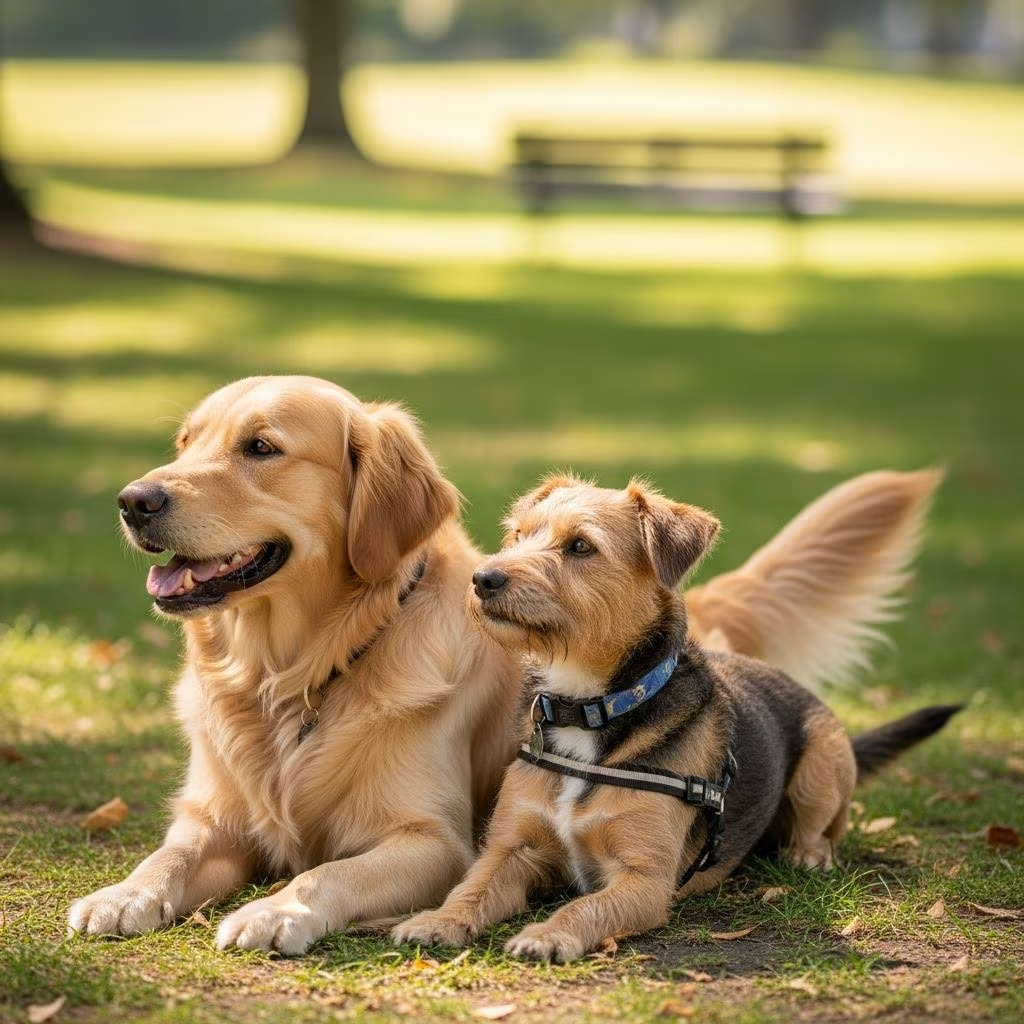
Dogs copy other dogs through a combination of instinctive social behaviors and learned imitation, driven by evolution for pack survival, bonding, and efficient learning. This mimicry ranges from spontaneous actions like yawning or blinking to deliberate copying of complex tasks demonstrated by conspecifics or humans.
What Is Dog Imitation?
Dog imitation, or mimicry, refers to when one dog replicates the actions or expressions of another dog or human observer. This behavior is not random; it serves critical social and cognitive functions. Research distinguishes true imitation—matching specific actions—from simpler forms like contagion (automatic reflexive responses) or emulation (copying results without the exact method).
For instance, in controlled experiments using a bidirectional control procedure, dogs pushed a screen in the exact direction demonstrated by another dog, outperforming controls where the screen moved independently. In the dog imitation group, 92% matched on the first trial, rising to 77.1% over trials, indicating deliberate imitation rather than mere facilitation.
Why Do Dogs Imitate Each Other?
Dogs imitate for several evolutionary and social reasons:
- Social Bonding: Mimicking facial expressions like blinking or yawning strengthens pack cohesion. A study in Royal Society Open Science found dogs spontaneously mimic each other’s blinks, a subtle cue for affiliation similar to human eye contact.
- Learning Efficiency: Puppies observe and copy littermates or mothers to acquire survival skills quickly, such as foraging or avoiding danger, bypassing trial-and-error.
- Pack Synchronization: Contagious behaviors like yawning or tail wagging align group actions, enhancing coordination in herding or hunting ancestors.
- Cognitive Matching: Dogs infer intent; they copy paw use when a demonstrator’s mouth is occupied, showing understanding of necessity over preference.
Historical observations, noted even by Charles Darwin, describe spontaneous imitation among dogs and other animals, underscoring its instinctive roots.
Types of Dog Copying Behaviors
Dog mimicry manifests in various forms, from reflexive to sophisticated:
- Contagious Behaviors: Automatic copying like yawning chains through a group, triggered without learning.
- Facial Mimicry: Dogs match play faces, yawns, or blinks to signal rapport.
- Action Imitation: Replicating body movements, such as pawing or pushing objects.
- Deferred Imitation: Remembering and copying actions after delays up to 10 minutes, a marker of declarative memory.
| Type | Example | Cognitive Level | Source |
|---|---|---|---|
| Contagion | Yawning | Reflexive | |
| Facial Mimicry | Blinking | Social | |
| True Imitation | Screen push direction | Deliberate | |
| Deferred | Copying after 10 min delay | Advanced memory |
Scientific Evidence: Do Dogs Really Imitate?
Peer-reviewed studies confirm dogs’ imitative abilities. In a 2009 PMC study, dogs in the imitation group matched demonstrated screen-push directions significantly above chance (p=.003 first trial), controlling for odors, emulation, and facilitation. Human demonstrations yielded similar trends, though variable.
The landmark “Do as I Do” protocol, refined by Topál et al. (2006), trained dogs like Philip to copy novel actions on command. Extended by Fugazza, it demonstrated deferred imitation: dogs waited up to 10 minutes post-demonstration (e.g., walking around a cone or dipping head in bucket) before accurately replicating, even with a novel cue-giver. All 18 dogs scored near-perfectly, suggesting declarative memory previously thought unique to primates.
Puppies also naturally mimic humans without training, per SN Explores, implying innate tendencies useful for modeling in training.
Dogs Copying Humans vs. Other Dogs
Dogs imitate humans comparably to conspecifics, adapting actions to their anatomy (e.g., translating human hand gestures to paw). In bidirectional tests, human demo groups matched directions akin to dog groups. This cross-species flexibility likely stems from domestication, enhancing human-dog cooperation.
However, dogs show selective fidelity: copying paw over mouth when demonstrated as necessary, indicating causal understanding.
How Imitation Helps in Dog Training
Harnessing imitation revolutionizes training:
- Modeling Over Luring: Demonstrate behaviors for natural copying, reducing food reliance.
- Do as I Do Training: Teach “Do it!” after demos for complex chains like agility or service tasks.
- Socialization Boost: Group classes leverage peer imitation for faster learning.
- Deferred Recall: Builds patience and memory, vital for obedience.
Trainers report surprises at dogs’ unpredicted proficiency in observing, remembering, and translating actions.
Instinct or Learned? The Debate
While reflexive in puppies, adult imitation requires training like “Do as I Do.” Critics debate declarative memory claims, but delayed replication evidence is robust. Species differences (e.g., pigeons outperform rats) tie to visual acuity and procedure rigor.
Frequently Asked Questions (FAQs)
Do all dogs imitate others?
Most dogs show spontaneous mimicry, enhanced by training. Puppies are most prone; breeds vary by sociability.
Why does my dog copy my yawn?
It’s contagious bonding, syncing emotional states like empathy.
Can I train my dog to imitate me?
Yes, via “Do as I Do”: Demo, command “Do it!” after delay. Success in weeks.
Is dog imitation a sign of intelligence?
Yes, indicates memory, inference, and social cognition rivaling apes.
Do dogs copy bad behaviors?
Yes, so model positives only; supervise multi-dog homes.
Conclusion: Embrace Your Dog’s Copycat Nature
Understanding canine imitation deepens bonds and optimizes training. From pack survival to modern companionship, dogs’ mimicry showcases their adaptable minds. Encourage it ethically for harmonious living.
References
- Imitation and Emulation by Dogs Using a Bidirectional Control Procedure — Johnston, A.M., et al. PMC/NCBI. 2009-03-18. https://pmc.ncbi.nlm.nih.gov/articles/PMC2662430/
- Your Dog Is a Copycat — Science Magazine (AAAS). 2013-01-01. https://www.science.org/content/article/your-dog-copycat
- Dogs May Unknowingly Mimic Blinking to Bond With Each Other — Discover Magazine. 2017-12-12. https://www.discovermagazine.com/dogs-may-unknowingly-mimic-blinking-to-bond-with-each-other-47142
- Do Dogs Spontaneously Imitate Behaviors? — Psychology Today (Canine Corner). 2021-08-01. https://www.psychologytoday.com/us/blog/canine-corner/202108/do-dogs-spontaneously-imitate-behaviors
- Analyze This: Dog Behavior — Puppies Mimic Human Actions — Science News Explores. 2016-01-01. https://www.snexplores.org/article/analyze-this-dog-behavior-puppies-mimic-human-actions



