

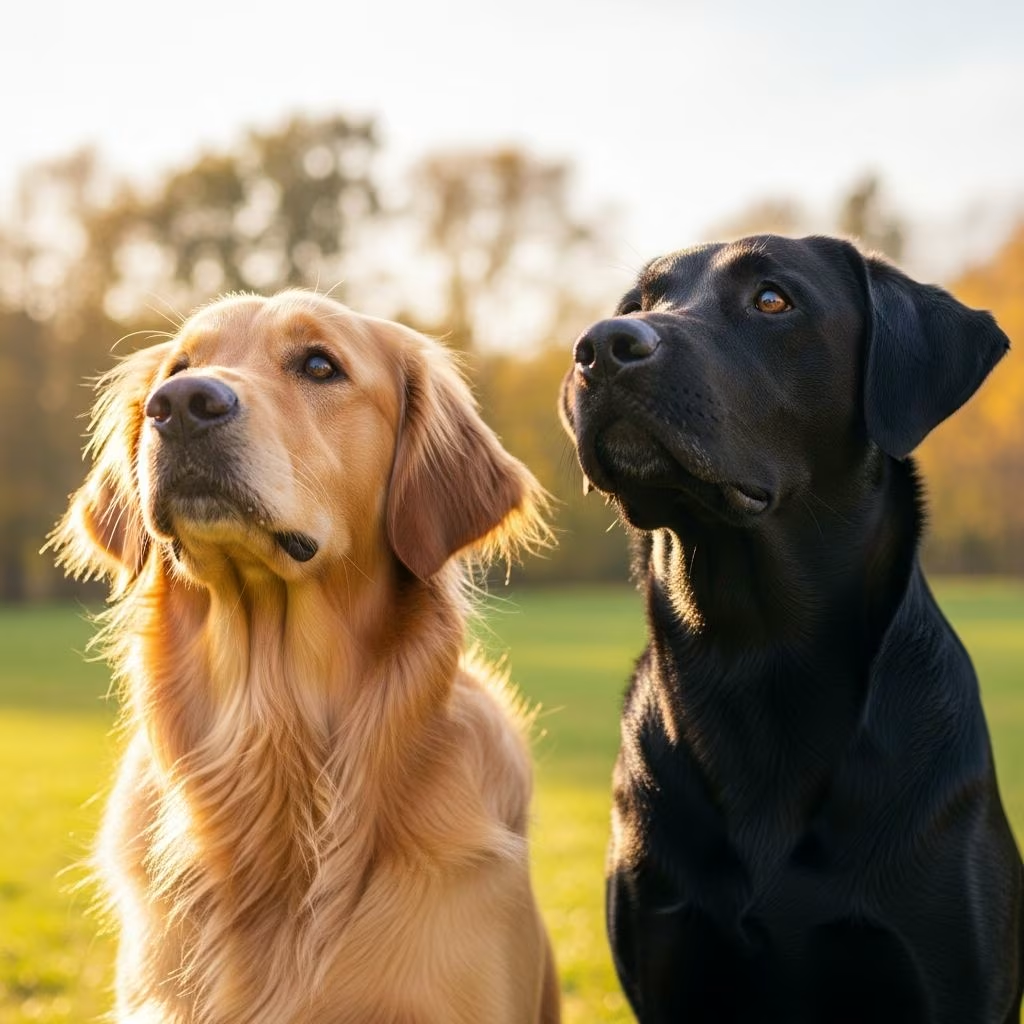
Dogs have captivated humans for millennia, their behaviors both mysterious and endearing. From tail wags to protective instincts, understanding why dogs do what they do reveals the depth of our shared history and emotional kinship. This article dives into the science, evolution, and psychology behind common canine quirks, drawing on credible research to explain the unbreakable human-dog bond.
The Ancient Kinship: How Dogs Became Our Companions
The human-dog relationship dates back approximately 40,000 years, marking one of the most profound interspecies partnerships in history. Unlike domestication of other animals through direct human intervention, dogs emerged through coevolution, where prehistoric humans and wolves mutually adapted to each other’s presence. Human camps became ecological niches for wolves, who scavenged scraps and alerted groups to dangers, while humans provided food and protection.
This co-becoming led to convergent evolution, where dogs developed human-like social skills, such as reading facial expressions and gestures more adeptly than even chimpanzees. Dogs form attachments akin to human infants with caregivers, seeking comfort and proximity during stress. Over time, humans sacrificed olfactory prowess for speech capabilities, with dogs filling the sensory gap—enhancing our survival against competitors like Neanderthals.
Historically, most dogs were free-living, sharing spaces without ownership. Colonial attitudes shifted this, imposing a nature-culture binary that positioned dogs as property. Yet, resilient ‘pariah’ dogs in India defied such control, embodying shared traits of emotion, sociality, and defiance.
Why Do Dogs Look Like Their Owners?
It’s no myth: people and their dogs often resemble each other physically and behaviorally. A review of 15 studies confirms that dog guardians select pets mirroring their appearance subconsciously, with less evidence for owners morphing to match dogs over time.
| Aspect | Human Trait | Dog Correlation |
|---|---|---|
| Physical | Facial features, hair color | Owners pick similar-looking dogs |
| Personality | Extraversion | Dogs show playful, outgoing behaviors |
| Neuroticism | Anxiety-prone | Dogs exhibit higher stress responses |
Personality convergence is bidirectional. Extraverted owners have bold dogs, while neurotic owners may foster anxious pups through inconsistent cues. Openness in owners correlates with trainable dogs, reducing aggression. This mirroring strengthens bonds, as compatible traits enhance daily harmony.
Why Do Dogs Wag Their Tails?
Tail wagging signals a dog’s emotional state, primarily joy or excitement, but direction matters: rightward wags indicate positive emotions, leftward suggest caution or fear. Evolved from wolf communication, this trait aids social bonding. Broad, vigorous wags during greetings release endorphins in both dog and human, reinforcing interactions.
- High wag: Confidence and play invitation.
- Low/slow wag: Uncertainty or mild interest.
- Tucked tail: Fear or submission.
Puppies wag to solicit care, mirroring infant human smiles—a child-like trait filling familial roles in modern homes.
Why Do Dogs Lick Faces?
Face licking stems from puppyhood, where pups lick mothers’ muzzles to beg food or seek attention. In adults, it shows affection, submission, or exploration via taste/scent glands on tongues. This reinforces pack hierarchy and bonds, with dogs ‘kissing’ favored humans to express love and reinforce status.
Excessive licking signals stress or health issues like allergies. Discourage by redirecting to toys, maintaining leadership.
Why Do Dogs Follow Us Everywhere?
Velcro dogs exhibit secure attachment, viewing owners as safety bases—a trait from coevolution. This ‘juvenile neoteny’ keeps dogs playful and dependent lifelong, unlike wolves maturing faster.
Reasons include:
- Pack mentality: Humans are family.
- Breed instincts: Herding breeds shadow to ‘manage’ flocks.
- Anxiety: Separation fears drive clinging.
Train independence gradually with crate training and alone-time rewards.
Why Do Dogs Sleep So Much?
Dogs sleep 12-14 hours daily, conserving energy for bursts of activity—a holdover from wild ancestors hunting sporadically. Puppies and seniors need more (up to 20 hours) for growth/repair.
- Puppy: 18-20 hours for development.
- Adult: 12-14 hours.
- Senior: 15-18 hours due to metabolism slowdown.
Excessive sleep may indicate boredom, depression, or illness—monitor for lethargy.
Dogs as Family: Redefining Kinship in Modern Life
In post-industrial societies, declining fertility and urbanization shrink kinship networks, elevating dogs to child-like roles. Owners treat dogs as ‘fur babies,’ providing emotional fulfillment amid smaller families. Dogs offer unconditional love, mirroring infant dependencies with neotenous features: big eyes, floppy ears, playful behaviors.
This shift redefines parenting: walks replace school runs, vet visits echo pediatric checkups. Yet, it raises ethical questions on boundaries between pet and progeny.
How Dogs Boost Social Connections
Dog ownership fosters neighborhood ties. A Japanese study of 377 adults found dog walkers form anchored relationships—routine-based bonds from repeated park encounters. These yield higher community sense and trust than casual chats, with dogs as natural icebreakers.
- Daily walks create familiarity.
- Dogs invite stranger interactions.
- Shared pet interest sparks conversations.
Limitations: Study Tokyo-specific; no deep friendships formed. Still, dogs enhance belonging.
Why Do Dogs Tilt Their Heads?
Head tilts aid hearing by adjusting ear positions and clear human faces for better expression reading—a human-pleasing adaptation. It’s often paired with curiosity or affection, endearing dogs further.
FAQs
Why do dogs dream while sleeping?
Dogs enter REM sleep, twitching from processing daily events, much like humans. Small breeds dream more frequently.
Do dogs feel jealousy?
Yes, dogs show rival-sensitive behaviors, like pushing between owners and rivals, indicating complex emotions.
Why do dogs eat grass?
Instinctual: to induce vomiting for gut relief or supplement fiber. Not always illness-related.
Can dogs sense emotions?
Dogs detect cortisol via smell and read micro-expressions, responding empathetically.
How to strengthen human-dog kinship?
Consistent training, exercise, and affection build trust, honoring our coevolutionary legacy.
References
- Co-Becoming: The Human-Dog Kinship — Coonoor & Co. 2023. https://coonoorandco.com/journal/co-becoming-the-human-dog-kinship
- Dog Parents Have Better Relationships With Their Neighbors — Kinship. 2024. https://www.kinship.com/news/dogs-owners-more-connected-to-neighbors
- The role of dogs is associated with owner management practices — PMC (NCBI). 2024-10-15. https://pmc.ncbi.nlm.nih.gov/articles/PMC11557872/
- People And Their Dogs Really Do Look Alike — Kinship. 2024. https://www.kinship.com/news/people-and-dogs-look-alike-study
- Redefining Parenting and Family – The Child-Like Role of Dogs — Hogrefe. 2023. https://econtent.hogrefe.com/doi/10.1027/1016-9040/a000552



