

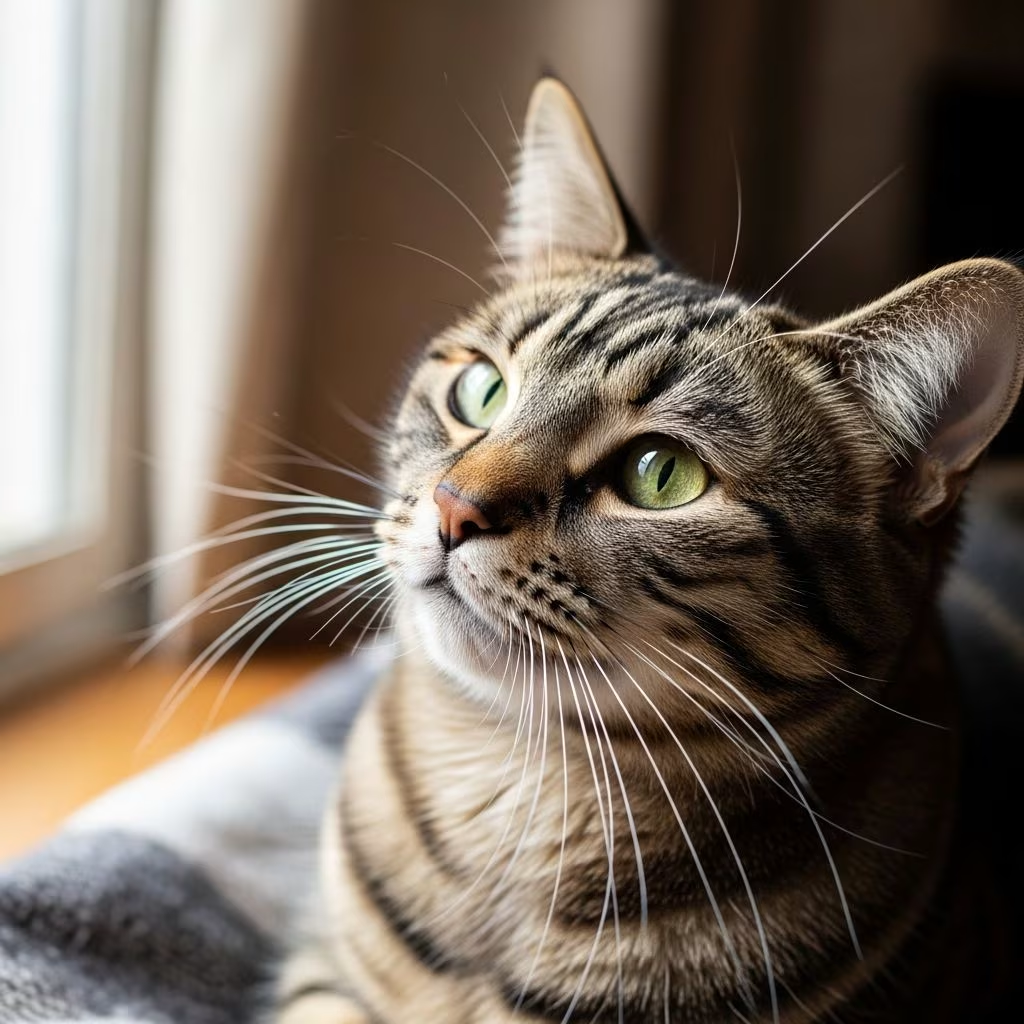
Why Do Cats Have Whiskers: Understanding Their Essential Function
Cat whiskers are far more than just charming facial features that make our feline companions look adorable. These specialized sensory organs, scientifically known as vibrissae, represent one of nature’s most sophisticated sensory systems. Whiskers are coarse, long, and widely spaced sensory hairs located around the muzzle of cats that serve multiple critical functions in their daily lives. Understanding the purpose and mechanics of whisker function can help cat owners appreciate just how remarkably adapted these animals are to their environment and improve their care of their feline friends.
What Are Cat Whiskers?
Cat whiskers are not ordinary hairs. They are specialized tactile organs made from keratin, the same protein that makes up human hair, but they are structurally quite different. Whiskers are significantly thicker than regular cat hair—more than twice as thick as ordinary hairs—and their roots are embedded three times deeper into the skin. This deeper embedding is crucial to their function as sensitive sensory receptors.
The technical name for whiskers, vibrissae, comes from the Latin word “vibissa,” which relates to their ability to vibrate and sense vibrations. Each whisker is connected to a dedicated muscle that allows cats to move them independently, giving them precise control over these sensory instruments. This muscular attachment is one of the key features that distinguish whiskers from regular fur.
The Structure and Anatomy of Cat Whiskers
The anatomy of cat whiskers is remarkably complex and designed for maximum sensory perception. Each whisker follicle is surrounded by a specialized structure containing a rich network of blood vessels and nerve endings. Specifically, each whisker follicle is innervated by 100 to 200 primary afferent nerve cells, making them extraordinarily sensitive to even the slightest touch or movement.
Within the dermal portion of the whisker follicle, there exists an endothelium-lined blood sinus between the inner and outer layers. This specialized tissue, combined with the dense nerve supply, transforms each whisker into an intricate receptor capable of detecting minute environmental changes such as air currents, fluctuations in air pressure, temperature variations, and wind direction. When a whisker moves, even slightly, it sends signals through this nerve-dense hub directly to the brain, particularly to regions responsible for tactile perception and spatial awareness.
The muscles attached to whiskers allow cats to move them backward and forward with remarkable precision. Interestingly, the bottom two rows of whiskers can move independently of the top two rows, providing cats with sophisticated control and the ability to direct their sensory perception in specific directions. Whisking movements are among the fastest produced by mammals, occurring at rates between 3 and 25 whisks per second.
Where Are Cat Whiskers Located?
While most people think of whiskers as being primarily on a cat’s face, these sensory organs are actually distributed across multiple locations on their body. This widespread distribution allows cats to gather sensory information from various points around their body, enhancing their spatial awareness and environmental perception.
Primary Whisker Locations
Muzzle Area: Cats have approximately 24 moveable whiskers on their muzzle, typically with about twelve on either side of the nose. These are arranged in four distinct rows in a highly organized pattern that is as unique as a human fingerprint. The whiskers on the upper lip are called mystacial whiskers, while those on the chin are known as mandibular whiskers. These upper lip whiskers are arranged in ordered rows of 4 to 5 hairs, with shorter whiskers in front and longer whiskers in back.
Above the Eyes: Cats have approximately three whiskers above each eye, technically called superciliary whiskers. These help protect the eyes from obstacles and debris.
Cheeks: Located on the cheeks between the upper lip and eyes are the genal whiskers. These whiskers help cats assess the width and dimensions of their surroundings.
Wrists: Perhaps the most surprising location for whiskers is on the back of the front legs at the wrist area. Called carpal whiskers, these are quite short and often overlooked but play an important role in hunting and prey detection. They help determine movement of prey and are one of the reasons cats are such successful hunters.
The Functions of Cat Whiskers
Cat whiskers serve multiple critical functions that enable cats to navigate their environment safely and effectively. The primary functions are touch sensation, spatial awareness, hunting assistance, and eye protection.
Sense of Touch and Tactile Awareness
The main function of cat whiskers is providing a highly sensitive sense of touch. The follicles from which whiskers grow are surrounded by sensory cells that transmit tactile information similar to the signals that human fingertips send to the human brain. These sensory cells are stimulated by the smallest vibrations in the hair, allowing cats to feel not only solid objects they brush against but also to notice air currents from movement nearby.
Whiskers are believed to be as sensitive as human fingertips, making them exceptionally responsive to touch. They help cats evaluate their environment up close, particularly in situations where their eyes cannot focus effectively. Cats are naturally farsighted, meaning they struggle to see things clearly at close range. Whiskers compensate for this visual limitation by providing detailed tactile information about nearby objects.
Navigation and Spatial Awareness
One of the most practical functions of whiskers is helping cats determine whether they can fit through small spaces. Whiskers tend to be the same width as a cat’s body, making them perfect measuring tools. By judging how wide a place is before entering, cats can determine if their body will fit through narrow passages such as gaps between furniture, fences, or other obstacles. This is particularly useful for cats navigating tight quarters.
However, it’s important to note that this function is genetically determined by whisker length. Cats that become overweight may lose this ability because their body width increases while their whisker length remains the same. This mismatch can lead to cats attempting to squeeze through spaces that are actually too narrow for their bodies.
Orientation and Balance
Some whisker follicle cells possess proprioceptive ability, meaning the way gravity pulls on the hair provides information about how the cat is oriented in relation to the ground. This sensory feedback is particularly important for an animal that is designed to land on its feet. Body position whiskers help cats understand how their limbs are oriented, especially when they’re mid-pounce during an attack or jump. This proprioceptive sense contributes significantly to cats’ famous agility and landing ability.
Eye Protection
Whiskers serve an important protective function for the eyes. Any touch to the whiskers causes the eyelids to blink reflexively. This automatic response helps protect the eyes from branches, insects, and other potential hazards. The whiskers essentially serve as an early warning system that triggers the protective eye-closing reflex before an object reaches the eye itself.
Hunting and Prey Detection
Hunting cats can move their whiskers back and forth to collect detailed information about their prey. The carpal whiskers on the wrists are particularly valuable for this purpose. Whiskers help hunters determine if prey is still alive so they can apply an accurate killing bite or whether it is safe to put a captured animal down. Additionally, whiskers can sense vibrations in the air, making them incredibly useful when measuring distances or chasing prey. The whiskers move into an attack position during hunting sequences, allowing cats to make precise judgments about where to deliver their bite.
Understanding Whisker Sensitivity and Fatigue
While whiskers are incredibly sensitive and valuable sensory organs, this sensitivity can sometimes become problematic. Each cat whisker follicle can be associated with as many as 100 to 200 neurons, making overstimulation a real concern. Whisker fatigue is a real issue that can occur when there is chronic, recurrent pressure on the whiskers, causing the neurons to fire in a way that overstimulates the cat.
Whisker fatigue is often associated with inappropriately sized food and water dishes. When a cat’s whiskers constantly brush against the sides of a narrow bowl while eating or drinking, it creates chronic stimulation of these sensitive nerves. This is why cats often prefer to eat and drink from wide, shallow bowls where their whiskers aren’t hitting the sides. Providing appropriately sized feeding dishes can help prevent whisker fatigue and keep your cat more comfortable during mealtimes.
Whisker Length and Genetics
The length of a cat’s whiskers is determined genetically and typically corresponds to the width of the cat’s body at a healthy weight. In large cat species, such as lions, tigers, and bobcats, whiskers can grow exceptionally long—up to five inches in some cases—giving them a wide sensing zone around their face. This expanded sensing zone helps these large predators detect movement and track air currents more effectively.
Whiskers are regularly spaced and grow in very specific locations with remarkable consistency. The arrangement follows a precise pattern that is unique to each individual cat, much like human fingerprints. The most prominent whiskers, those on the upper lip, are positioned in ordered rows with shorter whiskers in front and longer whiskers in back, creating an organized sensory array.
How Whiskers Affect Cat Behavior and Comfort
Understanding the importance of whiskers should influence how we care for our cats. Never trim or pluck a cat’s whiskers, as this removes crucial sensory information and can cause distress. A cat without full whisker function may become disoriented, anxious, or unable to navigate confidently.
Additionally, be mindful of environmental factors that might disturb whiskers. Ensure that your cat’s eating and drinking spaces have appropriately sized dishes, and try to maintain clear pathways through your home to minimize whisker contact with obstacles. Some cats may become stressed if their whiskers are constantly being touched or bent in uncomfortable ways.
Frequently Asked Questions About Cat Whiskers
Q: How many whiskers does a cat have?
A: Most cats have around 12 whiskers on each upper lip, 3 over each eye, and a few shorter ones on their chin. They also have whiskers on the back of their wrists. In total, cats typically have about 24 moveable whiskers on their muzzle alone, arranged in four distinct rows.
Q: Can cat whiskers grow back if they are cut or pulled out?
A: Yes, cat whiskers can regrow if they are damaged or trimmed. However, you should never intentionally cut or pluck a cat’s whiskers, as this removes important sensory information and can cause disorientation and stress to your cat. Whiskers will naturally regrow over time through the normal hair growth cycle.
Q: Why does my cat seem bothered when eating from narrow bowls?
A: Narrow bowls cause a cat’s whiskers to brush against the sides while eating, creating uncomfortable, chronic stimulation of these highly sensitive sensory organs. This condition, called whisker fatigue, can cause stress and discomfort. Switching to wide, shallow bowls can help prevent this problem.
Q: What is the difference between whiskers and regular cat hair?
A: Whiskers are much thicker than regular cat hair—more than twice as thick—and their roots are embedded three times deeper in the skin. Whiskers are connected to muscles, have dense nerve supplies, and contain specialized sensory receptors, making them fundamentally different from regular fur.
Q: Do all cats have whiskers in the same locations?
A: While all cats have whiskers in similar general locations (muzzle, above eyes, cheeks, and wrists), the exact arrangement and pattern is unique to each individual cat, similar to human fingerprints. The number and distribution follow consistent patterns, but slight variations exist between individual cats.
References
- Structure and Function of the Whiskers in Cats — PetPlace.com. Accessed 2025. https://www.petplace.com/article/cats/pet-health/structure-and-function-of-the-whiskers-in-cats
- Why Do Cats Have Whiskers? — PetMD. Accessed 2025. https://www.petmd.com/cat/behavior/evr_ct_why_do_cats_have_whiskers
- Cat Whiskers 101 — Zoetis Petcare. Accessed 2025. https://www.zoetispetcare.com/blog/article/cat-whiskers-101
- Whiskers — Wikipedia. Accessed 2025. https://en.wikipedia.org/wiki/Whiskers
- Why Do Cats Have Whiskers? 10 Fun Whisker Facts — Purina UK. Accessed 2025. https://www.purina.co.uk/articles/cats/behaviour/common-questions/why-do-cats-have-whiskers
- Whiskers with a Purpose: The Science of Big Cat Vibrissae — Lions Tigers and Bears. Accessed 2025. https://www.lionstigersandbears.org/whiskers-with-a-purpose-the-science-of-big-cat-vibrissae/
- Do Cats Whiskers Regrow? Understanding Feline Anatomy — TICA. Accessed 2025. https://tica.org/blogs/do-cats-whiskers-regrow-understanding-feline-anatomy/



