

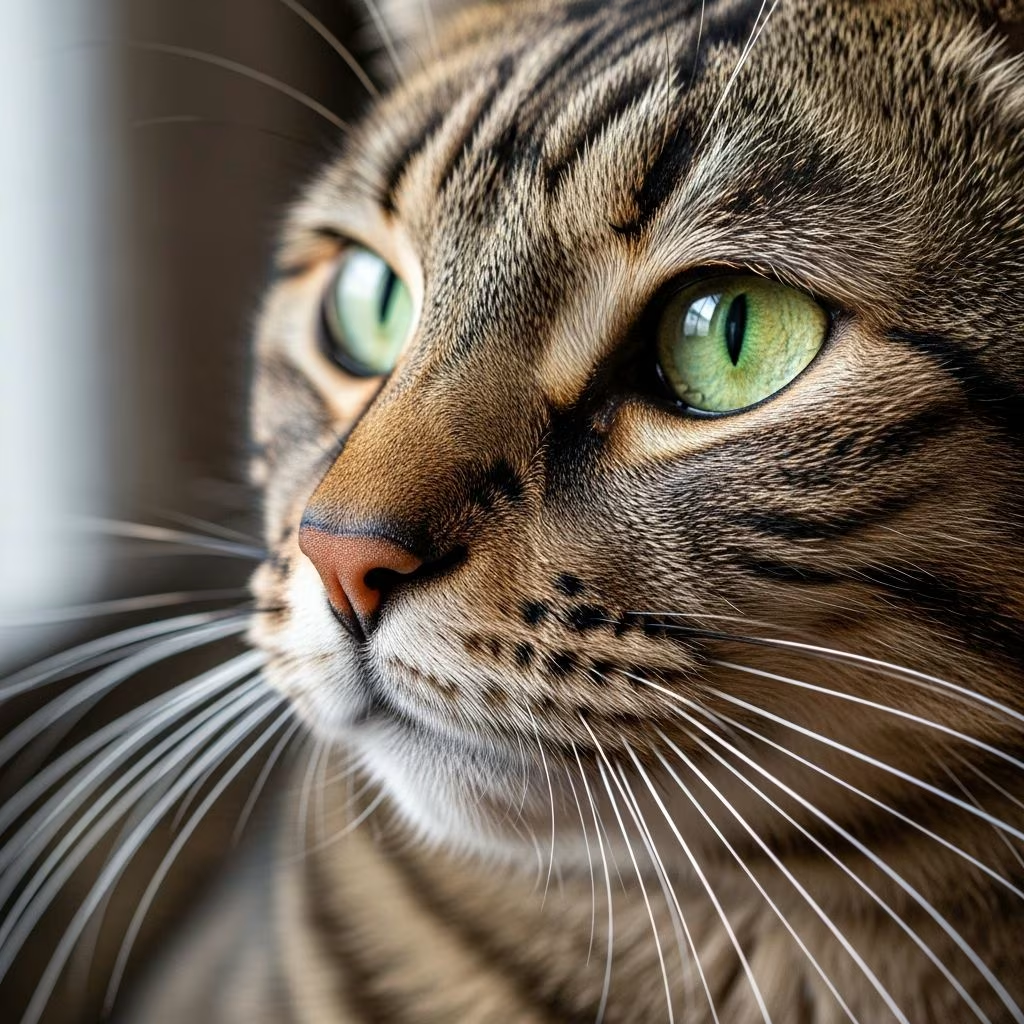
Why Do Cats Have Whiskers? Understanding Your Feline’s Most Fascinating Feature
Cat whiskers are far more than just cute facial features that make your feline friend look adorable. These specialized sensory organs, scientifically known as vibrissae, serve critical functions that help cats navigate their world, hunt prey, and communicate their emotional state. Understanding why cats have whiskers and what they do reveals just how sophisticated feline anatomy truly is.
What Are Cat Whiskers?
Whiskers are thick, long hairs that are embedded deep in a cat’s skin, quite different from regular fur. Each whisker follicle is attached to nerve endings and muscles, allowing cats to move them consciously. The tips of these specialized hairs act as highly sensitive sensors that help your cat understand and interpret the world around them. These sensory powerhouses contain as many as 100-200 neurons per follicle, making them extraordinarily responsive to even the slightest stimulation.
Where Are Cat Whiskers Located?
While most people think of whiskers as being only around a cat’s mouth, the reality is far more extensive. Cats have whiskers in multiple locations across their body, creating a sophisticated sensory network.
- Upper lip: The most prominent whiskers are located here, arranged in ordered rows of 4-5 with shorter whiskers in front and longer ones in back. Most cats have around 12 whiskers on each upper lip.
- Above the eyes: Cats typically have approximately 3 whiskers positioned above each eye.
- Jawline: Additional shorter whiskers are found along the jaw area.
- Behind the front legs: Known as carpal whiskers, these are particularly important for hunting as they help determine the movement of prey.
- Chin and wrists: A few shorter whiskers may also be present on these areas.
In total, cats usually have around 24 whiskers on their face, with the distribution being remarkably symmetrical. This bilateral symmetry ensures balanced sensory input from both sides of the body, allowing cats to make accurate spatial judgments.
The Primary Functions of Cat Whiskers
1. Built-In Measuring Tape for Navigation
One of the most important functions of cat whiskers is helping your feline navigate spaces. The whiskers around a cat’s mouth are precisely the same width as the cat’s body, making them perfectly calibrated as a sensory measuring tool. This allows cats to assess whether they can squeeze through tight spaces, around furniture, or through narrow openings without getting stuck. The whiskers essentially ask the question: “Is my body wide enough to fit through this space?”
2. Vibration and Air Current Detection
Cat whiskers function as sophisticated vibration sensors capable of detecting the tiniest movements in the air. These hairs can sense subtle changes in airflow and physical contact with objects, providing cats with an additional layer of sensory perception. Each whisker functions like an individual antenna, transmitting messages directly to the brain through a specialized nerve pathway called the infraorbital foramen. This capability is particularly valuable when cats are hunting or moving through their environment at high speeds.
3. Compensation for Poor Close-Up Vision
Cats are notoriously farsighted animals and cannot focus on anything closer than approximately 30 centimeters (about 12 inches) in front of them. This is where whiskers become essential. They compensate for this visual limitation by providing detailed tactile information about objects directly in front of the face and body. When hunting, stalking, or investigating something close up, cats rely almost entirely on whisker feedback rather than their eyes.
4. Night Vision Enhancement
Since most domestic cats are nocturnal or crepuscular (active during twilight hours), whiskers serve as vital night vision aids. The sensory information provided by whiskers allows cats to navigate through low-light conditions and environments with limited visibility. This whisker-based sensory system has been a crucial adaptation that helped cats evolve as successful nighttime hunters.
5. Spatial Awareness and Orientation
Some whisker follicle cells possess proprioceptive ability, meaning they can detect how gravity pulls on the hairs and use this information to determine how the cat is oriented in relation to the ground. This proprioceptive sense is crucial for cats’ famous ability to land on their feet during falls and helps them maintain balance while navigating uneven surfaces.
6. Hunting Excellence
Cat whiskers are integral to their hunting prowess. The carpal whiskers on the front legs help detect prey movement, while facial whiskers act like air traffic controllers as prey approaches during a hunt. When stalking and jumping at prey, whiskers help cats judge distance and make accurate directional decisions. The combination of whisker feedback with visual and auditory input allows cats to be remarkably effective predators.
What Do Your Cat’s Whisker Positions Tell You?
Beyond their physical functions, cat whiskers are expressive tools that communicate emotional states to other cats and observant owners. The position and movement of whiskers provide valuable insights into what your cat is feeling.
| Whisker Position | What It Means |
|---|---|
| Slightly drooping out to the side in a neutral position | Your cat is calm and relaxed |
| Pointing forward | Your cat is curious, alert, tense, or excited. May also indicate pain if held in this position for extended periods |
| Pushed back against the face | Your cat is worried, anxious, frightened, or feeling defensive |
| Flared outward | Your cat is content and relaxed |
When cats feel threatened or defensive, their whiskers flatten against their face as a protective measure. Conversely, when they’re enjoying themselves, their whiskers splay outward, almost like they’re smiling. By paying attention to your cat’s whisker position, you can better understand their emotional needs and respond appropriately.
Whisker Care and the Importance of Not Trimming
Whiskers are living sensory organs that naturally shed and regrow like other hairs on your cat’s body. However, it’s crucial never to trim or cut your cat’s whiskers. Cutting or damaging whiskers disrupts a cat’s sense of spatial awareness and can cause significant distress. Without intact whiskers, cats may experience disorientation, anxiety, and difficulty navigating their environment.
Additionally, overstimulation of whiskers can lead to a condition called whisker fatigue. This occurs when there is chronic, recurrent pressure on the whiskers that causes excessive firing of the neurons. Whisker fatigue is commonly associated with inappropriately sized food and water dishes that repeatedly brush against the whiskers while your cat eats or drinks. Consider using wider, shallower dishes to prevent this uncomfortable condition.
Interesting Facts About Cat Whiskers
- Each whisker can contain up to 100-200 sensory neurons, making them extraordinarily sensitive organs
- The sensory cells in whisker follicles transmit tactile information similar to signals sent by human fingertips to our brains
- Whiskers on large wild cats, such as lions and tigers, can grow up to five inches long, creating an even wider “sensing zone” around their faces
- The whisker follicles are surrounded by muscles that allow cats to move their whiskers independently and with precision
- Whiskers grow in very specific patterns and locations on a cat’s body, with remarkable symmetry between the left and right sides
- The positioning and width of whiskers appears to be genetically determined and does not change as a cat gains or loses weight
How Whiskers Enhance Your Cat’s Hunting Abilities
Cat whiskers are evolutionary adaptations that have made cats incredibly successful hunters. When cats evolved as nighttime predators, they developed the ability to see in the distance and detect far-away movement with their eyes. However, as prey gets closer—within that 30-centimeter range where cats can’t focus—whiskers take over as the primary sensory tool. They detect minute vibrations in the air caused by prey movement, allowing cats to make split-second decisions about pouncing direction and distance.
The carpal whiskers on the foreleg are particularly specialized for hunting, as they sense the movement of captured prey and help the cat determine exactly where to bite or hold. This combination of multiple sensory inputs—whisker vibration detection, auditory input, and visual cues—makes cats formidable predators capable of successfully hunting in near-total darkness.
Frequently Asked Questions About Cat Whiskers
Q: Can cat whiskers change color?
A: Yes, cat whiskers can change color over time, often becoming darker or lighter depending on the cat’s age and genetics, similar to how a cat’s fur changes throughout its life.
Q: How many whiskers does a typical cat have?
A: Most cats have approximately 24 whiskers on their face, with about 12 on each upper lip, 3 above each eye, and several shorter ones on the chin and jaw area. Additionally, they have carpal whiskers on their front legs.
Q: What is whisker fatigue?
A: Whisker fatigue is a condition caused by chronic, recurrent pressure on the whiskers that overstimulates the sensory neurons. It’s commonly caused by food and water dishes that are too small or too narrow, forcing whiskers to repeatedly brush against the bowl’s edges while eating or drinking.
Q: Do all cats have the same number of whiskers?
A: While most cats have around 24 facial whiskers, the exact number can vary slightly between individual cats. However, whiskers always grow in symmetrical pairs on both sides of the body.
Q: What should I do if my cat’s whisker is injured or pulled out?
A: If a whisker is damaged or pulled out, allow it to regrow naturally. Avoid touching the area and ensure your cat’s environment remains calm. The whisker should regrow within a few weeks. If multiple whiskers are damaged or your cat shows signs of distress, consult a veterinarian.
Q: Can whiskers grow back if cut?
A: Yes, whiskers do regrow after being cut, but cutting them can cause significant disorientation and stress to your cat. It’s best to never trim whiskers intentionally, as they serve essential sensory functions.
Conclusion
Cat whiskers are remarkable adaptations that showcase the sophisticated engineering of feline biology. Far from being merely decorative, these sensory organs are essential for navigation, hunting, spatial awareness, and emotional expression. By understanding the vital roles whiskers play in your cat’s life and recognizing what different whisker positions communicate, you can deepen your connection with your feline companion and better meet their physical and emotional needs. Remember to protect your cat’s whiskers, avoid trimming them, and use appropriately sized feeding dishes to prevent whisker fatigue. These simple gestures ensure your cat can continue to experience the world through one of their most important sensory systems.
References
- Why Do Cats Have Whiskers? — Purina UK. 2024. https://www.purina.co.uk/articles/cats/behaviour/common-questions/why-do-cats-have-whiskers
- Cats and Whiskers: FAQ — Blue Cross UK. 2024. https://www.bluecross.org.uk/advice/cat/wellbeing-and-care/why-do-cats-have-whiskers
- Vibrissae – Why do cats have whiskers, and what is their purpose? — Turpentine Creek Wildlife Refuge. 2024. https://www.turpentinecreek.org/vibrissae-why-do-cats-have-whiskers-and-what-is-their-purpose/
- Why Do Cats Have Whiskers? — PetMD. 2024. https://www.petmd.com/cat/behavior/evr_ct_why_do_cats_have_whiskers
- Whiskers — Wikipedia. 2024. https://en.wikipedia.org/wiki/Whiskers
- Whiskers with a Purpose: The Science of Big Cat Vibrissae — Lions Tigers and Bears. 2024. https://www.lionstigersandbears.org/whiskers-with-a-purpose-the-science-of-big-cat-vibrissae/
- Why Do Cats Have Whiskers? Educational Video — YouTube Educational Content. 2024. https://www.youtube.com/watch?v=GTVIuS2RIFk



