Why Do Cats Have Whiskers? Functions and Facts
Discover the fascinating science behind cat whiskers and their vital sensory functions.
Why Do Cats Have Whiskers?
Cat whiskers are far more than just decorative facial features. These remarkable sensory organs, scientifically known as vibrissae, play a crucial role in how cats navigate their world, hunt prey, and interact with their environment. Understanding the purpose and function of cat whiskers can give pet owners valuable insight into their feline companions’ behavior and needs.
What Are Cat Whiskers?
Whiskers are specialized, coarse hairs that are significantly different from regular fur. Unlike the soft hair covering a cat’s body, whiskers are made of keratin—the same protein found in human hair and animal horns—but they are substantially thicker and more rigid. Each whisker is deeply embedded in a cat’s skin, surrounded by nerve endings and blood vessels, making them incredibly sensitive sensory organs. These specialized hairs are connected to muscles that allow cats to move them independently, giving them precise control over their positioning.
Structural Characteristics of Whiskers
Cat whiskers possess unique structural properties that distinguish them from regular hair:
- Whiskers are more than twice as thick as ordinary hairs
- Their roots are embedded three times deeper into the skin
- They contain a blood sinus lined with an endothelium between the inner and outer layers of the dermal follicle
- They have a rich nerve supply that makes them intricate sensory receptors
- Each whisker is connected to muscle, allowing for independent movement
- The bottom two rows of whiskers can move independently of the top two rows
Where Are Cat Whiskers Located?
Most people are familiar with the prominent whiskers on a cat’s face, but these sensory hairs are actually distributed across multiple areas of the body. This widespread placement allows cats to gather sensory information from various parts of their body simultaneously.
Distribution of Whiskers
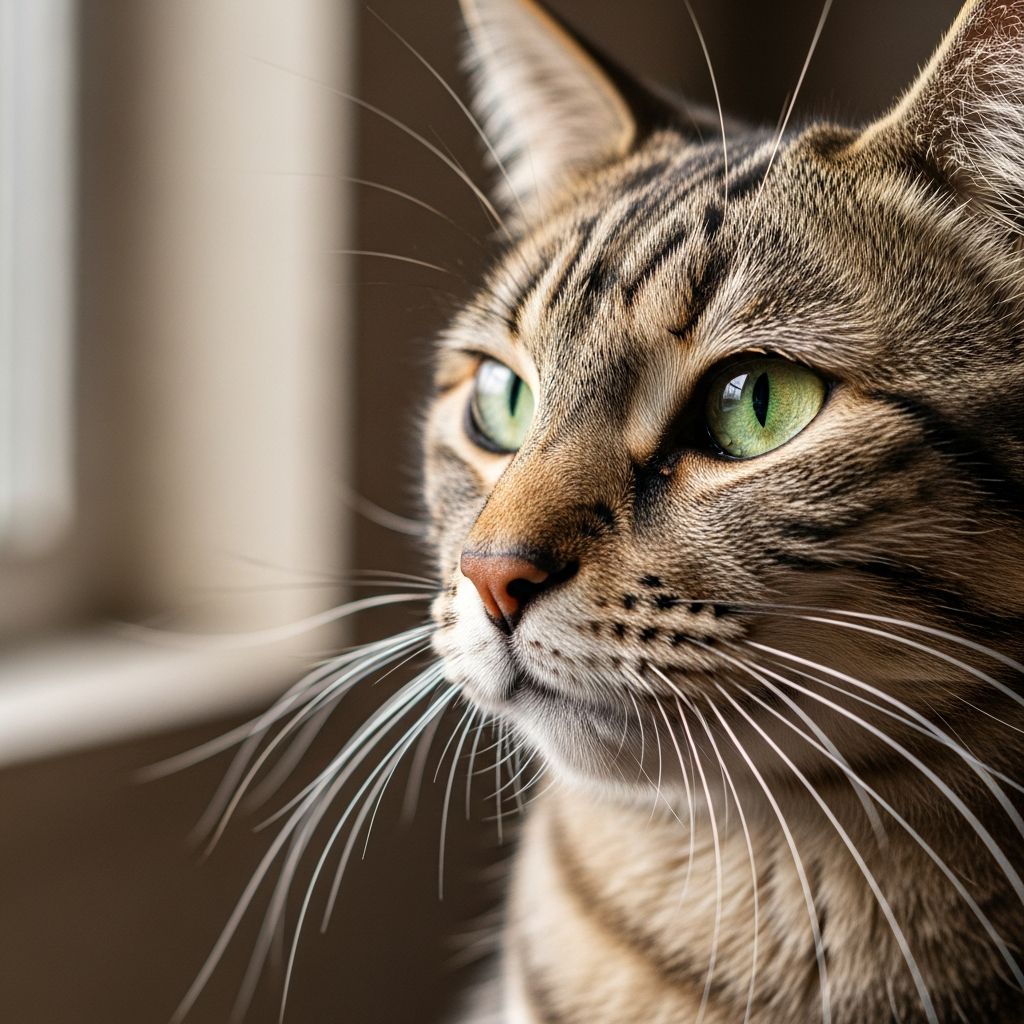
Cats have approximately 24 moveable whiskers arranged in four rows—twelve on each side of the nose. The arrangement of these whiskers is as unique as human fingerprints, with each cat having an individualized pattern. Beyond the muzzle, whiskers are also found in several other locations:
- Muzzle whiskers (Mystacial and Mandibular): Located on the upper lip and chin
- Superciliary whiskers: Positioned above each eye
- Genal whiskers: Situated on the cheeks between the upper lip and eyes
- Carpal whiskers: Found on the back of the front legs at the wrist area
These whiskers in various locations work together as an integrated sensory system, allowing cats to perceive their surroundings comprehensively.
How Do Cat Whiskers Work?
The mechanism behind cat whisker function is remarkably sophisticated. While the whisker hair itself doesn’t contain nerve endings, the follicles—the structures from which whiskers grow—are packed with nerve endings connected to a strong blood supply. This arrangement creates an exceptionally sensitive sensory apparatus.
The Sensory Process
When a whisker makes contact with an object or senses a change in air currents, the hair bends. This bending triggers signals from the nerve endings embedded deep in the follicle to the cat’s brain. The nerves send information about how far and how quickly each whisker is being bent back, creating a detailed sensory picture of the environment. This process is so sensitive that cats can detect even subtle vibrations in air currents and the slightest pressure changes in their surroundings.
The scientific name “vibrissae” comes from the Latin word “vibrio,” meaning to vibrate, reflecting the whiskers’ ability to sense and respond to vibrations. Cats can move their whiskers at rates between 3 and 25 whisks per second, and these movements are rapidly controlled in response to behavioral and environmental conditions.
Primary Functions of Cat Whiskers
Cat whiskers serve multiple essential functions that are vital to a cat’s survival, behavior, and overall quality of life.
Navigation and Spatial Awareness
One of the most important functions of cat whiskers is navigation. Whiskers are typically the same width as a cat’s body, making them perfect measuring tools. Cats use their whiskers to assess whether they can fit through tight spaces before attempting to squeeze through. By detecting the width of an opening through whisker contact, cats can make split-second decisions about their ability to pass through without getting stuck. This is particularly valuable when exploring new environments or moving through narrow passages.
In low-light conditions or complete darkness, whiskers become even more critical. They act as a sophisticated navigation system, similar to how humans use touch receptors in their fingers to navigate unfamiliar terrain in darkness.
Hunting and Prey Detection
Whiskers play a vital role in hunting success. When cats are stalking or attacking prey, they move their whiskers backward and forward to collect detailed information about their target. The exceptional sensitivity of whiskers allows cats to:
- Detect the slightest movements of potential prey
- Determine if captured prey is still alive
- Pinpoint the exact location for an accurate killing bite
- Assess whether it is safe to handle or put down captured animals
The carpal whiskers on the front legs are particularly important for hunting, as they help determine the movement of prey and allow cats to sense vibrations created by small animals.
Protection and Eye Safety
Whiskers serve a protective function for the eyes and face. Any touch to the whiskers triggers an automatic blink response, helping to protect the eyes from potential hazards. This reflex action is similar to how your eyelids automatically close when something approaches your face. Additionally, whiskers help cats avoid collisions with obstacles as they move through their environment, even in complete darkness.
Close-Up Vision Assistance
Cats have a significant blind spot directly in front of their nose. Whiskers help compensate for this limitation by providing sensory information about objects in close proximity. When prey is very close to the face, whiskers detect its presence and movement, allowing cats to accurately locate and capture their target despite the visual limitation.
Emotional Expression
Whisker position also communicates a cat’s emotional state and intentions:
- Relaxed cat: Whiskers are still and stick out sideways
- Curious or hunting: Whiskers are pushed forward
- Aggressive or frightened: Whiskers are pulled back against the face
These subtle changes in whisker position provide important signals to other cats and help owners understand their pet’s mood and emotional state.
Common Questions About Cat Whiskers
Do Cats Feel Pain When Their Whiskers Are Touched?
While whisker hair itself doesn’t contain nerve endings and cutting whiskers isn’t painful, the follicles and surrounding area are extremely sensitive. Cats are very protective of their whiskers and often resist direct contact with them. Trimming whiskers may not cause immediate pain, but it significantly impairs a cat’s sensory abilities and can cause disorientation.
Why Do Cats Avoid Bowls That Are Too Narrow?
Many cats prefer to eat and drink from wide bowls where their whiskers don’t make contact with the bowl sides. When whiskers continuously touch the bowl while eating or drinking, it can cause discomfort and stress. Providing wide, shallow bowls allows cats to eat comfortably without whisker stimulation.
What Happens If a Cat Loses Its Whiskers?
If a cat loses whiskers due to injury, accident, or necessary medical trimming (such as when treating a cheek abscess), the whiskers will regrow within approximately two months. During this regrowth period, cats may experience disorientation and difficulty assessing their surroundings accurately. They may struggle to judge distances for jumping and may be less confident in moving through narrow spaces.
Does Whisker Length Change as Cats Age?
Whisker length is genetically determined, meaning each cat’s whisker length is predetermined. However, if a cat becomes significantly overweight, the whiskers’ functionality as a measuring tool may be compromised, as they may no longer accurately represent the cat’s body width.
Caring for Your Cat’s Whiskers
As a cat owner, it’s important to respect and protect your cat’s whiskers:
- Never trim whiskers: Unless absolutely necessary for medical reasons, whiskers should never be cut or trimmed
- Avoid unnecessary contact: While gentle handling is generally fine, avoid repeatedly touching or playing with your cat’s whiskers
- Provide appropriate bowls: Use wide, shallow food and water bowls to prevent whisker contact
- Create safe environments: When rearranging furniture or creating new spaces, ensure your cat’s whiskers have appropriate clearance
- Monitor for damage: Watch for any signs of whisker damage or loss and consult a veterinarian if concerned
The Remarkable Sensitivity of Whiskers
The sensitivity of cat whiskers is comparable to the sensitivity of human fingertips. Each whisker follicle is innervated by 100 to 200 primary afferent nerve cells, which serve an even larger number of mechanoreceptors of at least eight distinct types. This extraordinary nerve density means that even the smallest deflection of a whisker hair can trigger a sensory response in the cat’s brain, creating a detailed, real-time map of the cat’s environment.
Conclusion
Cat whiskers are truly remarkable sensory organs that serve multiple critical functions in a cat’s life. From navigation and hunting to emotional expression and safety, whiskers are essential tools that enable cats to interact successfully with their world. Understanding the importance of these delicate sensory hairs can help cat owners better appreciate their pets’ abilities and provide them with appropriate care and environments. By respecting and protecting your cat’s whiskers, you’re contributing to their safety, comfort, and overall well-being.
Frequently Asked Questions (FAQs)
Q: How many whiskers does a cat have?
A: Cats have approximately 24 moveable whiskers—twelve on each side of the nose, arranged in four rows. Additionally, they have whiskers above the eyes, on the cheeks, chin, and on the backs of their front legs.
Q: Can you safely trim a cat’s whiskers?
A: While trimming whisker hair itself isn’t painful (as the hair has no nerve endings), it severely impairs a cat’s sensory abilities and causes disorientation. Whiskers should only be trimmed if medically necessary, such as when treating a cheek abscess, and will regrow within two months.
Q: Why do cats prefer wide food bowls?
A: Cats prefer wide bowls because their whiskers are sensitive. When whiskers constantly contact the sides of narrow bowls during eating or drinking, it causes discomfort and stress. Wide, shallow bowls allow cats to eat comfortably without triggering their whiskers.
Q: How do whiskers help cats see in the dark?
A: Whiskers detect vibrations, air currents, and changes in air pressure, creating a sensory picture of the environment. This sensory information allows cats to navigate effectively in complete darkness, compensating for visual limitations in low-light conditions.
Q: Do all cats have the same whisker pattern?
A: No, each cat’s whisker pattern is unique, similar to human fingerprints. The arrangement and distribution of whiskers vary from cat to cat, making each cat’s sensory configuration individualized.
Q: What does it mean when a cat’s whiskers are pushed forward?
A: When a cat’s whiskers are pushed forward, it typically indicates curiosity or hunting mode. Conversely, whiskers pulled back against the face signal aggression or fear, while relaxed whiskers sticking out sideways indicate a calm, contented cat.
References
- Structure and Function of the Whiskers in Cats — PetPlace.com. Accessed 2025. https://www.petplace.com/article/cats/pet-health/structure-and-function-of-the-whiskers-in-cats
- Whiskers — Wikipedia. 2025. https://en.wikipedia.org/wiki/Whiskers
- Cat Whiskers 101 — Zoetis Petcare. 2025. https://www.zoetispetcare.com/blog/article/cat-whiskers-101
- Why a cat’s whiskers are the bee’s knees — Pursuit, University of Melbourne. 2025. https://pursuit.unimelb.edu.au/articles/why-a-cat-s-whiskers-are-the-bee-s-knees
- 10 Fascinating Facts About Cat Whiskers — PetMD. 2025. https://www.petmd.com/cat/general-health/facts-about-cat-whiskers
- Why Do Cats Have Whiskers? 10 Fun Whisker Facts — Purina UK. 2025. https://www.purina.co.uk/articles/cats/behaviour/common-questions/why-do-cats-have-whiskers
- Cat Whiskers 101: The Remarkable Sensory Organs of Felines — McGehee Clinic. 2025. https://mcgeheeclinic.com/blog/cat-whiskers/
Similar Articles







Read full bio of medha deb