

Why Do Cats Have Whiskers: The Complete Guide
Cat whiskers are far more than cute facial features. These remarkable sensory organs, scientifically known as vibrissae, play a crucial role in how cats navigate the world, hunt prey, and communicate their emotions. Understanding why cats have whiskers provides insight into feline behavior and helps us appreciate the sophisticated sensory systems that make cats such efficient hunters and adaptable pets.
What Are Whiskers?
Whiskers are thick, long, flexible hairs that are fundamentally different from regular fur. Unlike ordinary hair, whiskers are deeply embedded in a cat’s skin, with follicles that connect directly to the muscular and nervous system. Each whisker follicle is surrounded by sensitive nerve endings and can be associated with as many as 100 to 200 neurons, making them extraordinarily sensitive sensory organs. The tips of these hairs act as sensors, allowing cats to detect minute vibrations and changes in their environment with remarkable precision.
Where Are Cat Whiskers Located?
Many people assume whiskers are only found around a cat’s mouth, but this is actually a misconception. Whiskers appear in multiple strategic locations on a cat’s body, each serving specific sensory purposes.
Facial Whiskers
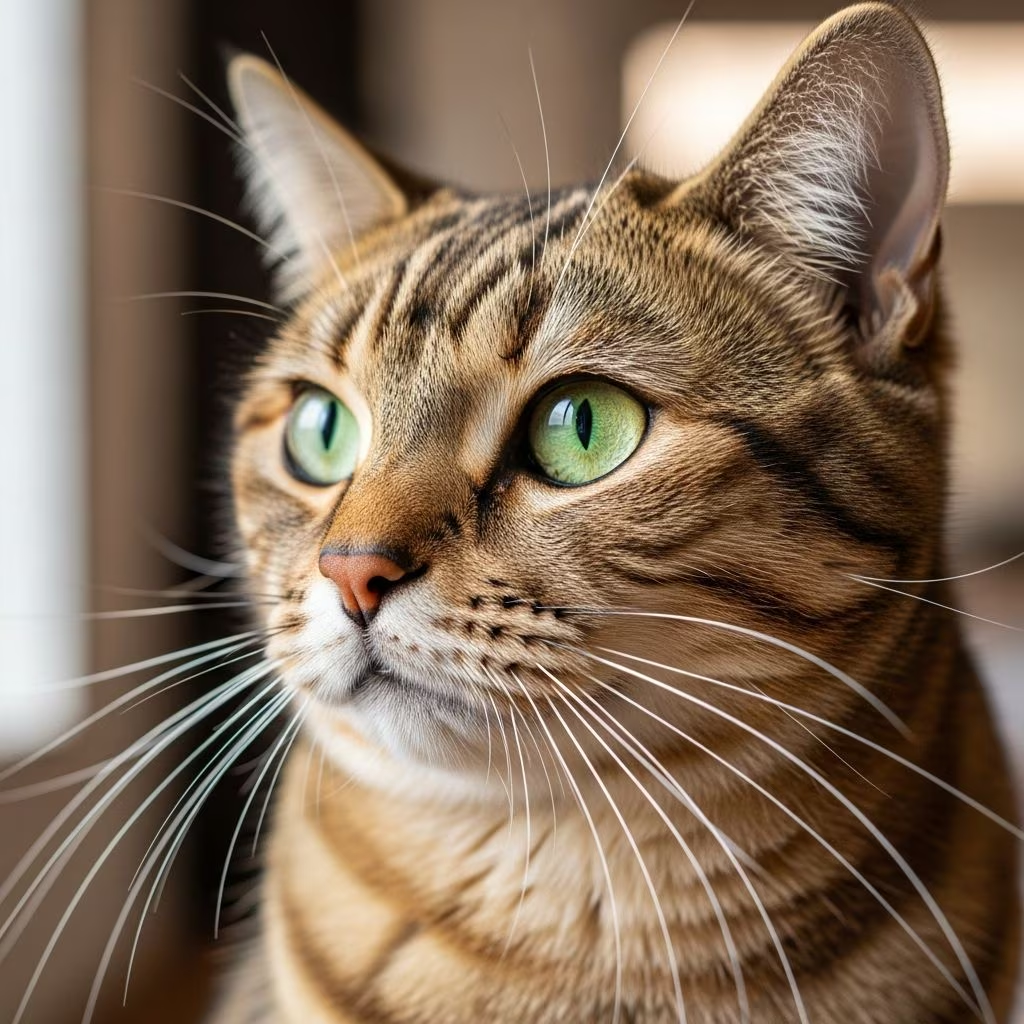
The most prominent whiskers are located on a cat’s muzzle, arranged in ordered rows of 4 to 5 hairs. Most cats have approximately 12 whiskers on each upper lip, with shorter whiskers in front and longer ones in back. These upper lip whiskers are typically the same width as a cat’s body, making them perfectly calibrated for measuring spaces and distances.
Additional Whisker Locations
Beyond the mouth, cats have whiskers in several other locations:
- Above the eyes: approximately 3 whiskers over each eye
- On the chin: shorter whiskers beneath the lower jaw
- Near the ears: whiskers positioned around the ear area
- On the forelegs: carpal whiskers on the back of the front legs and wrists
The distribution of whiskers is remarkably symmetrical, reflecting the organized nature of feline sensory systems. The forelegs whiskers are particularly important for hunting, as they help cats determine the movement and location of prey.
The Primary Functions of Cat Whiskers
Sensory Detection and Touch
The main function of cat whiskers is providing a sophisticated sense of touch. The sensory cells surrounding whisker follicles transmit tactile information similar to signals sent by human fingertips to the brain. These cells are stimulated by the smallest vibrations in the whisker hair, allowing cats to feel not only solid objects they brush against but also to detect air currents created by nearby movement. This capability is essential for cats’ survival and daily functioning.
Navigation in Close Spaces
Cats cannot focus on anything closer than approximately 30 centimeters in front of them, making close-range navigation challenging without additional sensory input. Whiskers solve this problem by serving as built-in measuring devices. Because whiskers extend to roughly the width of a cat’s body, they help felines judge whether they can fit through narrow openings, doorways, and confined spaces. As cats move through their environment, their whiskers constantly scan the surroundings, with nerve signals providing real-time information about objects’ size, shape, and proximity.
Hunting and Prey Detection
The sensitivity of whiskers is invaluable during hunting. These sensory hairs can detect the slightest movement, such as the scurrying of a mouse or the flutter of a bird’s wings. When stalking and pouncing on prey, whiskers function like air traffic controllers, guiding cats to accurately position their mouth and claws for capture. The whiskers help bring prey within the cat’s grasp with remarkable precision, ensuring successful hunting even in low-light conditions.
Vision Support at Close Range
While cats have excellent distance vision, whiskers compensate for their poor close-up vision. This sensory input allows cats to better evaluate their environment at close range, avoid threats to their eyes and face (such as branches and insects), and hunt more effectively at night. The whiskers essentially extend the cat’s visual capabilities by providing tactile feedback about nearby objects.
Nighttime Navigation
Cats are naturally nocturnal animals, and whiskers are crucial for their ability to navigate in darkness. The sensitivity of these hairs allows cats to detect obstacles and navigate environments with minimal or no light, making them exceptional nighttime hunters and explorers.
Sense of Orientation
Some whisker follicle cells possess proprioceptive ability, meaning that gravity’s pull on the hair provides information about a cat’s orientation relative to the ground. This sensory feedback is particularly important for cats’ famous ability to land on their feet, as the whiskers help maintain balance and spatial awareness during falls and acrobatic movements.
Collision Prevention
As cats move through their environment, whiskers constantly scan for obstacles. The nerves at the whisker bases send information to the brain about surrounding objects, helping cats avoid collisions even in complete darkness. This function is especially valuable in unfamiliar environments or when moving quickly through spaces.
Whiskers and Emotional Communication
Beyond their sensory functions, cat whiskers play a significant role in emotional expression and communication. Tiny muscles located around the base of each whisker allow cats to consciously move and position them, making whiskers an effective indicator of emotional state.
Reading Your Cat’s Mood Through Whiskers
Understanding what your cat’s whisker position reveals about their emotional state can improve your relationship with your pet:
- Relaxed and Calm: Whiskers are slightly drooped out to the side in a neutral position, indicating contentment and relaxation
- Curious or Alert: Whiskers point forward, suggesting your cat is interested, curious, alert, or excited about something
- Tense or Hunting: Forward-pointing whiskers may also indicate that your cat is in hunting mode or experiencing tension
- Fearful or Anxious: Whiskers pulled back against the face suggest worry, anxiety, or fear
- Stressed or Unwell: A cat that doesn’t feel well may pull their whiskers back against their face in a grimace-like position
- Aggressive: Whiskers pulled back can also signal aggression or defensive behavior
These whisker positions serve as a form of communication with other cats and with observant owners, conveying the cat’s current emotional state and intentions.
Common Whisker Characteristics and Facts
Whisker Count and Distribution
Most cats have around 24 whiskers on their face, distributed in a highly organized pattern. The arrangement is so consistent that whiskers are typically positioned in ordered rows with remarkable symmetry. In addition to the 12 whiskers on each upper lip and 3 above each eye, cats usually have a few shorter whiskers on the chin and back wrists.
Whisker Color and Changes
Cat whiskers can change color throughout a cat’s lifetime. Kittens are often born with light-colored whiskers that may darken as they mature. Additionally, whiskers may change color as cats age, sometimes becoming lighter or white, particularly in senior cats.
Whisker Sensitivity and Fatigue
Each whisker follicle’s association with 100 to 200 neurons makes them incredibly sensitive. However, this sensitivity also means that whiskers can become overstimulated through chronic, recurrent pressure—a condition known as whisker fatigue. Whisker fatigue is frequently caused by food and water dishes that are too small or deep, causing constant whisker contact during eating and drinking. This overstimulation can lead to stress and behavioral changes in cats.
The Importance of Whisker Care
Never Trim Whiskers
One of the most important rules of cat care is to never trim, cut, or pluck a cat’s whiskers. Removing whiskers can severely disrupt a cat’s sensory system, causing disorientation, anxiety, and reduced ability to navigate safely. Without their whiskers, cats become vulnerable to injury and stress. Whiskers naturally shed and regrow, so trimming is never necessary and is actually harmful.
Preventing Whisker Fatigue
To keep your cat comfortable and prevent whisker fatigue, provide appropriately sized food and water dishes. Wide, shallow bowls are preferable to deep or narrow ones, allowing your cat to eat and drink without their whiskers contacting the dish sides repeatedly. Elevated feeders can also help reduce whisker contact during meals.
Comparing Whisker Functions Across Sensory Tasks
| Function | Primary Whisker Locations | Importance Level |
|---|---|---|
| Close-range Navigation | Muzzle and facial whiskers | Critical |
| Prey Detection and Hunting | Muzzle, forelegs, and chin | Critical |
| Obstacle Avoidance | All facial whiskers | High |
| Balance and Orientation | All whisker locations | High |
| Emotional Communication | Muzzle whiskers primarily | Moderate |
Frequently Asked Questions About Cat Whiskers
Q: Can cat whiskers grow back if they fall out?
A: Yes, cat whiskers naturally shed and regrow throughout their lifetime, similar to regular hair. However, intentionally cutting or pulling whiskers should never be done, as this can cause immediate sensory disruption and stress.
Q: Why does my cat have different-length whiskers?
A: The variation in whisker length is intentional. Cats have shorter whiskers in the front rows and longer whiskers in the back rows on each side. This arrangement provides optimal sensory coverage. Additionally, whisker length is genetically determined and typically matches the width of the individual cat’s body.
Q: How do whiskers help cats land on their feet?
A: Whiskers provide proprioceptive feedback through gravity’s pull on the hairs, telling the cat’s brain the body’s orientation relative to the ground. Combined with inner ear balance mechanisms, this allows cats to adjust their body position mid-fall and land safely on their feet.
Q: What is whisker fatigue, and how can I prevent it?
A: Whisker fatigue occurs when whiskers are repeatedly stimulated by chronic contact with food or water bowl edges. Prevent this by using wide, shallow bowls that allow plenty of space around the whiskers during eating and drinking. Elevated feeders can also help.
Q: Do all cats have the same number of whiskers?
A: Most cats have approximately 24 whiskers distributed consistently across their face, but there can be slight variations between individual cats. The number and arrangement follow a general pattern, with roughly 12 per upper lip, 3 above each eye, and additional whiskers on the chin and forelegs.
Q: Why do cats’ whiskers point backward when they’re scared?
A: When cats pull their whiskers back against their face, it’s a defensive posture indicating fear, anxiety, or aggression. This positioning is controlled by the small muscles at the base of each whisker and communicates the cat’s emotional state to other animals and people.
References
- Why Do Cats Have Whiskers? 10 Fun Whisker Facts — Purina UK. 2024. https://www.purina.co.uk/articles/cats/behaviour/common-questions/why-do-cats-have-whiskers
- Cats and Whiskers: FAQ — Blue Cross. 2024. https://www.bluecross.org.uk/advice/cat/wellbeing-and-care/why-do-cats-have-whiskers
- Cat Whiskers 101: The Remarkable Sensory Organs of Felines — McGehee Clinic. 2024. https://mcgeheeclinic.com/blog/cat-whiskers/
- Why Do Cats Have Whiskers? — PetMD. 2024. https://www.petmd.com/cat/behavior/evr_ct_why_do_cats_have_whiskers
- Whiskers — Wikipedia. 2024. https://en.wikipedia.org/wiki/Whiskers



