

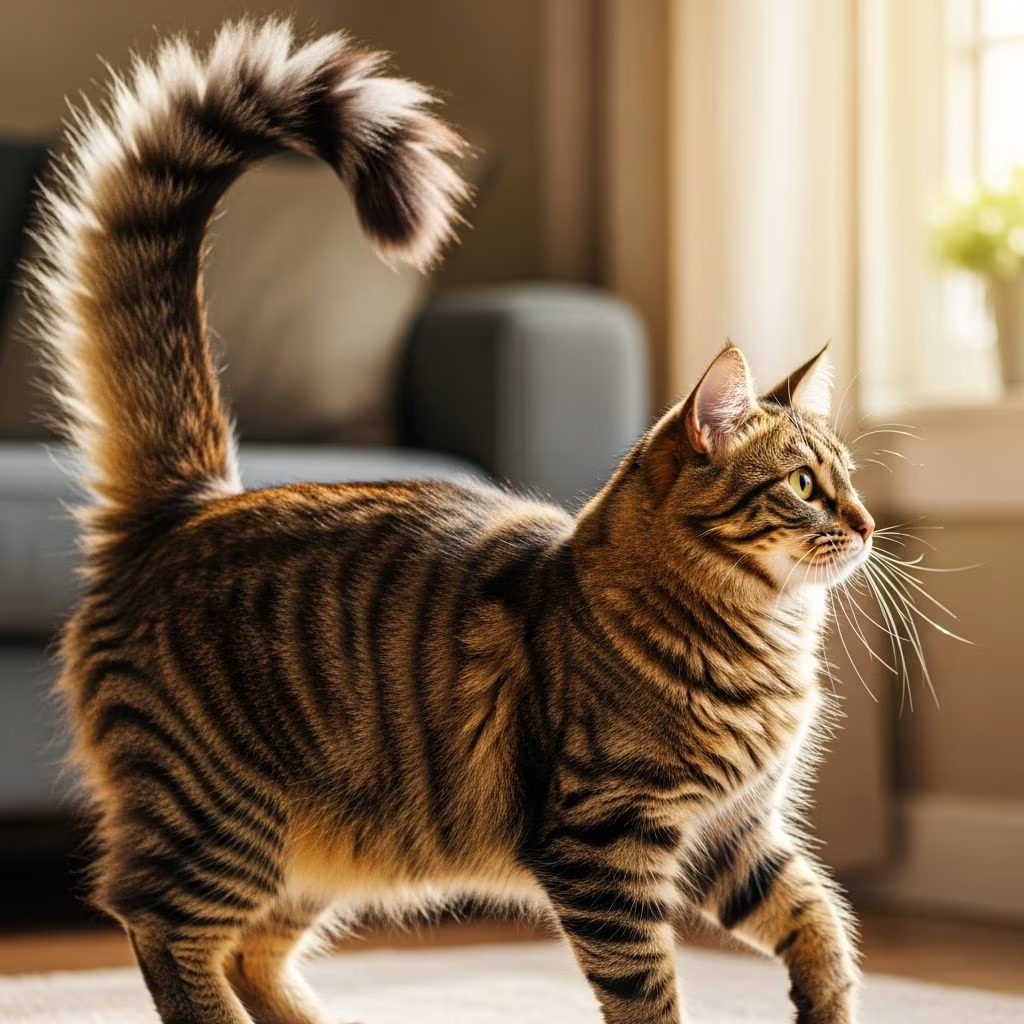
Cats possess tails as a crucial anatomical feature that enhances their survival, communication, and movement. These flexible appendages, composed of multiple vertebrae, muscles, and nerves, serve multifaceted roles from maintaining balance during leaps to expressing emotions through subtle movements.
What Is a Cat’s Tail?
A cat’s tail is the elongated extension at the end of the vertebral column, marking the hindmost part of the backbone. It consists of up to 20-23 caudal vertebrae in long-tailed breeds, which are smaller toward the tip and enclosed by versatile musculature for precise control. These vertebrae connect via soft discs, allowing flexibility, while surrounding muscles, tendons, and nerves—four to seven paired nerves—enable intricate motions like lifting, swaying, or curling.
The tail’s structure includes key muscles such as M. sacrocaudalis dorsalis medialis (SDM), lateralis (SDL), coccygeus lateralis (CL), medialis (CM), sacrocaudalis ventralis lateralis (SVL), and medialis (SVM). These facilitate dorsal bending (SDM/SDL), lateral curving (SDL/CL/CM/SVL), ventral bending (SVL/SVM), and rolling (CL/CM). Blood vessels and nerves extend from the spine, making the tail sensitive and integral to overall feline health.
Why Do Cats Have Tails? 7 Important Reasons
Cat tails evolved for essential functions in the wild and domestic life. Here are the primary reasons:
- Balance and Agility: The tail acts as a counterbalance during high-speed chases, jumps, and sharp turns. Accounting for about 10% of a cat’s bones, it adjusts position mid-air to ensure safe landings, with elastic discs cushioning impacts.
- Communication: Tails convey emotions—upright for greeting, swishing for irritation, puffed for fear. Subtle flicks signal playfulness or hunting focus, aiding social interactions.
- Protection: In confrontations, cats raise and puff tails to appear larger, deterring predators. It also shields the hindquarters and anus.
- Scent Marking: Tails spread pheromones from anal glands during rubbing, marking territory invisibly.
- Thermoregulation: Cats wrap tails around bodies for warmth or fan them to cool off.
- Expression and Mood: Position indicates confidence (high tail), submission (tucked), or aggression (lashing).
- Navigation Aid: Helps in tight spaces and precise movements, enhancing spatial awareness.
Do All Cats Have Tails?
No, certain breeds lack tails or have stumpy ones due to genetic mutations. The Manx cat, originating from the Isle of Man, exemplifies this with its tailless (rumpy), stubby (stumpy), or long-tailed variations caused by the dominant M gene, which can lead to spinal issues if homozygous.
Other tailless or bobtailed breeds include:
- Japanese Bobtail: Naturally short, pom-pom-like tail; ancient breed from Japan.
- American Bobtail: Medium-length bobtail, rugged appearance.
- Kyoto Shorthair (Kurilian Bobtail): Curled, flexible short tail.
- Pixie-Bob: Bobbed tail mimicking wild lynx.
Tailless cats compensate using body language but may face higher injury risks or balance challenges.
Cat Tail Anatomy
The tail extends the spine with 19-23 caudal vertebrae (vs. human’s 3-5 fused coccyx), largest at the base and tapering. Muscles originate from lumbar vertebrae, sacrum, and pelvic diaphragm, inserting via tendons for segmented control.
| Component | Description | Function |
|---|---|---|
| Vertebrae | 19-23 caudal bones, interspaced with discs | Flexibility and structure |
| Muscles | SDM, SDL, CL, CM, SVL, SVM | Bending, curving, rolling |
| Nerves | 4-7 paired nerves | Movement control, sensation |
| Blood Vessels | Extending from spine | Nourishment, sensitivity |
This setup allows rapid, strong movements via long tendons in SDL and SVL.
Cat Tail Injuries
Tails are prone to trauma from slams, fights, or falls, risking nerve damage, fractures, or degloving (skin stripping). Symptoms include limp tail, swelling, bleeding, or dragging. As a spinal extension, injuries can cause incontinence or paralysis.
Common issues:
- Fractures: Broken vertebrae from impacts.
- Nerve Damage: ‘Limp tail’ from compression.
- Infections: From bites or wounds.
What to Do if Your Cat Hurts Their Tail
Immediate first aid: Isolate, prevent licking, clean wounds gently, and apply cold compress for swelling. Monitor for dragging, urine issues, or pain. Seek veterinary care promptly—X-rays diagnose fractures; treatments range from splints to amputation for severe cases.
Prevention: Supervise outdoors, trim claws, avoid tail-stepping.
Conclusion
Cat tails are marvels of evolution, integral to balance, expression, and protection. Understanding their anatomy and functions helps owners appreciate and safeguard this vital feature, ensuring their feline companions thrive.
Frequently Asked Questions
Q: Why do cats have tails?
A: Cats have tails primarily for balance during movement, communication of emotions, protection, and scent marking, with up to 23 vertebrae enabling precise control.
Q: Do cats have bones in their tails?
A: Yes, long-tailed cats have 19-23 caudal vertebrae bones, decreasing in size toward the tip.
Q: What does it mean when a cat’s tail is puffed up?
A: A puffed tail signals fear or aggression, making the cat appear larger to threats.
Q: Can cats live without tails?
A: Yes, tailless breeds like Manx adapt, though they may have minor balance adjustments.
Q: How many muscles control a cat’s tail?
A: Key tail muscles include six main pairs like SDM, SDL, enabling complex motions.
Q: What should I do for a broken cat tail?
A: Provide first aid, restrict movement, and consult a vet for imaging and treatment.
References
- Structure and Function of the Tail in Cats — PetPlace.com. Accessed 2026. https://www.petplace.com/article/cats/pet-health/structure-and-function-of-the-tail-in-cats
- Anatomical structure and action of the tail muscles in the cat — PubMed (J Vet Med Sci). 1994-01-01. https://pubmed.ncbi.nlm.nih.gov/7696400/
- Do Cats Have Bones in Their Tails? Feline Anatomy Explained — Catster.com. Accessed 2026. https://www.catster.com/cat-health-care/do-cats-have-bones-in-their-tails/
- First Aid for Tail Injuries in Cats — VCA Animal Hospitals. Accessed 2026. https://vcahospitals.com/know-your-pet/first-aid-for-injured-tails-in-cats
- Cat anatomy — Wikipedia (informed by primary sources). Accessed 2026. https://en.wikipedia.org/wiki/Cat_anatomy
- Cat Anatomy Guide — Cats.com. Accessed 2026. https://cats.com/cat-anatomy-guide



