

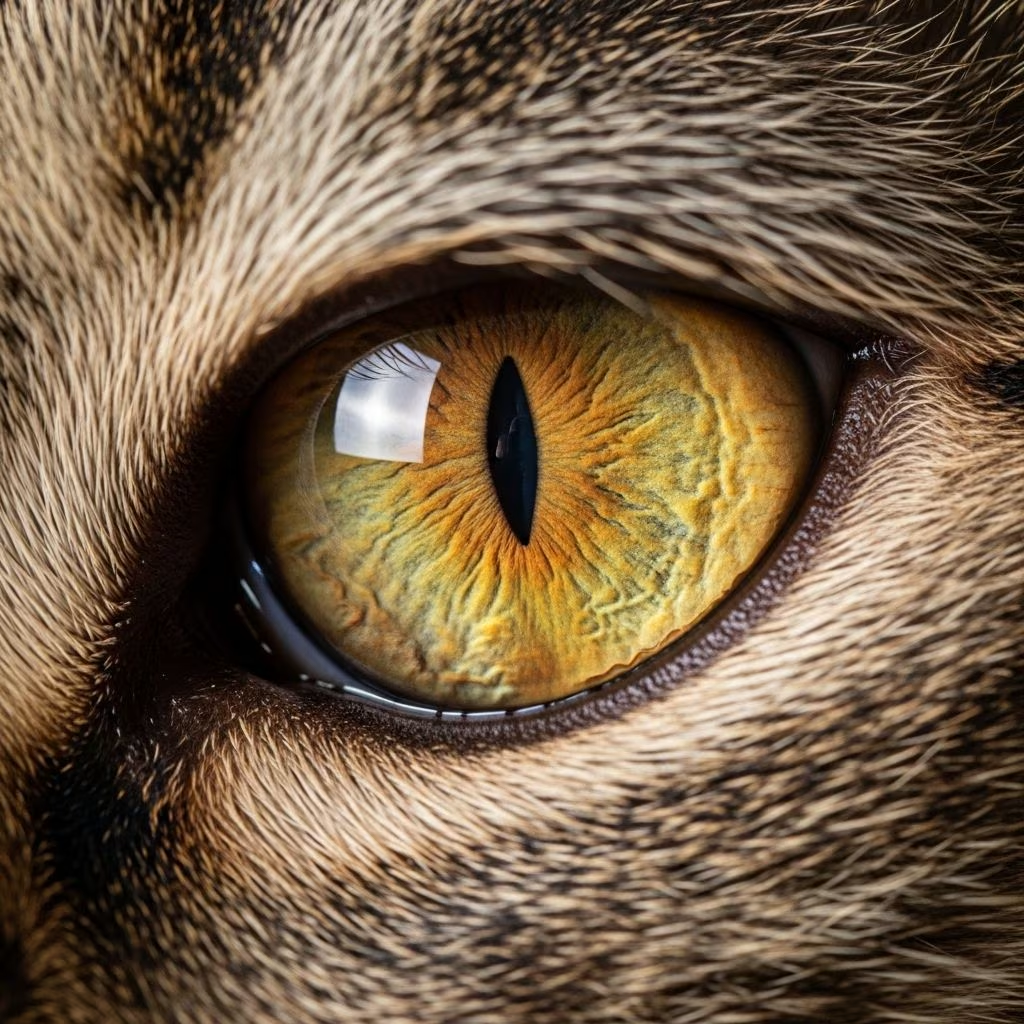
Cats possess vertical slit pupils as a key evolutionary adaptation for their role as ambush predators. This shape allows precise light control, enhanced depth perception, and superior vision in varying light conditions, particularly during dawn and dusk when they hunt most actively.
Structure of the Feline Eye
The feline eye shares basic similarities with human eyes but features specialized adaptations for predation and low-light vision. Key components include the sclera (white outer layer), iris (colored part surrounding the pupil), and cornea (protective front layer larger than in humans for increased light intake).
Behind the retina lies the tapetum lucidum, a reflective layer that amplifies available light, boosting night vision up to six times better than humans. Cats have more rod cells than cones in their retinas, prioritizing motion detection and low-light sensitivity over color perception; they likely see colors akin to human red-green color blindness.
The pupil, centrally located in the iris, is uniquely vertical and slit-shaped in cats. It dynamically adjusts from a narrow slit in bright light to nearly circular when dilated, offering a 135- to 300-fold area change—far surpassing the 15-fold range of human round pupils.
- Sclera: Protective white outer layer, similar to humans.
- Iris: Controls pupil size and light entry.
- Cornea: Larger in cats for greater light refraction.
- Retina: Rod-rich for low light; tapetum lucidum enhances photon capture.
- Pupil: Vertical slit for precise dilation/constriction.
Why Do Cats Have Vertical Slit Pupils?
Cats’ vertical slit pupils evolved primarily because they are crepuscular ambush predators—active at twilight. This shape provides evolutionary advantages in light regulation, hunting accuracy, and environmental adaptation.
Light Control and Dynamic Range
The slit pupil excels at managing light intake across extremes. In dim conditions, it dilates widely (nearly round) to capture maximal light for hunting rodents in grass. In bright daylight, it constricts to a thin vertical slit, preventing retinal overload and dazzle.
Vertical slits use specialized lateral muscles for constriction, achieving greater area modulation than circular pupils. This 135-fold (cats) to 300-fold (some reptiles) change supports vision from near-total darkness to full sun, ideal for cats’ active periods.
| Pupil Type | Max Area Change | Best For |
|---|---|---|
| Vertical Slit (Cats) | 135–300x | Low-to-bright light hunting |
| Round (Humans/Lions) | 15x | Consistent daylight |
Depth Perception and Hunting Precision
Vertical slits enhance stereopsis (binocular depth perception) and defocus blur cues. The slit creates astigmatic depth of field: sharper focus on vertical contours (prey bodies) versus horizontal ones (ground), aiding distance judgment for pouncing.
Studies show slit-pupiled predators are typically small, ground-level ambushers (shoulder height <42 cm), like cats, foxes, and geckos. Larger predators like lions have round pupils suited to open habitats.
- Stereopsis: Forward-facing eyes combine inputs for 3D distance estimation.
- Defocus Blur: Vertical contours stay sharp at varying distances; horizontals blur to signal range.
- Ambush Advantage: No head movement needed; pupils sharpen prey focus stealthily.
Crepuscular Lifestyle Fit
Cats hunt during crepuscular hours (dawn/dusk), when prey is active but light is low. Slit pupils maximize this niche: wide dilation for night stalks, tight slits for daytime without blindness.
This contrasts with diurnal herbivores (round pupils) or nocturnal burrowers (horizontal pupils).
How Slit Pupils Differ from Round Pupils
Round pupils (humans, dogs, big cats) offer uniform light control but limited range. Slit pupils provide finer granularity, especially vertically, aligning with prey orientation.
In constriction, slits keep lens periphery active for image quality, unlike rounds that occlude edges. This maintains acuity in bright conditions.
Slit Pupils in Other Animals
Vertical slits characterize small ambush predators: domestic cats, foxes, some snakes, geckos. Horizontal pupils suit prey animals (sheep, goats) for panoramic vision; round pupils fit larger/open-habitat predators (lions, eagles).
| Pupil Shape | Typical Animals | Adaptation |
|---|---|---|
| Vertical Slit | Cats, foxes, geckos | Ambush predation, depth cueing |
| Horizontal | Sheep, octopuses | |
| Round | Humans, lions, eagles | Balanced all-day vision |
Common Misconceptions About Cat Pupils
- Myth: Slits mean anger. Pupils reflect light/arousal, not just emotion.
- Myth: All cats have slits. Big cats have rounds; size/activity differs.
- Myth: Better than human vision overall. Superior low-light/motion; weaker color/acuity.
Frequently Asked Questions (FAQs)
What are cat pupils called?
Vertical slit pupils, adapted for predation.
Why do cats’ pupils change size?
To regulate light: wide in dark, slit in light.
Do all cats have slit pupils?
Domestic/small wild cats yes; lions/tigers have round.
Can cats see in complete darkness?
No, but 6x better low light via tapetum/pupils.
Why vertical, not horizontal?
Aligns with vertical prey contours for sharp focus.
Final Thoughts
Vertical slit pupils are an evolutionary masterpiece for cats as crepuscular predators. They deliver unmatched light control (135x range), precise depth perception via astigmatism, and blur-reduced focus on prey. This adaptation sharpens hunting success from twilight ambushes to daytime patrols, distinguishing cats from round-pupiled kin.
Understanding this anatomy reveals why cats’ eyes glow with predatory prowess—nature’s design for survival.
References
- Why Do Cats Have Slit Pupils? Feline Anatomy Explained (Vet Reviewed) — Catster. 2023. https://www.catster.com/lifestyle/why-do-cats-have-slit-pupils/
- What that Distinctive Vertical Slit in Your Cat’s Eye Is About — NutriSource Pet Foods. 2023. https://nutrisourcepetfoods.com/blog/what-that-distinctive-vertical-slit-in-your-cats-eye-is-about/
- Why Do Cats Have Vertical Pupils? The Hunt’s the Thing — Fear Free Happy Homes. 2023. https://www.fearfreehappyhomes.com/why-do-cats-have-vertical-pupils-the-hunts-the-thing/
- Why do animal eyes have pupils of different shapes? — PMC (Peer-Reviewed). 2015-11-18. https://pmc.ncbi.nlm.nih.gov/articles/PMC4643806/
- Why do cats have vertical pupils? – Emma Bryce — TED-Ed/YouTube (Educational). 2016. https://www.youtube.com/watch?v=jdrNjHPYKz4



