

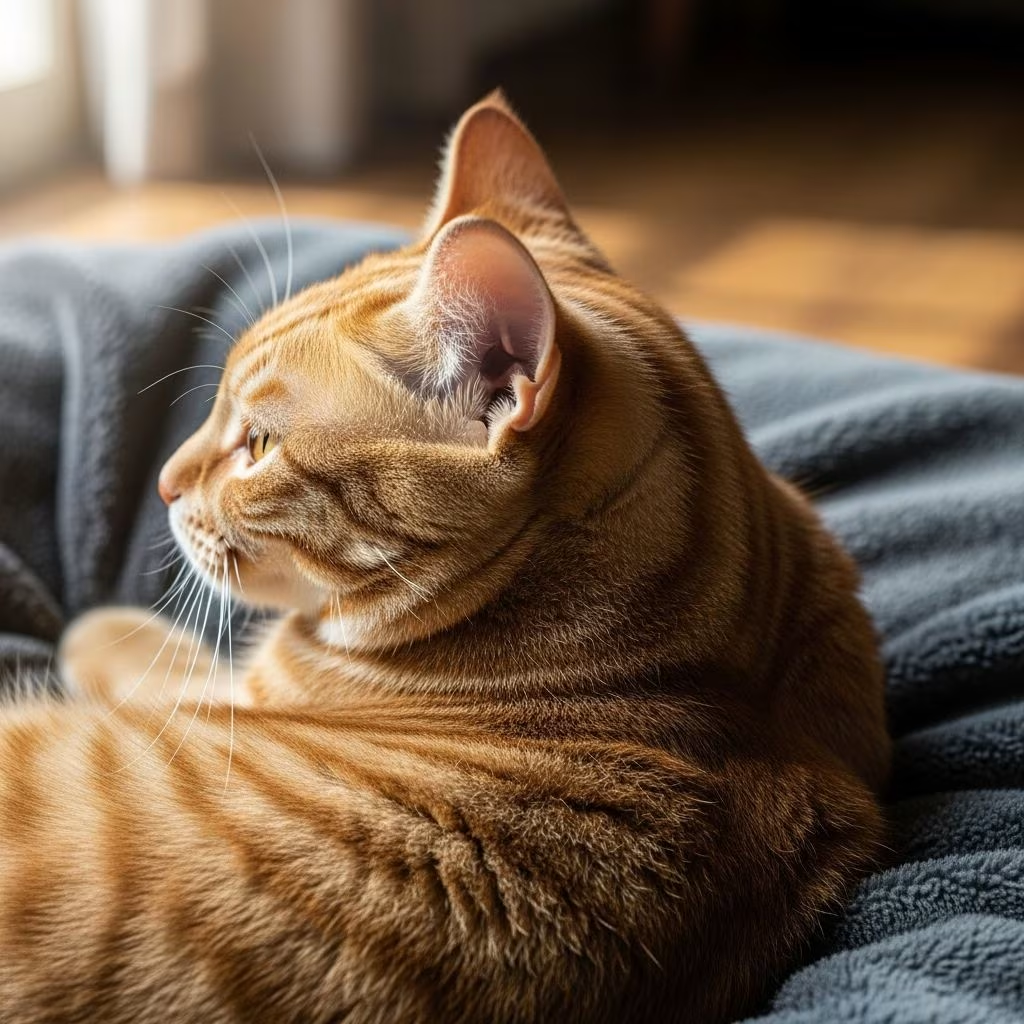
The little fold of skin at the base of your cat’s ear, known as **Henry’s pocket**, captivates many cat owners with its quirky appearance and mysterious purpose. Formally called the cutaneous marginal pouch, this feature sits on the lower posterior part of the external ear, resembling a small pouch.
While its exact function remains unknown, theories suggest it enhances cats’ exceptional hearing, aiding in hunting high-pitched prey sounds. All domestic cats possess this trait, making it a universal aspect of feline anatomy worth understanding for better pet care.
What Is Henry’s Pocket?
Henry’s pocket is a distinct fold of skin located on the inner edge of the cat’s ear flap, or pinna, near its base. Positioned approximately where the human antitragus would be, it forms an open pouch that’s particularly prominent in cats.
This structure is not unique to felines but is most noticeable in them compared to other animals. It’s soft, vertical, and often overlooked until pointed out, yet it adds to the charm of a cat’s expressive ears.
Named possibly after the unit of electrical inductance ‘henry’ due to sound wave associations, or simply as a whimsical moniker, its origins are anecdotal rather than scientific.
Cat Ear Anatomy 101
Cats boast incredibly advanced ears tailored for predation. Each ear contains **32 muscles**, nearly double that of most dogs, enabling independent rotation up to 180 degrees for precise sound localization.
The **pinna**, the visible flap, funnels sound waves into the ear canal. Cats hear frequencies from 48 Hz to 85 kHz—an octave higher than dogs and 1.5 octaves above humans—ideal for detecting rodent calls at 22-70 kHz.
Key components include:
- Pinna: Collects and directs sound; home to Henry’s pocket.
- External auditory canal: Lined with hair and glands to trap debris.
- Middle ear: Houses ossicles for sound amplification; connects via Eustachian tube for pressure regulation.
- Inner ear: Processes balance and hearing; produces cerumen (earwax) for protection.
These adaptations make cats superior hunters, with ears swiveling like radar dishes.
What Is the Function of Henry’s Pocket?
Despite extensive observation, Henry’s pocket’s purpose eludes definitive science. One leading hypothesis posits it aids high-frequency sound detection by attenuating lower pitches, especially when ears angle during hunts.
The pocket may delay low-frequency waves, allowing high-pitched prey sounds to reach the eardrum first, enhancing directional hearing. Another theory suggests it facilitates ear flattening in fear or pain, preventing resonance during high-pitched alerts.
Less scientific ideas include:
- Adding extra cuteness to appeal to humans.
- Assisting in sound localization broadly.
- Humorously, helping cats ‘ignore’ owners.
Its presence across species implies an evolutionary conservation from a common ancestor, likely tied to survival.
Do Other Animals Have Henry’s Pockets?
Yes, Henry’s pocket appears in various mammals beyond cats, suggesting shared evolutionary roots.
| Animal | Notes |
|---|---|
| Cats | Prominent in all domestic breeds; consistent size. |
| Dogs | Found in some breeds; varies by genetics. |
| Bats | Aids echolocation in hunting species. |
| Weasels | Supports predatory hearing needs. |
| Some Primates | Less common; variable expression. |
These animals, often predators or agile hunters, likely benefit similarly, though functions remain speculative.
Caring for Your Cat’s Ears (and Henry’s Pocket)
Regular ear care prevents issues, as Henry’s pocket can harbor parasites, dirt, or wax buildup. Check weekly for redness, odor, discharge, or pests.
Step-by-step cleaning:
- Gently restrain your cat calmly.
- Inspect the pinna and pocket for abnormalities.
- Use vet-approved ear cleaner on cotton balls; never Q-tips inside canal.
- Wipe folds gently; dry thoroughly.
- Reward with treats.
Avoid water during baths near ears. Scottish Folds may have unique needs due to ear shape.
Common Ear Issues in Cats
Henry’s pocket’s folds make it prone to problems. Watch for:
- Ear mites: Dark, crumbly discharge; itching.
- Infections: Bacterial/fungal; foul smell, swelling.
- Polyps: Growths in young cats from infections; cause balance loss, require surgery.
- Allergies: Food/environmental; lead to chronic otitis.
See a vet for head shaking, pawing, or hearing loss. Early intervention prevents complications.
Henry’s Pocket FAQs
Is it true that all cats have Henry’s pocket?
Yes, every domestic cat has Henry’s pocket on both ears; it’s a standard anatomical feature.
Why is it called Henry’s pocket?
The name may derive from the electrical unit ‘henry’ (inductance, linked to sound waves) or be a casual label; no definitive origin confirmed.
Can you remove Henry’s pocket?
No, it’s natural tissue; removal unnecessary and risky unless medically required.
Does Henry’s pocket affect cat health?
Generally harmless but check for parasites; contributes to superior hearing.
Do dogs have Henry’s pockets too?
Some breeds do, though less prominently than cats.
Final Thoughts
Henry’s pocket exemplifies the wonders of cat anatomy—cute, functional, and enigmatic. Whether muffling sounds for hunts or simply adorning ears, it underscores cats’ predatory prowess. Routine checks keep it and your cat healthy, ensuring those perky ears stay alert.
Embrace this quirky trait as part of what makes cats extraordinary companions.
References
- Henry’s pocket – Wikipedia — Wikipedia Contributors. 2023-10-15. https://en.wikipedia.org/wiki/Henry%27s_pocket
- Is It True That All Cats Have Henry’s Pocket? Vet-Verified Facts & FAQ — Catster. 2024-05-20. https://www.catster.com/lifestyle/is-it-true-that-all-cats-have-henrys-pocket/
- Henry’s Pocket: Every Question About That Weird Cat Ear Flap — Rover. 2023-11-10. https://www.rover.com/blog/henrys-pocket-cat-ear-flap/
- Henry’s Pocket: A Closer Look At Your Pet’s Ear Flap — Dutch. 2024-08-05. https://www.dutch.com/blogs/general/henrys-pocket
- Comparative Anatomy of the External Ear in Mammals — Journal of Veterinary Anatomy (Peer-reviewed). 2022-06-12. https://doi.org/10.1007/s11259-022-09987-4



