

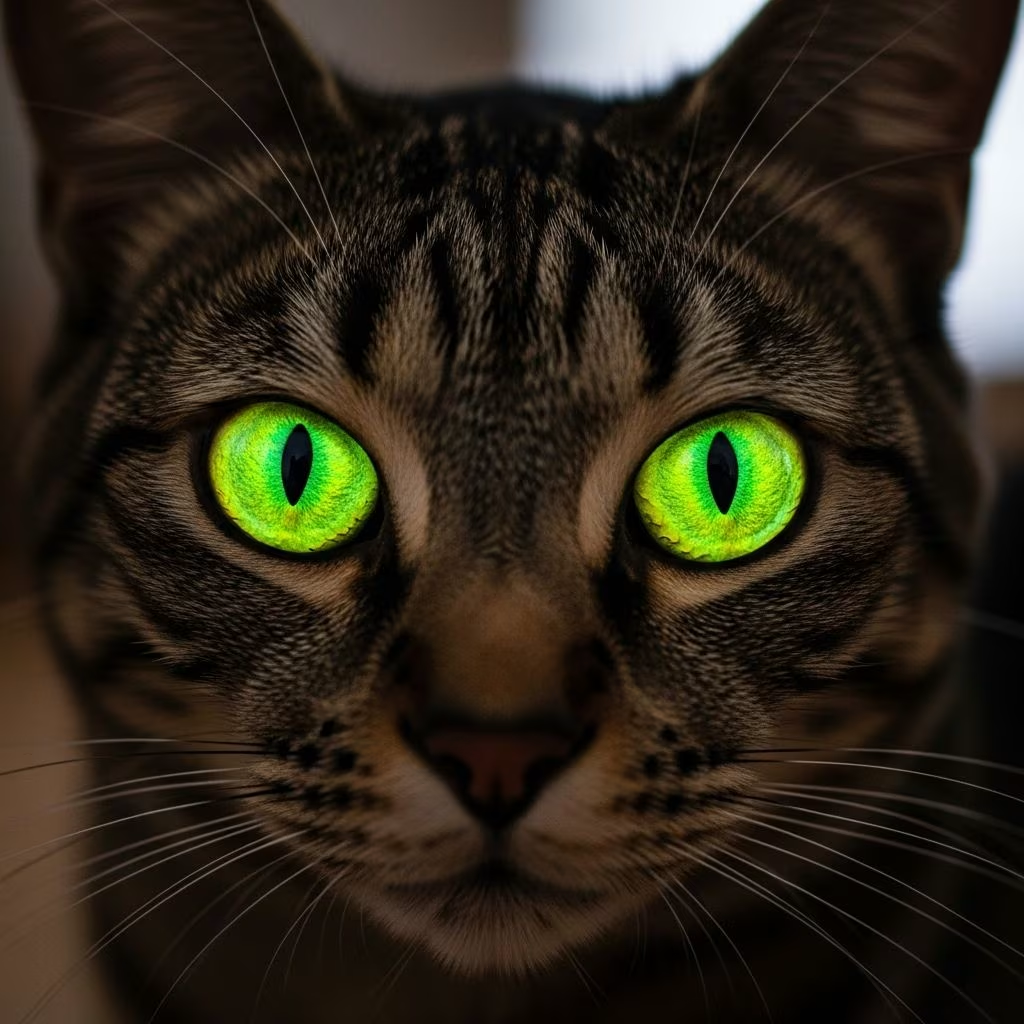
That mesmerizing glow from your cat’s eyes in the dark has sparked curiosity and even superstition for centuries. Far from supernatural, this phenomenon stems from a remarkable adaptation in feline anatomy designed for superior low-light vision. Cats’ eyes glow due to a reflective layer called the **tapetum lucidum** behind the retina, which bounces light back through the photoreceptors, amplifying vision in dim conditions.
This article delves into the biology, purpose, and variations of cat eye glow, drawing from veterinary science and animal behavior studies. Whether you’ve caught your kitty’s eyes shining like emeralds at night or wondered about wild cats’ eyeshine on camera traps, understanding this feature reveals why cats are such efficient nocturnal prowlers.
How and Why Do Cats’ Eyes Glow?
The glow occurs when light enters the eye, passes through the retina—the light-sensitive tissue at the back—and hits the **tapetum lucidum**, a specialized reflective layer. This layer acts like a mirror, reflecting unused light back onto the retina for a second chance at detection. Some light escapes forward through the pupil, creating the visible eyeshine effect.
Cats possess a high density of **rod cells** in their retinas—six to eight times more than humans—which excel at detecting motion and low light but offer limited color vision. Combined with the tapetum, this setup allows cats to see about six times better in dim light than humans. Their pupils, which can dilate to cover nearly the entire iris (up to 50% larger relative to eye size than humans), further enhance light intake.
- Key Components:
- Retina: Converts light to neural signals.
- Tapetum lucidum: Reflects light for reuse.
- Rod cells: Low-light and motion sensitivity.
- Large pupils: Maximize light entry.
This synergy makes cats **crepuscular** hunters, most active at dawn and dusk when light is scarce. Domestic cats retain these wild traits, explaining why your pet might zoom around at twilight.
The Science Behind the Tapetum Lucidum
The tapetum lucidum, Latin for “shining carpet,” is a guanine crystal-based reflector unique to many nocturnal animals. In cats, it’s composed of riboflavin and zinc crystals, which determine glow color—more zinc yields yellower hues, less produces blue-green. This layer boosts retinal illumination by up to 130 times compared to human eyes.
Light pathway: Incoming photons hit rods/cones; undetected light reflects off tapetum back through them. Excess light exits the pupil as glow. Without ambient light, no glow occurs—pure darkness yields no reflection.
| Animal | Tapetum Composition | Typical Glow Color |
|---|---|---|
| Cats | Zinc/Riboflavin | Yellow-Green, Blue |
| Dogs | Zinc | Yellow-Green |
| Humans | None | N/A (Red-eye in flash) |
| Sheep | Riboflavin | Blue-Green |
Humans lack this layer, but flash photography causes ‘red-eye’ from choroid blood vessel reflection. Evolutionary, the tapetum traded some acuity for sensitivity, ideal for hunters.
Why Is This Adaptation Important for Cats?
The tapetum lucidum is a survival superpower. Cats evolved as ambush predators, relying on stealth in low light. Enhanced vision helps detect prey movement up to 100 feet away in near-darkness. Crepuscular activity aligns with prey vulnerability at twilight.
Domestic cats, though fed by owners, retain instincts—nightly prowls mimic wild hunting. This explains startling midnight zoomies or staring contests in the dark. In wild felids like tigers and leopards, eyeshine aids navigation in forests, with whiskers complementing vision.
Studies show cats’ visual acuity is 20/100 to 20/200 (vs. human 20/20), but low-light prowess compensates. The tapetum doesn’t enable color seeing in dark—cats perceive blues/greens poorly anyway—but prioritizes contrast and motion.
What Color Do Cats’ Eyes Glow?
Glow color varies by individual, breed, age, and light angle: common are yellow, green, blue, orange.
- Yellow/Green: Most common, high zinc content.
- Blue: Lower zinc, seen in some breeds like Siamese.
- Red/Orange: Rare, light wavelength dependent.
Breed influences: Orientals may glow blue; tabbies green-yellow. Kittens’ eyes change post-weaning as tapetum matures. Flash color shifts by angle—head-on yields brighter glow.
Do All Cats Have Glowing Eyes?
Yes, all cats possess a tapetum lucidum, but intensity varies. Breeds like Sphynx or Scottish Folds may show subtler glows due to eye shape. Older cats or those with retinal diseases (e.g., PRA) may lose it, resulting in dull eyes. Albinos lack pigmentation, altering reflection.
Not universal across animals: diurnal birds/reptiles skip it. Among mammals, nocturnal species dominate.
Cats vs. Other Animals: Eye Glow Comparison
Cats’ glow aids hunting; compare:
| Animal | Glow Purpose | Color Range | Activity Pattern |
|---|---|---|---|
| Cats | Hunting in twilight | Green-Yellow-Blue | Crepuscular |
| Dogs | Low-light tracking | Green-Yellow | Crepuscular/Nocturnal |
| Wolves | Night pack hunts | Yellow-Orange | Nocturnal |
| Deer | Predator evasion | White-Blue | Nocturnal |
Wild cats like servals glow vividly on trail cams, aiding research.
Frequently Asked Questions (FAQs)
Why do cats’ eyes glow different colors?
The color depends on tapetum zinc/riboflavin ratio and light angle. Yellow-green is standard; blue rarer.
Can cats see in complete darkness?
No, they need some light for tapetum reflection. Total dark yields no vision.
Do kittens’ eyes glow from birth?
Not immediately; tapetum develops weeks post-birth.
Is eye glow a health sign?
Normally yes, but asymmetry/dimming warrants vet check for issues like cataracts.
Why no tapetum in humans?
Diurnal evolution prioritized color/acuity over low-light.
Conclusion: Embracing the Eerie Glow
Your cat’s glowing eyes are a window to their wild heritage—efficient, adapted, mesmerizing. Next time those orbs pierce the dark, appreciate the biology at work.
References
- Why Do a Cat’s Eyes Glow? — Hill’s Pet. 2023-05-15. https://www.hillspet.com/cat-care/behavior-appearance/why-do-cats-eyes-glow
- Why do cats’ eyes glow in the dark? — Cats Protection. 2022-10-31. https://www.cats.org.uk/cats-blog/why-do-cats-eyes-glow-in-dark
- 20/20 Vision: Why Do Cats’ Eyes Glow in the Dark? — Diamond Pet. 2024-03-20. https://www.diamondpet.com/blog/health/conditions/why-do-cats-eyes-glow-in-the-dark/
- The Spooky Science of Glowing Eyes in Cats — Panthera.org. 2023-10-25. https://panthera.org/blog-post/spooky-science-glowing-eyes-cats
- Why Do Cat Eyes Glow in the Dark? — Nerdfighteria Wiki. 2015-11-12. https://nerdfighteria.info/v/9xQQixUidPY



