

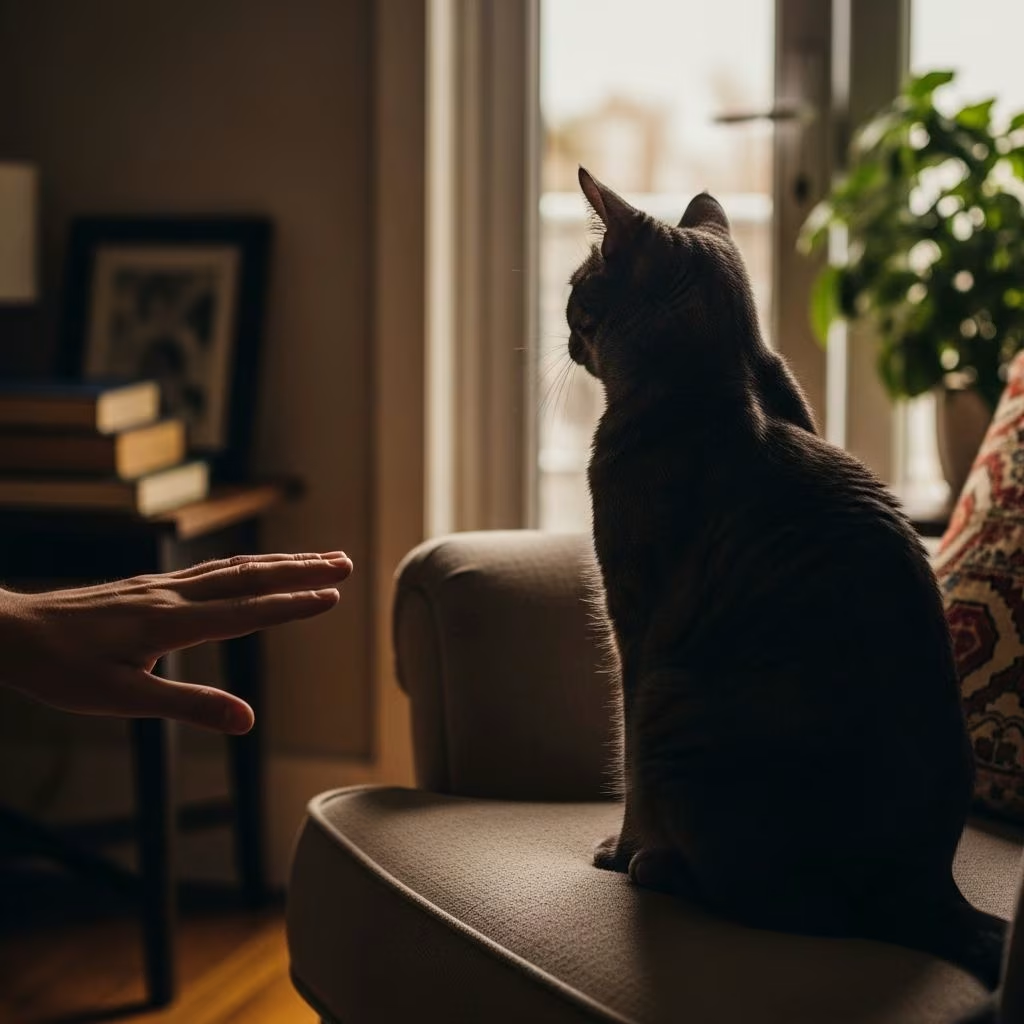
Cats often get labeled as independent or standoffish, but emerging research shows this perception stems largely from how humans engage with them. Studies demonstrate that felines are highly attuned to our cues and respond based on our initiation styles and emotional states. When owners respect feline-led interactions, bonds strengthen, leading to more affectionate and prolonged engagements.
The Science of Cat-Human Communication
Domestic cats employ visual, auditory, and olfactory signals originally evolved for cat-to-cat interactions when communicating with people. For instance, raising the tail upright signals friendly intent, a gesture cats use both with familiar felines and returning owners. This overlap highlights cats’ adaptability in mixed-species households.
Quantitative observations reveal cats distinguish between owners and strangers in emotional recognition. They match human facial expressions with vocalizations, particularly high-intensity ones, indicating a mental model of partner emotions. Recent experiments confirm cats alter behavior upon detecting fear scents from owners, showing elevated stress responses like ear flattening and retreat compared to neutral odors.
Who Leads the Dance? Initiation Patterns in Cat-Human Pairs
Observational data from over 150 households tracks interaction initiations, acceptances, durations, and totals. Cats primarily control interaction length; human success in starting contacts inversely correlates with overall time spent together—the more humans push, the shorter sessions become. Feline-initiated bouts last longer, fostering reciprocity.
Adults mesh better with cats than children do. Women and girls often lower to cat level, speak softly, prompting more feline vocalizations, while abrupt child approaches trigger flight. This underscores goal meshing: harmonious bonds arise when humans mirror cats’ pace.
| Interaction Initiator | Average Bout Duration | Total Interaction Time Impact |
|---|---|---|
| Cat | Longer | Higher overall |
| Human (frequent) | Shorter | Lower overall |
| Adult vs. Child | Adult: reciprocal | Child: more rejections |
Data synthesized from multi-day household studies.
Early Socialization: Building Trust Foundations
Kittenhood experiences dictate adult sociability. Well-socialized kittens require numerous negative encounters to grow wary, but few positives to trust new people. Maternal behavior influences offspring; a friendly mother cat models human approachability.
Cats vocalize more—like infant cries—to elicit responses, training owners unwittingly. They meow primarily at humans, not peers, adapting to our vocal reliance while retaining scent and body cues inter-cat.
Emotional Synchronization: Cats Mirror Our Moods
Cats detect human emotions via posture, voice, and scent, adjusting accordingly. Depressed owners initiate less but accept cat approaches, which alleviate anxiety and introversion comparably to human partners. Cats respond by rubbing and vocalizing more near moody owners.
Fear odors provoke strongest feline stress, hinting at empathetic concern. Relaxed scents yield neutral responses, preserving baseline calm. This bidirectional influence challenges aloof stereotypes, revealing nuanced attachment.
Psychological Profiles of Cat Lovers
Cat enthusiasts seek low-pressure intimacy, mirroring feline independence. They favor environments allowing natural closeness without demands, avoiding overstimulation. Cats’ neotenous features—large eyes, upward gaze—trigger caregiving instincts safely, sans emotional reciprocity pressure.
Research affirms cats form secure attachments akin to dogs, preferring owners in social referencing tasks. They follow pointing gestures and owner calls more reliably, evidencing learned bonds.
Practical Strategies to Deepen Your Cat’s Affection
To counter perceived distance:
- Let cats initiate: Wait for approaches to extend natural sessions.
- Get low: Sit or crouch to match eye level, reducing intimidation.
- Respond to meows: Reinforce vocal communication promptly.
- Use slow blinks: Mimic feline trust signals for rapport.
- Provide scent variety: Introduce calm odors to test emotional responses safely.
- Socialize early: Expose kittens positively to diverse humans.
Enrich environments with vertical spaces and toys to boost confidence in interactions.
Common Myths vs. Research Realities
| Myth | Reality | Evidence |
|---|---|---|
| Cats ignore emotions | Detect via multi-senses | Scent, voice, face studies |
| Cats don’t attach | Secure bonds like dogs | Attachment tests |
| Humans train cats | Cats train us via cries | Vocal adaptation |
Health Impacts of Stronger Bonds
Interactive cats buffer owner stress, enhancing mood subscales especially in women. Mutual engagement reduces depression markers, promoting well-being. Feline presence alone helps, but active play amplifies benefits.
FAQs
Why does my cat ignore me sometimes?
Cats control interactions; frequent human pushes shorten time together. Allow feline leads for warmer responses.
Can cats sense my stress?
Yes, via scents and cues—fear odors heighten their stress, prompting comfort-seeking.
How to make my cat more affectionate?
Socialize young, respect pace, use body language like slow blinks.
Do cats prefer women over men?
They respond better to lowered, verbal approaches common in women/girls.
Are cats as bonded as dogs?
Research shows comparable attachment, expressed subtly.
Conclusion: Embrace Feline-Led Love
Shifting from director to responder transforms aloof cats into devoted companions. Science empowers better bonds through understanding.
References
- The Mechanics of Social Interactions Between Cats and Their Owners — PMC (NIH). 2021-04-15. https://pmc.ncbi.nlm.nih.gov/articles/PMC8044293/
- Cats and human emotions: A stronger bond than we thought? — Noldus. 2023. https://noldus.com/blog/cats-react-to-human-emotional-scents
- The Psychology of People Who LOVE Cats — YouTube (Psychology Research). 2023. https://www.youtube.com/watch?v=fvQFC84Eadw
- What Do Cats Think of Humans? — My Lovely Feline. 2024. https://mylovelyfeline.com/en-ca/blogs/content/what-do-cats-think-of-humans
- What’s going on inside your cat’s head? — APA. 2022-10-02. https://www.apa.org/news/podcasts/speaking-of-psychology/cat-human-bond



