

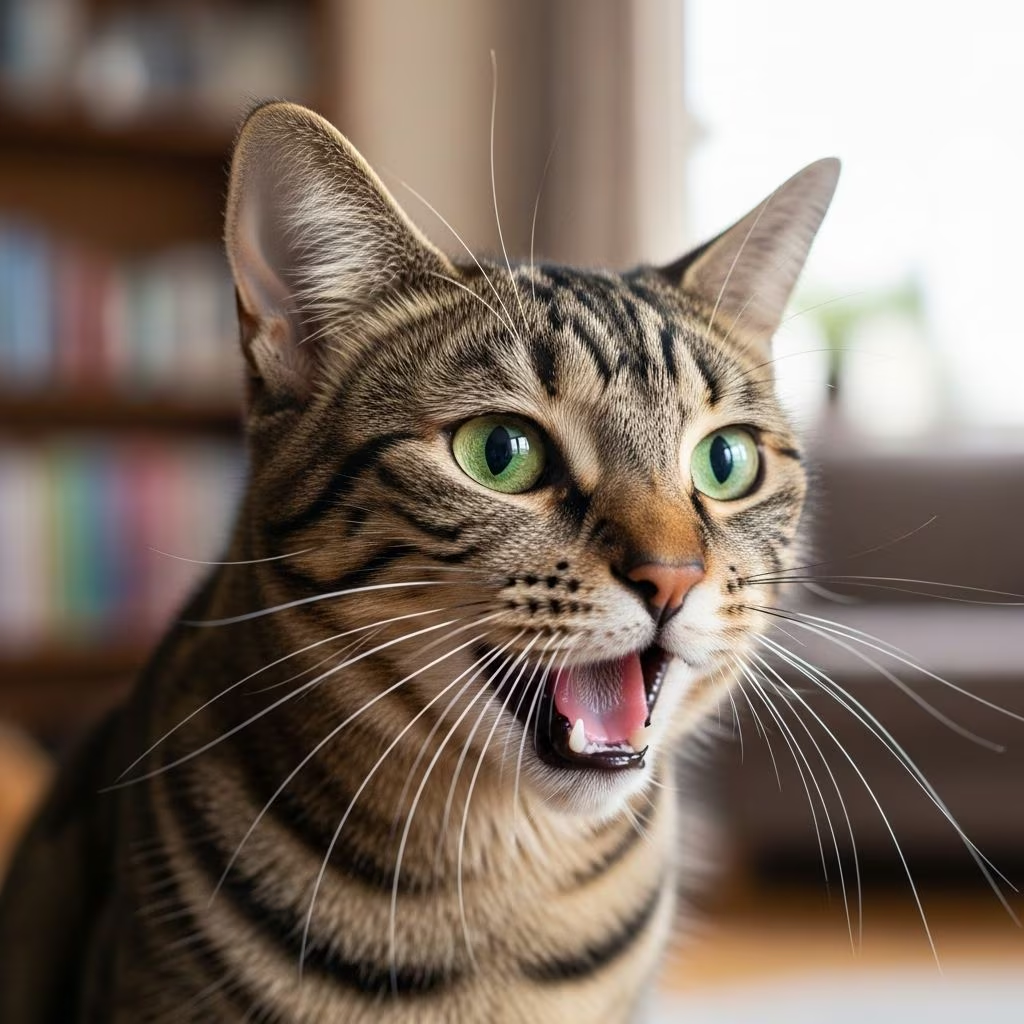
Cats have a unique way of talking to us that sets them apart from their interactions with other felines. While they rarely meow at each other as adults, domestic cats frequently use this vocalisation to communicate with humans. This behaviour stems from kittenhood and evolves into a sophisticated tool for getting our attention, whether for food, play, or affection.
Why Do Cats Meow at Humans?
Meowing is primarily a human-directed communication method that cats have refined over thousands of years of domestication. Kittens meow to their mothers for basic needs like hunger, cold, or distress, relying on sound because their other senses are underdeveloped. As cats mature, they shift to body language, scent marking, and other vocalisations like growls or hisses when interacting with fellow cats. However, with humans—who lack their acute sense of smell—cats retain and adapt meowing as an effective strategy.
Research indicates this is a learned behaviour: cats meow because it elicits responses from us. A study on feral cats showed they meow far less and less discriminately than pets, relying instead on growls or other sounds. Domestic cats, observing our positive reactions—such as feeding or petting—have essentially “hacked” human empathy by mimicking infant-like cries that trigger caregiving instincts. This manipulation through tone, timing, and eye contact works reliably on pet owners worldwide.
Unlike true language, meowing isn’t a structured feline dialect but a flexible signal tailored to us. Cornell University research describes it as “not language, strictly speaking, but close enough to skillfully manage humans.” Cats produce varied meows modulated by context, pitch, duration, and melody to convey emotions, with positive contexts yielding different acoustics from negative ones.
The Science Behind Cat Meows
Domestic cats possess a complex vocal repertoire, with meows being highly context-dependent. A peer-reviewed study published in the National Library of Medicine examined humans’ ability to classify meows from contexts like waiting for food, isolation, and brushing. While meows differ acoustically—allowing discrimination in lab settings—average humans struggle to pinpoint exact contexts, performing only slightly above chance.
Humans better perceive emotional valence: isolation meows sound most negative (agitated, frightened, frustrated), while brushing meows seem positive (calm, friendly, playful). Food-waiting meows fall in between. Recognition improves with cat ownership experience, female gender, and higher animal empathy, but remains limited overall. This suggests cats communicate effectively despite our imperfect decoding.
Meows resemble baby cries to exploit human nurturing responses. Electromyographic studies on purring (a related vocalisation) show laryngeal muscle control, hinting at similar mechanisms for meows. Feral vs. domestic differences reinforce that pet cats amplify meowing for human benefit.
Different Types of Cat Meows and What They Mean
Cats employ a spectrum of meows, each tuned to specific needs. Here’s a breakdown:
- Short, high-pitched meow: A standard greeting or casual check-in, like “hello” or “I’m here.”
- Long, drawn-out meow (e.g., ‘Mooow’): Urgent demand, often for food or door access. Demand meows are loud and insistent to grab attention.
- Multiple meows in a row: Excited greeting or strong desire for interaction, play, or pets.
- Low-pitched, growly meow: Irritation, pain, or warning—proceed with caution.
- Trill or chirrup (rolling ‘R’ sound): Affectionate greeting, akin to a mother’s call to kittens, signaling fondness.
- Rising inflection meow: Questioning or polite request, like “Can I have that?”
Context matters: kitchen meows often mean hunger, bedroom chirps seek companionship. Repetitive meowing signals unmet needs like food, play, or cuddles.
Why Do Cats Meow Back When You Talk to Them?
It’s normal—and endearing—when cats “converse” by meowing in response to your voice. This back-and-forth mimics human dialogue, strengthening bonds. Certified behaviourists note several motivations:
- Friendly small talk: Cats are social and reciprocate chit-chat to maintain connection, even if frustrated by our incomprehension.
- Hunger cues: Kitchen convos often precede meals; cats learn meowing prompts feeding.
- Attention-seeking: Post-feeding meows may demand play or pets. Impromptu sessions resolve this.
- Affection: High-pitched trills or soft meows show liking, a compliment from your cat.
They don’t grasp words like Netflix plots but associate tone and our responses with outcomes.
Common Reasons Cats Meow at Humans
| Reason | Description | Typical Meow Type |
|---|---|---|
| Hunger | Most common; timed around meals. | Loud, insistent |
| Attention/Play | Boredom or loneliness prompts interaction. | Repetitive, chirpy |
| Greetings | Homecoming ritual. | Short series |
| Affection | Bonding vocalisation. | Soft trill |
| Door Access | Want in/out. | Drawn-out |
| Discomfort | Illness, pain, or stress. | Low, plaintive |
Excessive meowing may indicate issues like hyperthyroidism, injury, or anxiety in seniors.
When Excessive Meowing Is a Concern
Not all meows are benign. Sudden increases warrant vet checks for:
- Medical issues: Thyroid problems, arthritis, hypertension.
- Stress/Anxiety: New pets, moves, or isolation.
- Breed traits: Siamese are naturally vocal.
Monitor patterns; rule out health first.
How to Understand Your Cat’s Meows Better
Enhance communication by:
- Observing context, body language (tail, ears), and timing.
- Responding consistently to reinforce positive signals.
- Enriching environment: toys, scratching posts reduce demands.
- Recording meows for pattern analysis.
- Consulting behaviourists for persistent issues.
Experience hones recognition; cat owners outperform novices.
Frequently Asked Questions (FAQs)
Q: Why does my cat meow at me but not other cats?
A: Cats meow mainly at humans as a learned behaviour; adults use scent and posture with peers.
Q: Is it bad if my cat meows a lot?
A: Occasional is fine; excessive may signal health or stress issues—see a vet.
Q: Do cats understand when I talk to them?
A: They respond to tone and associate with rewards, not words.
Q: Why do some cats trill?
A: Trilling shows affection, like a mother’s kitten call.
Q: Can I train my cat to meow less?
A: Address needs, ignore demands, provide enrichment.
References
- Understanding What Your Cat Wants When They Meow — PetPlace. Accessed 2026. https://www.petplace.com/article/cats/pet-behavior-training/understanding-what-your-cat-wants-when-they-meow
- Why Do Cats Meow Back When You Talk to Them? — Chewy. Accessed 2026. https://www.chewy.com/education/cat/training-and-behavior/is-this-normal-why-do-cats-meow-back-when-you-talk-to-them
- What’s in a Meow? A Study on Human Classification and Discrimination of Cats’ Meows — National Center for Biotechnology Information (PMC). 2020-12-09. https://pmc.ncbi.nlm.nih.gov/articles/PMC7765146/
- Cat communication — Wikipedia (informed by primary sources). Accessed 2026. https://en.wikipedia.org/wiki/Cat_communication
- Why Your Cat Meows at You, Especially If You Are Male? | GRAVITAS — YouTube (transcript). Accessed 2026. https://www.youtube.com/watch?v=Ja6FPGFNxUI
- It’s the cat’s meow: Not language, strictly speaking, but close enough — Cornell University News. 2002-05. https://news.cornell.edu/stories/2002/05/meow-isnt-language-enough-manage-humans



