

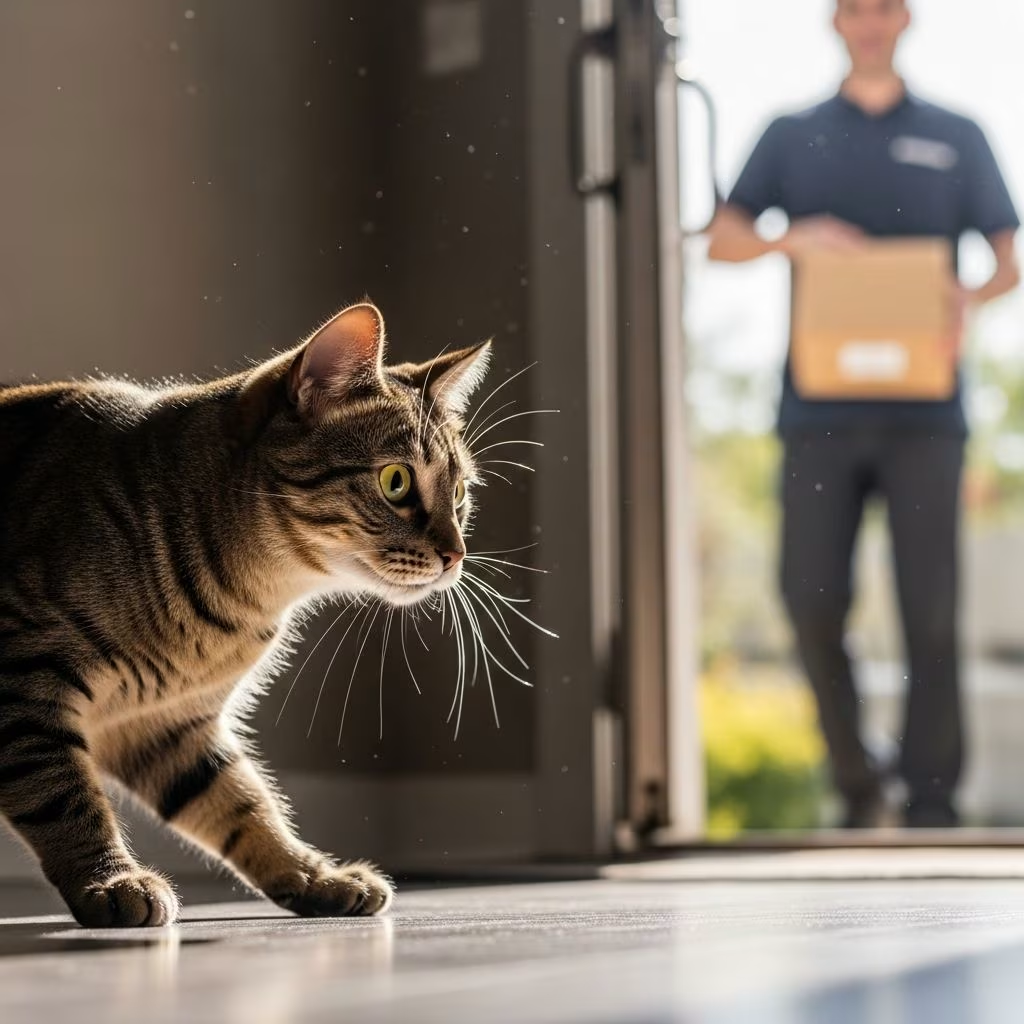
Cats often display sudden aggressive outbursts toward unfamiliar visitors, such as mail carriers or delivery personnel, due to instinctual fear responses, territorial instincts, or redirected frustration from external stimuli. These behaviors stem from their evolutionary wiring as solitary hunters, making them wary of perceived intruders in their domain.
Instinctual Roots of Feline Defensiveness
Cats are naturally predisposed to protect their territory, a trait honed over millennia as independent predators. Unlike dogs, which have been selectively bred for social integration with humans, cats retain a strong sense of personal space and vigilance against outsiders. When a stranger approaches the door—knocking, ringing the bell, or even just passing by—these actions can mimic threats in a cat’s heightened sensory world, triggering a defensive posture that escalates to swats, hisses, or full lunges.
This territorial vigilance is particularly pronounced in indoor cats, whose home environment represents their entire known world. Research from veterinary behaviorists indicates that such reactions are not personal malice but survival mechanisms. For instance, the sound of footsteps or uniform rustling can evoke predatory alerts, prompting cats to position themselves at strategic points like windowsills or doorways.
Key Triggers Sparking Attacks on Outsiders
Several interconnected factors can provoke a cat to target delivery workers or similar strangers. Understanding these helps demystify the behavior and paves the way for effective interventions.
- Fear-Based Reactions: The most prevalent cause, where cats perceive strangers as imminent dangers. Defensive postures emerge when escape routes seem blocked, leading to preemptive strikes.
- Overstimulation from Petting or Proximity: Even familiar handling can tip into aggression if prolonged, and strangers exacerbate this by invading space unexpectedly.
- Redirected Frustration: External agitators, like neighborhood animals visible through windows, build tension that innocent bystanders like mail carriers absorb.
- Pain or Medical Issues: Underlying health problems amplify irritability, turning routine encounters into flashpoints.
- Play Misinterpretation: Energetic young cats may blur play-hunting with real threats, pouncing on moving figures outside.
Decoding Your Cat’s Warning Signals
Recognizing pre-attack cues is crucial for prevention. Cats communicate discomfort through subtle shifts in body language long before physical contact.
| Body Part | Warning Sign | Meaning |
|---|---|---|
| Ears | Flattened backward | High alert or fear |
| Tail | Rapid swishing or thrashing | Building agitation |
| Pupils | Sudden dilation | Overstimulation or threat detection |
| Body Posture | Crouching, piloerection (fur standing up) | Defensive preparation to strike |
| Vocalizations | Growling, hissing, chattering | Explicit ‘back off’ signal |
Observing these in sequence allows owners to intervene early, such as by distracting the cat or creating distance from the trigger.
Fear: The Primary Driver of Stranger Aggression
Fear aggression tops the list of reasons cats lash out at delivery personnel. When cornered—physically or psychologically—cats opt for offense as the best defense. This is especially true for under-socialized cats or those with past traumas, who view uniformed strangers as amplified threats due to novel scents, sounds, and appearances.
Veterinary sources note that fearful cats exhibit a mix of retreat signals (crouching, ear flattening) and offensive ones (hissing, swatting). If the stranger persists near the door, the cat may escalate to biting or scratching through cracks or upon entry. Prevention involves desensitization: gradually exposing the cat to doorbell sounds paired with treats in controlled settings.
Redirected Aggression and Invisible Culprits
Often, attacks on mail carriers are misdirected energy from unseen stressors. A cat spotting a rival feline outside or hearing distant dogs may enter a hyper-aroused state, then unleash on the nearest available target—the approaching delivery person.
This ‘redirected aggression’ is reflexive, not deliberate. Common catalysts include window views of wildlife, residual scents from outdoor adventures, or household tensions like inter-cat spats. Owners can mitigate by blocking sightlines with curtains, using pheromone diffusers, or providing enrichment toys to diffuse pent-up energy.
Petting-Induced Overload and Handling Sensitivities
While less directly tied to strangers, petting aggression contributes indirectly; cats intolerant of touch may generalize wariness to all humans, heightening reactions to outsiders. Overstimulation occurs when stroking exceeds a cat’s tolerance, signaled by skin rippling or vocal warnings.
Such cats often have genetic predispositions or poor early socialization. Short, positive sessions—focusing on preferred areas like cheeks—build tolerance. For stranger encounters, advise visitors to avoid reaching out entirely.
Health Factors Fueling Irritability
Pain from arthritis, dental issues, or infections can lower a cat’s aggression threshold, transforming mild provocations into attacks. Irritable aggression flares when touched near sore spots or during general discomfort.
A veterinary exam rules out these, often resolving behaviors post-treatment. Regular check-ups, especially for seniors, prevent escalation.
Play Aggression in Youthful Cats
Kittens and young adults channel hunting instincts into ‘play’ attacks on moving shadows or door rattles. This predatory sequence—stalk, pounce, bite—mimics real hunts but alarms visitors.
Redirect with interactive toys like wand teasers, scheduled daily to satisfy urges without human targets.
Proven Strategies to Curb Doorway Ambush Behaviors
Addressing cat attacks on strangers requires a multi-pronged approach emphasizing safety and gradual behavior shaping.
- Environmental Tweaks: Install baby gates to sequester cats during deliveries; use motion-activated deterrents outside.
- Desensitization Training: Play delivery sounds at low volumes, rewarding calm with treats, increasing gradually.
- Enrichment Boost: Puzzle feeders, climbing trees, and window perches reduce boredom-fueled tension.
- Professional Help: Certified behaviorists for persistent cases, possibly with medication.
- Visitor Protocols: Warn guests; ignore cats to diminish appeal as targets.
Long-Term Management for Multi-Cat Homes
In households with multiple cats, intra-group conflicts often spill over to stranger aggression. Core triggers like resource competition amplify overall stress. Vertical spaces and separate feeding zones promote harmony.
FAQs on Feline Stranger Aggression
Why does my cat only attack the mailman and not family?
Uniforms, predictable timing, and external scents mark mail carriers as ‘other,’ triggering territorial defenses absent in familiar humans.
Is it safe to punish an aggressive cat?
No—punishment heightens fear, worsening cycles. Focus on positive reinforcement instead.
How long does redirected aggression last?
Minutes to hours; remove the trigger promptly to shorten episodes.
Can spaying/neutering stop these attacks?
It reduces hormone-driven territoriality but not fear or pain-based aggression.
When to see a vet for sudden aggression?
Immediately if accompanied by appetite loss, lethargy, or litter box issues—medical causes first.
By interpreting these behaviors through a cat’s perspective and applying targeted fixes, homes can become safer zones for both pets and visitors. Patience yields calmer companions.
References
- Aggression in Cats — ASPCA. 2023. https://www.aspca.org/pet-care/cat-care/common-cat-behavior-issues/aggression-cats
- Feline Behavior Problems: Aggression — Cornell University College of Veterinary Medicine. 2024. https://www.vet.cornell.edu/departments-centers-and-institutes/cornell-feline-health-center/health-information/feline-health-topics/feline-behavior-problems-aggression
- Cat Aggression Toward People: Causes and Prevention — Best Friends Animal Society. 2023. https://bestfriends.org/pet-care-resources/cat-aggression-toward-people-causes-and-prevention
- Feline Aggression Toward People — Humane Society. 2024. https://www.thehumanesociety.org/feline-aggression-toward-people/
- Cat Aggression Toward Familiar People — Maddie’s Fund. 2022. https://www.maddiesfund.org/cat-aggression-toward-familiar-people.htm



