

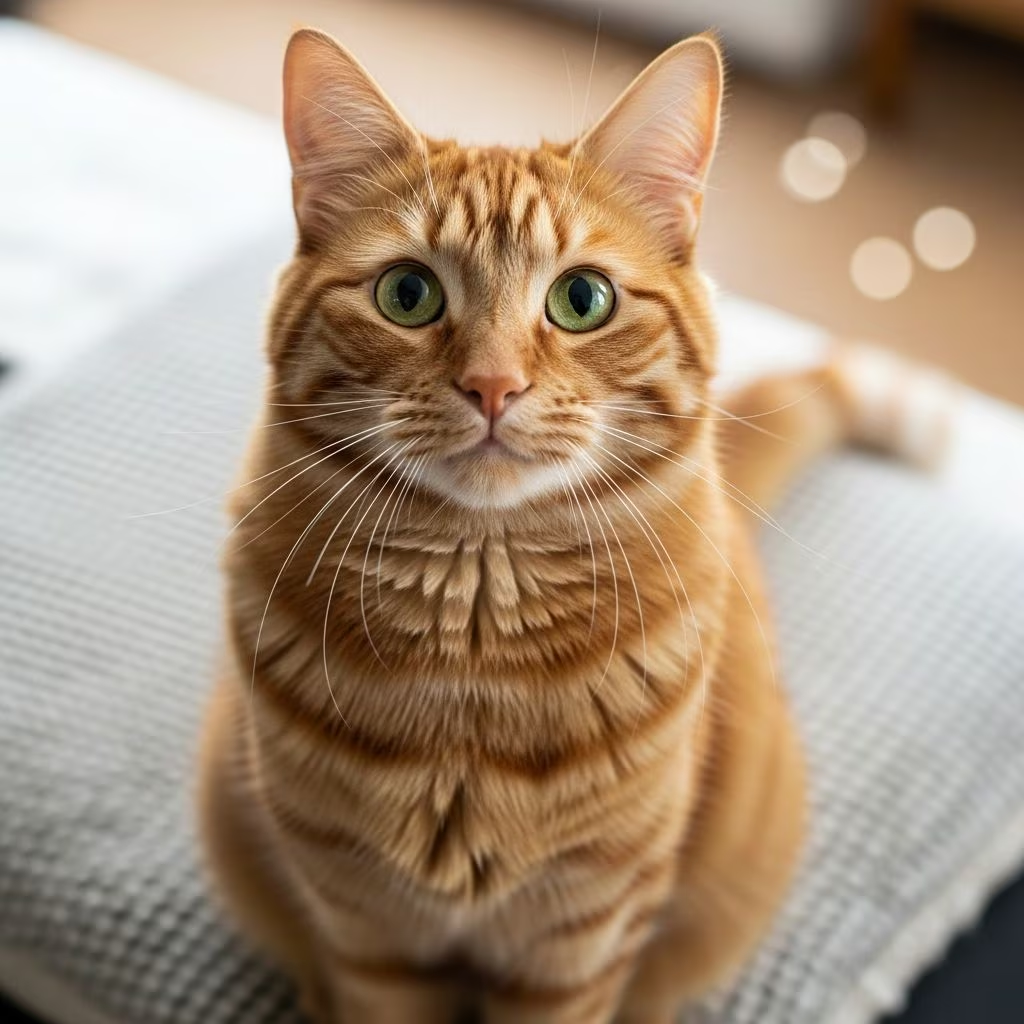
Cats captivate millions worldwide with their playful antics, soft purrs, and irresistible gazes. But what makes them so profoundly cute? Science reveals that feline charm stems from evolutionary adaptations exploiting human “baby schema” responses, triggering caregiving instincts originally designed for human infants. This phenomenon, rooted in ethology and neuroscience, explains why cats have become cherished companions.
The Baby Schema: Konrad Lorenz’s Kindchenschema
Austrian ethologist Konrad Lorenz introduced the concept of Kindchenschema (baby schema) in the 1940s, identifying specific infant-like features that elicit protective caregiving behaviors in adults. These include large heads relative to body size, big eyes, small noses, chubby cheeks, and round features. Lorenz proposed this as an “innate releasing mechanism,” hardwired to promote survival of helpless offspring.
Cats masterfully embody these traits. Kittens exhibit exaggerated baby schema: oversized heads (up to 50% larger proportionally than adults), enormous eyes positioned low on the face, tiny snouts, and fluffy, rounded bodies. Even adult cats retain neotenous (juvenile) features through selective breeding, such as the short-faced Persians or wide-eyed Siamese, amplifying their cuteness quotient.
- Large eyes: Comprise up to 35% of a kitten’s face, mimicking human infant proportions that signal vulnerability.
- Big head-to-body ratio: Evolves rapidly; at 8 days old, kittens have heads nearly as wide as their bodies, tapering as they grow.
- Soft, rounded features: Fluffy fur and plump paws enhance tactile appeal, inviting petting and nurturing.
These features hijack our brain’s reward centers, releasing dopamine and oxytocin—hormones linked to bonding and pleasure—much like interacting with a human baby.
How Cats Hijacked Human Instincts
Domestic cats (Felis catus) self-domesticated around 10,000 years ago near human grain stores in the Fertile Crescent, controlling rodent populations without losing wild traits. Unlike dogs, bred for docility, cats retained predatory independence but evolved subtle cues to foster human kinship.
Photographer Tim Flach, in his book Feline, collaborated with neuroscientist Morten Kringelbach to document how cat cuteness unfolds. Images of kittens from 8 days to 8 weeks reveal proportional shifts mirroring baby schema peaks, explaining their emotional pull even in photos or videos.
Modern breeding over the last 50 years has intensified juvenile traits: brachycephalic (flat-faced) breeds like Exotics have outsized eyes and noses, while selective pressures favor ‘cuter’ morphologies. Humans unconsciously act as ‘godlike’ shapers, prioritizing adorability alongside utility.
Neuroscience of Cuteness: Brain Responses to Cats
Cuteness ignites rapid neural activity. Functional MRI studies show cute stimuli activate the orbitofrontal cortex (OFC) within 100 milliseconds, biasing attention before conscious awareness. This ‘fast lane’ processing precedes slower appraisal in networks for emotion, empathy, and reward.
For cats, proximity triggers the same medial orbitofrontal cortex (mOFC) regions as human infants, processing affiliative emotions. Viewing kitten photos elicits stronger responses than adult cats, correlating with caregiving urges: petting, cooing, and protection.
Multisensory cues amplify this: kitten mews resemble baby cries (high-pitched, urgent), purrs vibrate at 25-150 Hz (therapeutic frequencies reducing stress), and their milky scent evokes nurturing. Unlike aversive cries prompting termination, cuteness invites prolonged interaction, fostering bonds.
| Cuteness Trigger | Brain Region | Effect |
|---|---|---|
| Visual (big eyes) | Orbitofrontal Cortex | Fast attention bias, dopamine release |
| Auditory (mews/purrs) | Amygdala, Insula | Empathy, reward anticipation |
| Olfactory (scent) | Piriform Cortex | Affiliative bonding |
This privileged neural access suggests cuteness expands the ‘moral circle,’ increasing compassion for non-kin like cats, aiding sociality and well-being.
Evolutionary Advantages for Cats
Cuteness ensures feline survival in human environments. Wild kittens hidden in burrows display schema to mothers; domesticated ones extend it to humans, securing food and shelter. Cats filling the ‘wildlife vacuum’ in urban settings remind us of nature, promoting empathy without full adoption of human norms.
Adult cats maintain cuteness via play bows, belly exposes (trust signals), and REM-heavy sleep optimizing hunting skills—balancing adorable vulnerability with lethal prowess.
Cultural Evolution of Cat Cuteness
Cats transitioned from revered Egyptian deities to witch-hunt villains, now internet superstars. Viral videos exploit cuteness: 80% of top memes feature felines, driven by schema responses. Gen AI blurs real-vs-fake boundaries, yet authentic cuteness persists.
Breeds like Scottish Folds (perpetually surprised expressions) exemplify human curation for maximum appeal, tracing cultural shifts from utility to companionship.
Why Adult Cats Stay Cute
Unlike wolves-to-dogs, cats paedomorphose subtly: retained kitten voices, flexible play, and grooming invites. Flach’s to-scale photography shows how proportions evolve yet linger, sustaining lifelong bonds.
Cuteness Beyond Cats: Broader Implications
Schema works on puppies, bunnies, and robots (e.g., Roomba with eyes). For cats, it facilitates niche expansion: humans provide resources, cats control pests, creating symbiosis.
Potential downsides: overbreeding health issues (brachycephaly impairs breathing). Ethical breeding preserves cuteness without compromising welfare.
Frequently Asked Questions (FAQs)
Why do kittens seem cuter than adult cats?
Kittens peak in baby schema proportions—huge heads and eyes—triggering stronger instinctual responses. Adults retain echoes but less intensely.
Do all cat breeds have cute features?
Most do, amplified by breeding. Sphynx cats rely more on behavior (kneading, head-butts) for appeal despite hairlessness.
Is cat cuteness universal?
Largely yes, cross-cultural studies confirm schema elicits caregiving globally, though cultural exposure modulates intensity.
Can cuteness influence cat adoption rates?
Absolutely; shelters report ‘cute’ kittens adopted 3x faster, underscoring schema’s power in human decision-making.
Does viewing cat videos benefit mental health?
Yes, they boost oxytocin, reduce cortisol—mini ‘therapy sessions’ via mOFC activation.
References
- On cuteness: unlocking the parental brain and beyond — Kringelbach ML, et al. National Library of Medicine (PMC). 2016-07-05. https://pmc.ncbi.nlm.nih.gov/articles/PMC4956347/
- The Strange Science Behind Cat Cuteness — New Scientist (Tim Flach interview). New Scientist. 2025-10-29. https://www.youtube.com/watch?v=9HPKxLbx7m8
- Niche Expansion and the Natural History of Human-Cat Kinship — Bradshaw JWS, et al. University of Chicago Press Journals. 2024. https://www.journals.uchicago.edu/doi/10.1086/737151



