

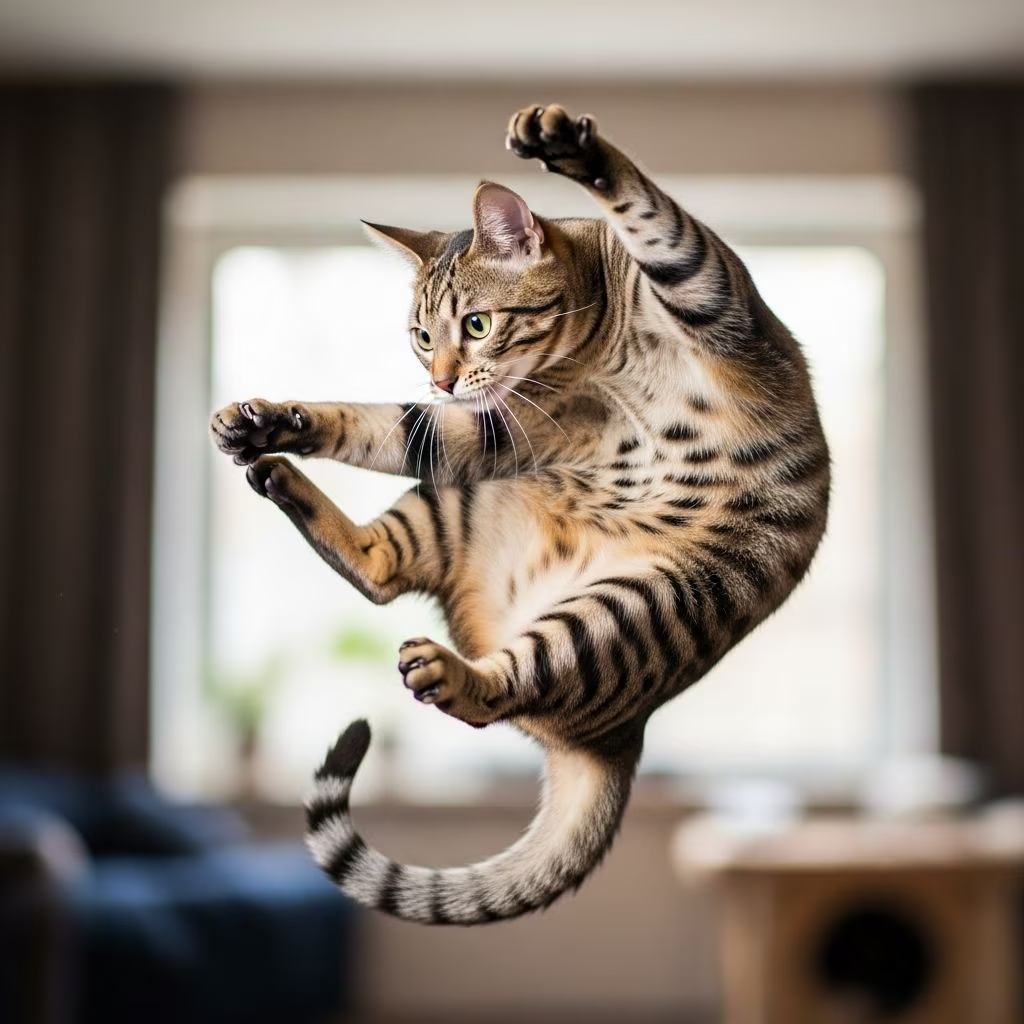
Why Are Cats So Flexible: The Science Behind Feline Agility
Cats are renowned for their seemingly impossible contortions—curling into tight boxes, twisting mid-air, and landing gracefully from falls. Their flexibility appears almost supernatural, but the truth lies in millions of years of evolution and a remarkably adapted skeletal structure. Unlike humans and many other mammals, cats possess specialized bones, ligaments, and muscles that allow them to achieve extraordinary ranges of motion. This superior flexibility isn’t merely for show; it’s a critical survival tool that helps cats hunt prey, escape danger, and navigate their environment with precision.
The Remarkable Feline Spine
The foundation of a cat’s flexibility begins with their spine. Cats have significantly more vertebrae than humans—approximately 53 vertebrae in total, compared to just 33 in humans. The difference is particularly striking in the tail region, where cats possess 22 to 23 caudal vertebrae, accounting for roughly 20 of their total vertebrae count.
Beyond sheer numbers, the structure of these vertebrae is distinctly different. According to biomechanical research, cat vertebrae are lighter, shorter, and fit together in a way that allows for a greater range of motion. The vertebrae are cushioned with elastic discs between each one, providing flexibility while protecting the spine from impact. These cushioned connections explain why cats can twist in mid-air without injuring their spines—a feat that would be impossible with a human-like skeletal structure.
A detailed biomechanical analysis of cat spine flexibility revealed that the spine demonstrates the least rotational stiffness in axial rotation movement, followed by extension and lateral bending. The mean height-to-width ratio of vertebrae is 1.04, and the heights of all vertebrae account for 90.34% of the total spinal length, contributing to the spine’s exceptional mobility. Additionally, cat vertebrae are held primarily by muscles rather than rigid ligaments, as seen in humans. This muscular attachment system contributes to the cat’s elasticity and ability to elongate and contract their back by curving upward or oscillating along their vertebral line.
Perhaps equally important is what cats don’t have: a nuchal ligament. Dogs, horses, and humans all possess this thick, tough ligament that supports the head on the neck and is essential for species that sustain long-distance running. Cats lack this structure entirely, making their heads far more agile. However, this adaptation comes with a trade-off—cats can only sustain short bursts of sprinting activity, unlike dogs that can maintain speed over longer distances.
Another anatomical advantage is the loose connection between a cat’s pelvis and spine. This looser articulation provides additional flexibility compared to other mammals.
The Unique Clavicle and Shoulder Blade Structure
Beyond the spine, the bones that attach to a cat’s limbs play a crucial role in their flexibility. The clavicle, or collarbone, is particularly unusual in cats. Unlike humans, where clavicles anchor the arms to the rest of the skeletal structure, feline clavicles do not attach to other bones. This free-floating design allows cats to twist in virtually any direction and squeeze through openings that seem impossibly small.
The principle is straightforward: if a cat can fit its head through an opening, its body can follow. Once the head passes through, the cat can adjust its clavicles as needed to manipulate the rest of its body through the gap. This adaptation has made cats legendary for their ability to squeeze into confined spaces that defy logic.
Similarly, a cat’s shoulder blades are attached only by muscle rather than bone. This muscular attachment provides tremendous freedom of movement. Unlike human shoulder blades, which are tethered to the ribcage via bone, a cat’s shoulder blades are essentially free-floating, allowing them to move independently and extend the cat’s reach. This adaptation enables cats to produce extra-long strides while hunting and to manipulate their shoulders far beyond human capability.
The Tail: A Flexible Counterbalance
A cat’s tail is far more than a decorative appendage. Composed of 22 to 23 vertebrae with fairly loose attachments and elastic cushioning, the tail provides remarkable flexibility and rotation. The tail serves as a critical counterbalance during quick movements and directional changes, allowing cats to maintain equilibrium while twisting and turning at high speeds.
The Righting Reflex and Landing on Their Feet
Perhaps the most famous demonstration of feline flexibility is their ability to land on their feet, even from significant heights. This famous behavior is called the **righting reflex**, and it’s made possible by the cat’s exceptional spinal flexibility and proprioceptive awareness.
When a cat falls, it doesn’t simply tumble haphazardly. Instead, the cat engages its righting reflex, twisting its body mid-air and orienting one part of its body while letting the rest follow. The flexible spine allows the front and back halves of the body to rotate independently, enabling the cat to reorient itself for a graceful landing. This self-stabilization mechanism is so effective that it has attracted the attention of biomechanical researchers seeking to inspire the design of rescue robots for confined environments.
Evolutionary Advantages and Practical Applications
The cat’s superior flexibility serves several critical survival functions. Flexibility allows cats to excel at hunting by enabling rapid directional changes and precise body positioning to land strikes on prey. It also aids in evading predators by allowing cats to maneuver in ways larger predators cannot replicate. Additionally, the flexibility helps cats reach otherwise inaccessible areas of their body for grooming and maintenance.
Biomechanical studies have demonstrated that during the cat’s spine in dorsiflexion motion—bending backward—stress is evenly distributed across the vertebrae without significant stress concentration. This even distribution of force is key to the cat’s ability to withstand impact and prevent injury during falls and landings. The compressive stiffness of the cat spine is approximately 53.62±4.68 N/mm, which is notably close to that of the human spine, increasing their ability to prevent impact damage.
Comparing Cats to Other Animals
Cats stand out among carnivores and domestic animals in their flexibility. While cats have long spines with extra cushioning between vertebrae, dogs have shoulder blades attached to bone, which limits their flexibility compared to cats. This structural difference explains why cats can squeeze into tight spaces and rotate their bodies in ways dogs simply cannot.
The cheetah exemplifies feline spinal flexibility in extreme form. A cheetah’s spine functions like a slinky while running, with vertebrae expanding and compressing at different points during the animal’s famous gallop. This allows the cheetah to stretch itself and cover more ground with each stride, contributing to its status as the fastest land animal.
The Downy Undercoat and Overall Softness
While not strictly a flexibility factor, a cat’s soft exterior complements its flexible skeleton. Cats have both a downy undercoat and outer fur, which makes them exceptionally fluffy and soft. Combined with their flexible, elastic spines, this soft exterior allows cats to appear almost “liquidy”—fitting into small spaces in seemingly impossible positions.
Frequently Asked Questions
Q: Why are cats more flexible than humans?
A: Cats possess multiple anatomical advantages over humans. They have 53 vertebrae compared to our 33, with cushioned spines that allow greater range of motion. Additionally, cats have small, unattached clavicles and shoulder blades attached only by muscle rather than bone. These adaptations work together to provide cats with extraordinary flexibility.
Q: Why are cats so much more flexible than dogs?
A: While both are carnivores, cats and dogs have evolved different skeletal structures. Cats have long spines with extra cushioning between vertebrae, allowing rotation and flexibility. Cats also have shoulder blades attached only by muscle, whereas dogs have their shoulder blades connected to bone. Additionally, cats’ small clavicles are unattached, allowing them to squeeze into tight spaces in ways dogs cannot.
Q: How many vertebrae do cats have?
A: Cats have approximately 53 vertebrae in total. This is significantly more than humans, who have 33. The extra vertebrae are distributed throughout the spine, with 22 to 23 located in the tail region alone.
Q: Why do cats have so many vertebrae?
A: The extra vertebrae, particularly in the tail, contribute to increased spinal mobility and flexibility. This evolved adaptation allows cats to twist, turn, and maneuver with precision, which is essential for hunting, climbing, and evading danger.
Q: What is the righting reflex?
A: The righting reflex is a cat’s innate ability to reorient its body in mid-air during a fall. The cat twists one part of its body while letting the rest follow, enabling it to land on its feet. This reflex is made possible by the cat’s exceptional spinal flexibility and proprioceptive awareness.
Q: How do cats squeeze through small spaces?
A: Cats can squeeze through openings by using their unique shoulder girdle. Their unattached clavicles and muscle-attached shoulder blades allow them to manipulate their body shape. The key principle is that if a cat can fit its head through an opening, its flexible body can follow by adjusting the clavicles and shoulder blades as needed.
Q: What happens to a cat’s spine when it falls?
A: During a fall, a cat’s flexible spine allows it to distribute forces evenly across vertebrae without creating stress concentrations. The vertebrae can twist independently, enabling the cat to reorient itself for a safe landing. The compressive stiffness of the cat spine is similar to that of humans, which helps prevent impact damage.
Q: Are cats truly “liquid”?
A: While cats aren’t actually liquid, their skeletal structure and flexible spines allow them to contort their bodies into seemingly impossible positions. Combined with their soft, downy undercoat, this gives the illusion of being “liquidy” and able to fit into confined spaces.
Key Takeaways
- Cats possess approximately 53 vertebrae, compared to humans’ 33, providing a structural foundation for exceptional spinal flexibility.
- The vertebrae are lighter, shorter, and cushioned with elastic discs that allow for greater range of motion along multiple axes.
- Cats lack a nuchal ligament found in dogs and humans, allowing their heads to move with greater agility.
- Unattached clavicles and muscle-attached shoulder blades enable cats to squeeze through tight spaces and manipulate their body shape.
- The tail, composed of 22 to 23 flexible vertebrae, serves as a counterbalance during rapid movements.
- The righting reflex allows cats to land safely on their feet by twisting mid-air, a behavior made possible by spinal flexibility.
- Even stress distribution during dorsiflexion and compressive stiffness comparable to humans prevents injury during falls and impacts.
- This flexibility evolved to support hunting, evading predators, and navigating complex environments.
Conclusion
A cat’s flexibility is not a single trait but rather the result of millions of years of evolution producing a perfectly adapted skeletal system. From their abundance of cushioned vertebrae to their unique clavicles and muscle-attached shoulder blades, every aspect of feline anatomy contributes to their legendary agility. This flexibility allows cats to be efficient hunters, escape danger, maintain balance, and contort themselves into seemingly impossible positions. Understanding the science behind cat flexibility provides insight into how evolution shapes animal bodies to meet environmental demands. The cat’s remarkable adaptability serves as a testament to nature’s engineering prowess and has even inspired biomechanical researchers to develop rescue robots based on feline spinal principles.
References
- Cat Spine Biomechanics: FEA, Observations, Morphology — SSRN Electronic Journal. 2024. https://papers.ssrn.com/sol3/Delivery.cfm/98c152a4-64df-493b-a97b-5e1368afbd5d-MECA.pdf
- Why Are Cats So Flexible? A Vet Explains — Cats.com. 2024. https://cats.com/why-are-cats-so-flexible
- Why Are Cats So Flexible? This Body Part Is Key — Inverse. 2024. https://www.inverse.com/science/cats-so-flexible-vertebrae
- Cat anatomy — Wikipedia. 2024. https://en.wikipedia.org/wiki/Cat_anatomy
- Ever Wonder Why Cats Are So Flexible? Ask Our Cat Veterinarian — Catonsville Cat Clinic. 2024. https://www.catonsvillecatclinic.com/holmes-corner/why-cats-are-so-flexible-ask-cat-veterinarian/
- How do cats squeeze through small spaces? — Live Science. 2024. https://www.livescience.com/how-cats-squeeze-through-small-spaces



