

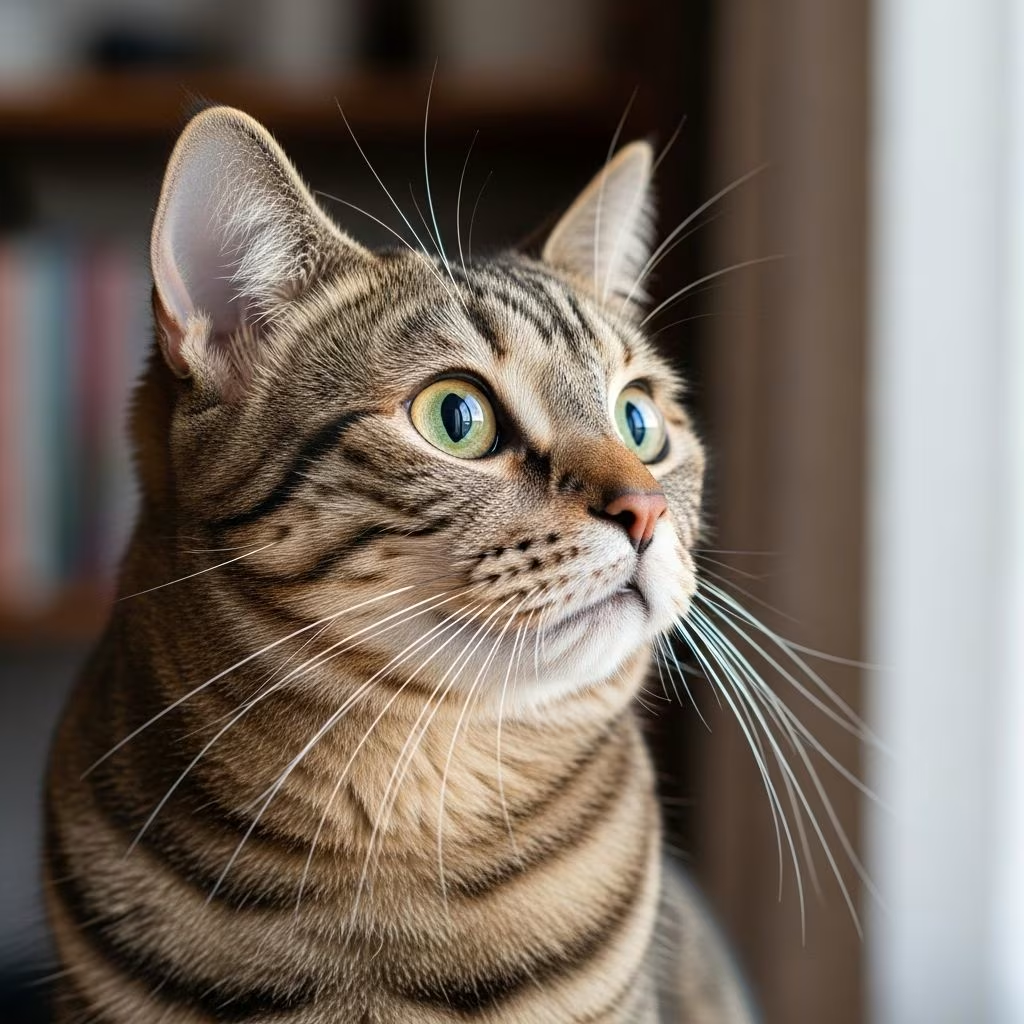
Why Are Cats So Curious? Understanding Feline Behavior
Cats are undeniably curious creatures. From knocking objects off counters to squeezing into impossibly tight spaces, felines exhibit behaviors that often baffle their human companions. This curious nature isn’t random—it’s deeply rooted in their evolutionary history and biological makeup. Understanding why cats are so curious helps us appreciate their quirky antics and provides insight into their unique personalities and needs.
The Evolutionary Origins of Feline Curiosity
Survival instinct is at the core of why cats are curious animals. Cats are mesopredators, meaning they function as both predators and prey in the animal kingdom. This dual role shaped their ancestors’ behavior in profound ways. Unlike apex predators that can afford to ignore their surroundings, wild cats had to constantly monitor their environment for two critical reasons: to identify food opportunities and to detect potential threats.
As Dr. Mikel Delgado, a feline behavior expert, explains, “Cats must always be aware of what is going on in their surroundings. They can’t afford to miss an opportunity to eat, but they must also be cautious of any dangers.” This constant need for observation, investigation, and learning—in essence, curiosity—became an essential survival tool that cats passed down through generations.
This evolutionary drive remains strong in modern domestic cats. Even though your pet cat likely has a full food bowl at home, the ancestral drive to investigate and explore persists. Your cat’s behavior is an echo of thousands of years of evolutionary adaptation.
Superior Sensory Abilities Fuel Curiosity
Part of what makes cats so curious is their extraordinary sensory perception. Cats experience the world in ways vastly different from humans, and their heightened senses naturally draw them toward investigation and exploration.
- Sense of smell: A cat’s nose contains 40 times more olfactory receptors than a human nose, allowing them to detect scents imperceptible to us.
- Vision: Cat eyes have six to eight times more rods than human eyes, giving them superior night vision and motion detection.
- Hearing: Cats can detect frequencies far beyond human hearing range, picking up ultrasonic sounds from small prey.
- Atmospheric sensitivity: The inner ear of a cat is so sensitive that they can sense a storm rolling in by detecting drops in air pressure.
Living in such a vibrant, stimulus-rich world naturally motivates cats to investigate. When your cat stares intently at a seemingly empty corner or tracks invisible movements, they’re likely responding to sensory information you cannot perceive. This rich sensory environment creates endless opportunities for curiosity.
Intelligence and Curiosity Go Hand in Hand
There’s a direct link between intelligence and curiosity in cats. According to researcher Stephen Grand, Ph.D., “Lively minds are by definition curious.” This means that the very trait that makes cats intelligent also drives their curious behaviors.
While a cat stuck in a tree or jammed in a trash can might seem like an example of poor judgment, it’s actually evidence of a smart, inquisitive mind. Curious cats are constantly learning because they’re intelligent enough to recognize that exploring their environment yields valuable information. Each investigation teaches them something new about how their world works.
This connection between intelligence and curiosity explains why indoor cats, which researchers have found to display more curiosity than their outdoor counterparts, may be actively compensating for a less stimulating environment by initiating more contact with objects.
The Critical Learning Period of Kittenhood
Curiosity isn’t equally strong throughout a cat’s life. According to Dr. Mikel Delgado, kittens are most curious during their sensitive learning period, which occurs between two and nine weeks of age. During this crucial window, young cats are motivated to investigate everything in their environment to determine what is safe and what poses a threat.
When encountering something new, a kitten follows a predictable pattern: watch, slowly approach, then touch, smell, or taste the object. This methodical exploration strategy helps kittens build mental maps of their world and form associations that last a lifetime.
As cats age beyond the sensitive period, they don’t lose their curiosity entirely—they simply become slower to form new positive associations. Older cats are more wary of novel experiences but can still learn and adapt. The difference is that an adult cat requires more time and positive reinforcement to feel comfortable with new stimuli compared to a curious kitten experiencing the world for the first time.
The Hunger-Curiosity Connection
While hunger clearly motivates cats to search for food, the relationship between hunger and curiosity is more complex than it might appear. A cat will scope out countertops and explore new areas searching for snacks even immediately after eating a full meal.
This behavior reflects the evolutionary reality of wild cats, where meals weren’t guaranteed. The drive to search for food became hardwired into feline behavior, independent of immediate hunger sensations. In modern homes, this translates to cats curiously investigating food-related areas out of instinct rather than genuine need.
Curiosity as an Alert System
Alertness is a survival mechanism, and curiosity serves as the vehicle for maintaining it. When cats explore new spaces, they’re simultaneously gathering information about potential threats and opportunities. Both bold and timid cats will display enough curiosity to locate safe hiding spots or vantage points from which to defend themselves or attack passing prey.
Bold cats tend to express curiosity more openly, touching, smelling, and tasting new environments to identify food sources, water, and suitable bathroom locations. Timid cats may approach with more caution, but they still engage in investigative behavior because it serves their safety needs. In essence, curiosity is a cat’s way of maintaining control over their environment.
Curiosity and Social Bonding
Beyond survival and physical needs, curiosity plays an important role in social bonding for cats. Researcher R.A. Butler explored the concept that curiosity isn’t driven solely by biological needs like hunger or thirst, but by deeper psychological drives including the need for love and belonging.
Research has demonstrated that cats’ behavior and curiosity levels are influenced by their owners’ emotions. In studies where cats were shown objects designed to evoke specific emotional responses in their owners, cats mirrored their owners’ reactions 79% of the time. When owners displayed enthusiasm and curiosity, their cats became more curious. Conversely, when owners exhibited negative emotions, their cats displayed more hesitant and cautious behavior.
This emotional contagion suggests that cat curiosity isn’t just about the cat’s individual temperament—it’s intertwined with the emotional environment their humans create. A cat living with an engaged, curious owner is more likely to exhibit heightened curiosity themselves.
Common Curious Cat Behaviors Explained
Perching in High Places
Cats’ love of high vantage points stems directly from their curious, investigative nature. Being elevated offers protection from ground-level predators while providing an excellent viewpoint to survey their territory and spot potential prey. However, some cat breeds, like Persians, naturally prefer staying closer to the ground, showing that curiosity expression varies among individual cats.
The “Zoomies” and Play
When your cat suddenly races around the house at top speed, they’re releasing pent-up energy in a way that reflects their curious nature. These spontaneous bursts of activity are common in cats of all ages and represent normal behavior as cats explore and interact with their environment.
Chattering and Prey Drive
When cats chatter at birds or other prey animals they can see but not reach, they’re expressing a mixture of excitement about spotted prey and frustration at the barrier preventing capture. This behavior demonstrates how curiosity and hunting instinct intertwine in feline psychology.
Early Socialization and Curiosity Development
The level of socialization a kitten receives has long-lasting effects on how curious they become as adults. Kittens raised around humans who express enthusiasm and curiosity naturally develop more curious temperaments themselves. In contrast, kittens raised in environments with less social interaction may develop more cautious, less exploratory personalities.
This underscores an important point: cat curiosity isn’t entirely predetermined by genetics. While evolutionary instincts create the foundation for curious behavior, environmental factors and human interaction significantly shape how that curiosity is expressed throughout the cat’s life.
Why Some Cats Seem Less Curious Than Others
Not all cats display curiosity equally. Research suggests that cats may prefer predictability and feel more secure in familiar environments. Additionally, cats can exhibit avoidant or hesitant behavior around unfamiliar humans, which affects their willingness to engage in curious exploration.
Individual personality, breed characteristics, early socialization, and current living situation all influence how curious a particular cat appears to be. An indoor cat in a predictable environment may seem less curious than an outdoor cat, though indoor cats often compensate by showing increased curiosity about indoor objects and changes to their home.
Frequently Asked Questions (FAQs)
Q: Is it normal for cats to be so curious about everything?
A: Yes, curiosity is a natural and normal feline behavior rooted in evolutionary survival instincts. However, the degree of curiosity varies between individual cats based on genetics, early socialization, and personality.
Q: Can curiosity be dangerous for cats?
A: Excessive curiosity can sometimes lead cats into unsafe situations, such as getting stuck in tight spaces or investigating toxic substances. Providing a safe, cat-proofed environment while encouraging healthy exploration helps balance their natural curiosity with safety.
Q: Do older cats lose their curiosity?
A: Cats don’t lose curiosity as they age, but they become more cautious about new experiences and slower to form positive associations with unfamiliar stimuli. Senior cats remain curious but are more selective about what they investigate.
Q: How can I encourage my cat’s natural curiosity?
A: Provide enrichment toys, create vertical spaces for exploration, rotate objects in their environment, and engage with your cat through interactive play. Your own enthusiasm and curiosity will positively influence your cat’s exploratory behavior.
Q: Why does my cat investigate new objects so carefully before interacting with them?
A: This methodical approach—watching, approaching slowly, then touching, smelling, and tasting—is a survival strategy kittens learn during their sensitive period. It allows cats to assess whether something is safe before fully engaging with it.
Q: Does a cat’s curiosity indicate intelligence?
A: Yes, curiosity and intelligence are directly linked. More intelligent cats tend to be more curious because they recognize that exploration provides valuable information about their environment, making them better able to learn and adapt.
References
- 8 Reasons Cats Are Curious & How They Show It — Rover.com. Accessed January 2026. https://www.rover.com/blog/why-are-cats-so-curious/
- Cats and Science: Three Studies to Explain Their Behaviour — Oasy. Accessed January 2026. https://www.oasy.com/en/pet-news/useful-tips/studies-to-understand-cats-behaviour
- Curious Cat Behaviors Explained — Wisdom Panel. Accessed January 2026. https://www.wisdompanel.com/en-us/blog/curious-cat-behaviors-explained
- 8 (Very Very Cute) Facts About Cats, According to Science — BBC Science Focus Magazine. Accessed January 2026. https://www.sciencefocus.com/nature/cat-facts-science
- Unanswered Questions and Hypotheses About Domestic Cat Behavior and Cognition — National Institutes of Health. Accessed January 2026. https://pmc.ncbi.nlm.nih.gov/articles/PMC8532687/
- Not So Curious After All: New Study Finds Cats Prefer Predictability — University of Sussex. Accessed January 2026. https://www.sussex.ac.uk/broadcast/read/68547



