

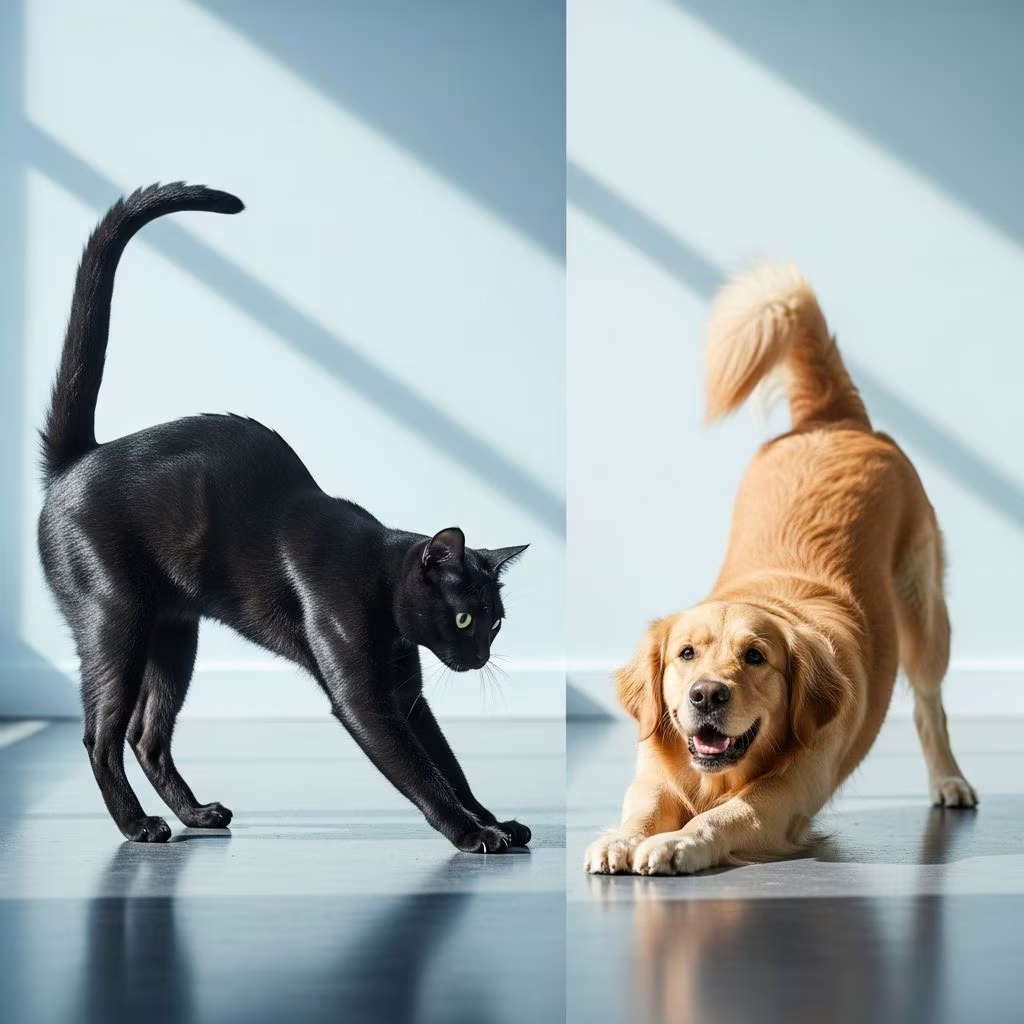
Why Are Cats More Flexible Than Dogs?
Have you ever wondered why your cat can twist and contort their body in ways that seem almost impossible, while your dog struggles to even scratch their back? The difference between these two beloved pets goes far deeper than just personality and behavior. The truth lies in their anatomy. A cat’s spine is significantly more flexible than that of a dog, thanks to increased elasticity in the discs between their bones. This fundamental difference explains not only why cats can perform incredible feats of agility but also why they have different athletic abilities and hunting strategies. Understanding these anatomical differences provides fascinating insights into how evolution has shaped these two species.
How Cats Are So Flexible
Cats are solitary hunters that rely on stealth, explosive power, and remarkable flexibility to catch their prey. Unlike dogs, they don’t hunt in packs or chase their quarry to exhaustion. Instead, cats use short bursts of speed combined with their extraordinary flexibility to pounce on unsuspecting prey. This hunting strategy has directly influenced their physical evolution over millions of years.
One of the most impressive demonstrations of a cat’s flexibility is their jumping ability. From a sitting crouch, a cat can jump up to nine times their own height, and they can change direction in a split second while twisting their spine mid-fall to land on all fours. This remarkable ability to right themselves in the air is one reason cats almost always land on their feet. But what makes this possible?
The Elastic Spine
The foundation of a cat’s flexibility lies in their spine. Scientists at the Cornell Feline Health Center have found that cats have a much more elastic spinal column than humans, dogs, and many other animals. Cats possess 30 vertebrae, with up to 53 additional small bones in their tails, compared to humans who have only 33 vertebrae total. This increased number of vertebrae allows for greater flexibility throughout the body.
The vertebral bones in cats have increased elasticity in the discs between bones when compared to dogs. These intervertebral discs are highly elastic, allowing cats to twist and rotate their bodies, especially when falling through the air. In fact, cats can twist their bodies almost 180 degrees from side to side, compared to humans who can only rotate about 90 degrees. The bones in a cat’s spine and the discs are much more loosely connected than in dogs, giving them even higher flexibility. This loose connection is key to their remarkable range of motion.
Additionally, cats have more thoracic and lumbar vertebrae than humans. Cats have 13 thoracic vertebrae and seven lumbar vertebrae, compared to humans who have 12 and five respectively. This structural difference significantly increases the range of movement possible in a cat’s body.
The Pelvis and Shoulders
Beyond the spine itself, a cat’s pelvis and shoulders are more loosely attached to their backbone than a dog’s. This loose attachment means that the cat’s entire body can move with greater freedom. The flexibility of the shoulders and pelvis allows cats to squeeze through tight spaces, rotate their bodies in unexpected ways, and maintain balance while performing complex movements. This anatomical advantage explains why cats can navigate narrow spaces that dogs simply cannot access.
Why Cats Don’t Have Back Problems
One interesting consequence of a cat’s flexible spine is that cats don’t have the back problems that dogs tend to experience. The loose connections and increased elasticity in cat vertebrae distribute stress more evenly throughout the spine, preventing the concentrated pressure that leads to degenerative disc disease and other spinal issues common in dogs. This is a significant advantage that has kept cats relatively free from chronic back pain throughout their evolutionary history.
A Big Physical Difference: The Nuchal Ligament
One of the most significant physical differences between cats and dogs involves a little-known tendon in the neck called the nuchal ligament. This ligament attaches the head to the spine and was originally designed to stabilize the head in animals that run fast and far. Dogs have a well-developed nuchal ligament, similar to the one found in horses, which supports the head without using muscles. This adaptation saves energy and makes the animal more efficient during long-distance running.
Humans and horses also possess nuchal ligaments, and this shared adaptation marks them as unique long-distance runners. But here’s where cats differ significantly: cats don’t have a nuchal ligament in the same way that dogs, humans, and horses do. This absence is directly related to their evolution as solitary hunters who rely on short bursts of speed rather than sustained long-distance running. The lack of a nuchal ligament means cats must use their neck muscles to support their head, but this trade-off allows for the greater flexibility they need for hunting and evasion.
The nuchal ligament tells an important evolutionary story. While dogs lost dexterity in their front limbs and evolved relatively weaker neck muscles needed to take down prey alone, they compensated by evolving group hunting techniques. This trade-off made them better suited for pack hunting but less flexible overall.
Unique Skeletal Features Contributing to Flexibility
Beyond the spine and neck structures, cats possess several other unique skeletal features that contribute to their overall flexibility:
- Free-floating collarbones: Cats have two tiny collarbones (clavicles) that are not attached to other bones. This unique structure allows their front legs to move independently from their body and lets them squeeze through spaces that seem impossibly narrow. In contrast, many mammals, including humans and dogs, have large collar bones that stay fixed in position and prevent chest flattening.
- Flexible tail: Cats have many small bones in their tails with very little space between them. This construction gives their tails exceptional flexibility, allowing them to use their tails for balance, communication, and adjustment while jumping or climbing.
- Specialized muscle arrangement: Cats possess more muscle fibers that allow for quick, agile movements. These specialized muscles enhance their ability to leap and pounce with precision and enable the rapid body adjustments they make during hunting or righting themselves mid-fall.
- Retractable claws: While not strictly skeletal, cats’ retractable claws provide traction similar to runner’s spikes, allowing them to maintain grip and balance during their flexible movements.
Are Dogs Or Cats Faster?
When comparing the speed and athletic abilities of cats and dogs, it’s important to understand that these animals are optimized for different types of movement and endurance.
Cat Speed and Sprinting Ability
A cat can stretch their body and run with a stride length that is three times their body length. A cat’s flexible spine, powerful muscles, and retractable claws all contribute to top speeds of around 30 miles per hour. There’s a reason the cheetah is the fastest land animal in the world—felines are built for speed in short bursts. However, a cat can only sustain this kind of anaerobic activity for very short periods of time, which makes cats fantastic sprinters but terrible distance runners. This limitation doesn’t trouble most cats, as their hunting strategy doesn’t require sustained speed.
Dog Speed and Endurance
Dogs, by contrast, are exceptional long-distance runners. Some dogs, such as Greyhounds, have top speeds of 45 miles per hour, but they can only maintain that speed for short distances. Most dogs, though, are capable of speeds closer to 15 to 20 miles per hour, depending on their size and breed. The crucial difference is that dogs can maintain a long-distance jog that cats cannot and, honestly, choose not to. This endurance comes from their nuchal ligament and their evolution as pack hunters who needed to pursue prey over long distances.
Speed Comparison Table
| Attribute | Cats | Dogs |
|---|---|---|
| Top Speed | ~30 mph (most species) | 15-45 mph (breed dependent) |
| Sprint Distance | Short bursts only | Short to moderate distances |
| Endurance Running | Poor | Excellent |
| Hunting Strategy | Stealth and explosive power | Pursuit and pack coordination |
| Jumping Ability | Up to 9x their height | Varies by breed (typically 1-3x) |
The Role of Evolution in Flexibility
Evolution is the biggest reason that cats are more flexible than dogs. Dogs evolved to be pack hunters and developed the ability to keep their heads in a position low to the ground to use their keen sense of smell to hunt for prey. This evolution favored a more rigid spine and the development of the nuchal ligament for efficiency during long-distance pursuits.
Cats, on the other hand, evolved differently. Cats had far more natural enemies than dogs and developed lightning-fast reflexes that demanded a highly flexible spine. Additionally, cats hunt alone as opposed to dogs that hunt in packs. These survival pressures led cats to evolve into incredibly flexible creatures capable of escaping danger and capturing prey through agility and precision rather than endurance and pack coordination.
How Cats Use Their Flexibility in Daily Life
While most house cats no longer need these athletic abilities for survival, their flexibility remains evident in their daily behavior. Cats use their exceptional flexibility to:
- Squeeze through tight spaces and explore confined areas
- Perform acrobatic movements to escape trouble quickly
- Land safely from falls and jumps
- Groom and maintain their coat effectively
- Navigate three-dimensional environments like trees and cat furniture
- Make sharp turns and sudden directional changes
Frequently Asked Questions
Q: How many vertebrae do cats have compared to dogs?
A: Cats have 30 vertebrae plus up to 53 additional small bones in their tails. Dogs have fewer vertebrae overall, making their spines less flexible. The greater number and looser connection of cat vertebrae allows for superior range of motion.
Q: Can cats really always land on their feet?
A: Cats have an exceptional ability to right themselves mid-fall, allowing them to land on their feet in most situations. Their flexible spine, combined with their righting reflex and fluid sense of spatial awareness, makes this possible. However, falls from very low heights or very high heights can still injure cats.
Q: Why don’t cats have a nuchal ligament like dogs?
A: Cats lack the specialized nuchal ligament because they evolved as solitary hunters relying on short bursts of speed and flexibility rather than long-distance endurance running. The trade-off allowed for greater neck and spine flexibility needed for their hunting strategy.
Q: Are flexible spines in cats better for their health?
A: Yes, in many ways. Cats’ flexible spines with loosely connected vertebrae and elastic discs distribute stress more evenly, which is why cats are less prone to degenerative disc disease and chronic back problems that commonly affect dogs.
Q: Why can’t cats run long distances like dogs?
A: Cats evolved as sprint hunters who rely on short bursts of speed and flexibility. Their anatomy is optimized for anaerobic activities rather than sustained aerobic exercise. They can only maintain top speeds for very short periods before exhaustion sets in, making them poor distance runners.
References
- Why Are Cats More Flexible Than Dogs? — Kinship. 2024. https://www.kinship.com/pet-behavior/why-are-cats-more-flexible-than-dogs
- Why Are Cats So Flexible? Vet-Verified Facts & Reasons — Catster. 2024. https://www.catster.com/lifestyle/why-are-cats-so-flexible/
- Why Cats’ Joints Are More Flexible Than Dogs’ — Nutreats. 2024. https://nutreats.co.nz/blogs/nutreats-dog-hub/why-cats-joints-are-more-flexible-than-dogs
- Dogs and Cats Couldn’t Be More Different — Bark & Whiskers. 2017. https://www.barkandwhiskers.com/2017-05-04-nl-differences-between-dogs-cats/
- Why Are Cats More Flexible Than Dogs? — PetGuide360. 2024. https://www.youtube.com/watch?v=q5keBC1SOkw



