

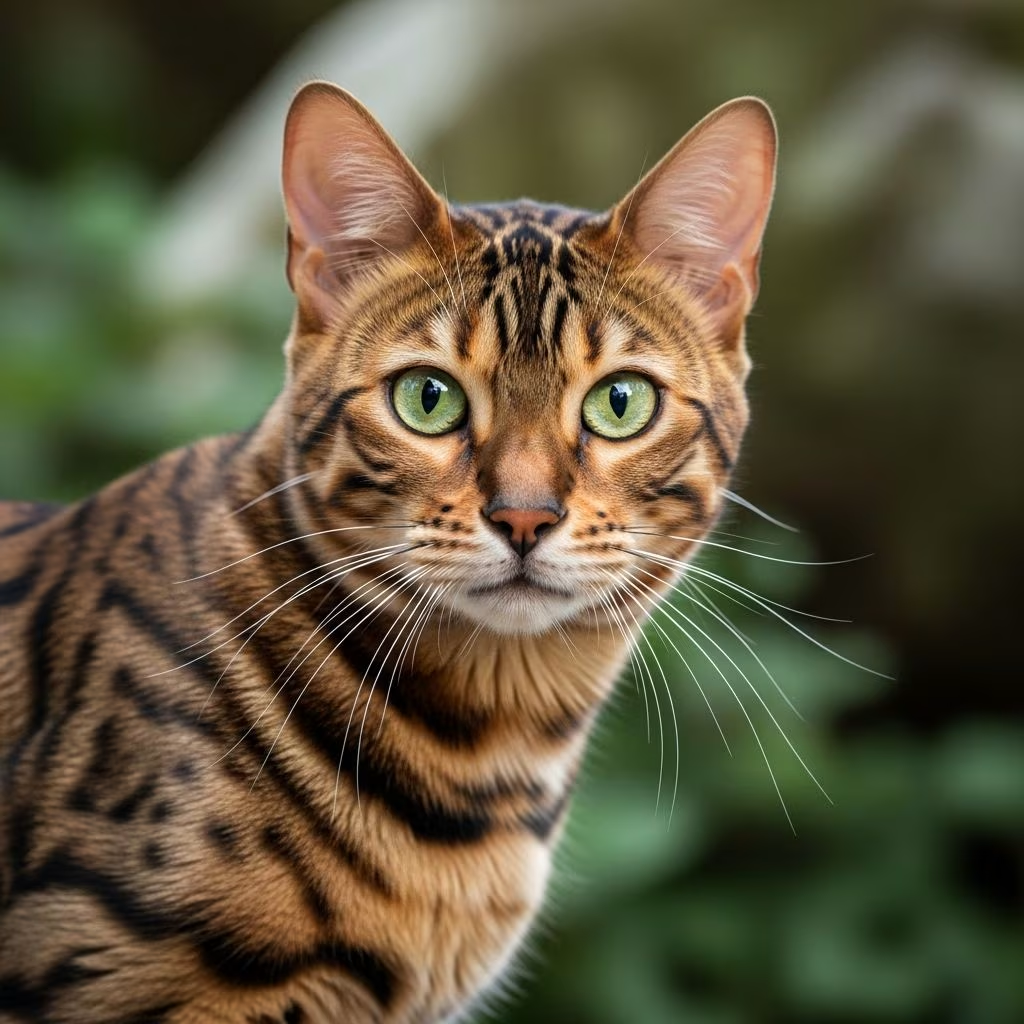
Bengal cats are fully legal to own in the United Kingdom, marking a significant shift from past restrictions. Previously regulated under the 1976 Dangerous Wild Animals Act, these exotic-looking felines saw their licensing requirements lifted in 2007 by the Department for Environment, Food and Rural Affairs (Defra). This change made importing and owning Bengals far more accessible, fostering thriving breeder communities and enthusiast groups across the country.
Today, Bengals are classified as domestic cats in the UK, provided they meet standard breeding criteria. This status reflects confidence in their domestication through selective breeding, distinguishing them from truly wild animals. However, prospective owners should always verify local council rules, as minor variations can exist in urban areas.
Legal status of Bengal cats in the UK
In the UK, Bengal cats enjoy unrestricted ownership rights nationwide. The 2007 deregulation removed all special permits needed under the Dangerous Wild Animals Act, which once treated early-generation Bengals as potential hazards due to their Asian leopard cat ancestry. Post-2007, only general pet ownership laws apply, including microchipping mandates under the Microchipping of Dogs (England) Regulations 2015—soon extending to cats—and standard welfare obligations via the Animal Welfare Act 2006.
Breeders must register with bodies like the Governing Council of the Cat Fancy (GCCF) or The International Cat Association (TICA) for pedigree certification. F1 to F3 Bengals, closer to wild roots, are rare and ethically discouraged in the UK due to health concerns, but F4 and beyond are commonplace and unregulated beyond basic pet laws. This liberalization has boosted Bengal popularity, with registrations surging in shows and households.
Owners report Bengals as vibrant companions, but their high energy demands ample stimulation. UK vets note no elevated risks compared to other active breeds like Abyssinians, supporting the legal stance.
Historical context behind Bengal cat restrictions
The Bengal breed originated in the 1970s when American breeder Jean Mill crossed domestic cats with Asian leopard cats (Prionailurus bengalensis) to create a domestic cat with wild aesthetics. The first cross produced F1 hybrids—fertile females with 50% wild genetics—followed by backcrossing: F2 (one F1 parent), F3 (one F2), and so on. Each generation dilutes wild traits, with F4+ considered fully domestic by most standards.
- F1: 50% Asian leopard cat; often wild-like, illegal in many places.
- F2: 25% wild; high energy, spotting issues.
- F3: 12.5% wild; transitioning to domestic.
- F4: 6.25% wild; standard pet Bengals begin.
- F5+: <3% wild; legally domestic everywhere except strict bans.
In the UK, early F1-F2 Bengals triggered 1976 Act licensing due to size (up to 15kg), strength, and instincts like spraying or aggression. By 2007, evidence showed F4+ Bengals posed no greater threat than other cats, prompting deregulation. This mirrors global trends where generational thresholds define ‘domestic’ status.
Why Bengal cats are illegal in some countries
Bengal restrictions stem from fears of ecological disruption, disease transmission, and retained wild behaviors. Countries with fragile biodiversity prioritize native species protection, viewing hybrids as ‘invasive’.
Australia: A complete import ban applies since recent years, reversing prior F5+ allowances. Bengal cats risk preying on endemic wildlife like quails and lizards, while carrying toxoplasmosis—a parasite fatal to seals and possums. Existing owners comply with state rules like desexing.
Hawaii (USA): All Bengals are banned to safeguard monk seals and birds. Toxoplasmosis from cat feces contaminates ocean waters, killing seals—the species’ top mortality cause. Feral cat threats amplify concerns, despite applying to all breeds.
New York City (USA): Bengals classify as ‘exotic’, prohibited citywide regardless of generation. Statewide, F5+ are allowed, but urban density heightens escape risks. Enforcement varies; breeders operate discreetly.
Other hotspots: Connecticut and Hawaii ban all generations. Alaska, Iowa require F4+. Ireland, Singapore, Hong Kong limit to F5+. New Zealand’s Southland needs permits; offshore islands ban them. Seattle and Denver impose city limits.
| Country/Region | Status | Generation Allowed | Main Reason |
|---|---|---|---|
| UK | Legal | All (F4+ common) | Deregulated 2007 |
| Australia | Banned (import) | None new | Ecosystem protection |
| Hawaii | Banned | None | Toxoplasmosis, birds |
| NYC | Banned | None | Exotic classification |
| Ireland | Restricted | F5+ | Import controls |
Consequences of owning Bengal cats illegally
Violating Bengal laws invites severe repercussions, varying by jurisdiction. Ignorance isn’t a defense; sellers may mislead on regulations.
In New York City, fines reach thousands, with cat confiscation and euthanasia possible. Owners face court, criminal records. Australia’s federal biosecurity laws impose $420,000 fines or 10-year jail for imports. Hawaii quarantines indefinitely; non-compliance leads to destruction.
Steps for compliance:
- Check state/federal laws via official sites like USDA APHIS (US) or DEFRA (UK).
- Review county/municipal codes—cities like NYC override states.
- Contact animal control or clerks for permits.
- Retain pedigree papers proving F5+ status.
- Desex and microchip to mitigate roaming risks.
Moving? Re-verify laws. A 2023 petition in the UK to criminalize ‘aggressive’ Bengals like roamers causing damage was rejected, affirming no special rules.
Bengal cats: frequently asked questions
Where are Bengal cats illegal?
Bengals are fully banned in Hawaii, Connecticut, and Australia’s imports. NYC, Seattle, Denver restrict them. Ireland/Singapore/Hong Kong allow F5+ only.
What is the problem with Bengal cats?
Primary issues: toxoplasmosis spread harming wildlife; predation on birds/reptiles; potential hybridization diluting native cats. Early generations retain wild traits like aggression or poor litter habits. Critics argue all cats pose similar risks if feral.
Why are Bengal cats illegal in the UK?
They aren’t—regulations ended in 2007. UK views F4+ Bengals as domesticated, no riskier than other breeds.
Why are Bengal cats not good pets?
Bengals suit active homes needing stimulation; they’re not low-maintenance. High intelligence demands toys, training; boredom leads to mischief. Best for experienced owners.
Can I own an F1 Bengal?
Rarely legal outside private sanctuaries due to wildness. UK allows but discourages; most countries ban.
Are Bengal cats aggressive?
Properly socialized F4+ are playful, not aggressive. Early gens may be; a rejected UK petition highlighted rare roaming incidents.
Bengals captivate with leopard spots, athleticism, and loyalty. Legality hinges on location and generation—research thoroughly for responsible ownership.
References
- Are Bengal Cats Legal In the UK? — Kinship.com. 2023. https://www.kinship.com/uk/cat-lifestyle/why-are-bengal-cats-illegal
- Change the law regarding the ‘right to roam’ for aggressive cats — UK Parliament Petitions. 2023-09-12. https://petition.parliament.uk/petitions/594373
- Why Are Bengal Cats Illegal in Some States & Countries? — Hepper. 2024. https://articles.hepper.com/why-are-bengal-cats-illegal-in-some-states-countries/
- Bengal cat — Wikipedia (citing official sources). 2024-01-10. https://en.wikipedia.org/wiki/Bengal_cat
- The Bengal Cat — The Cat is in the Box. 2023. https://thecatisinthebox.com/blogs/kitty-contemplations/the-bengal-cat
- Bengal Cat Breed Information — Purina UK. 2024. https://www.purina.co.uk/find-a-pet/cat-breeds/bengal



