Whipworm Infection in Cats: Causes, Symptoms, and Treatment
Complete guide to understanding, diagnosing, and treating whipworm infections in cats.
What Are Whipworms?
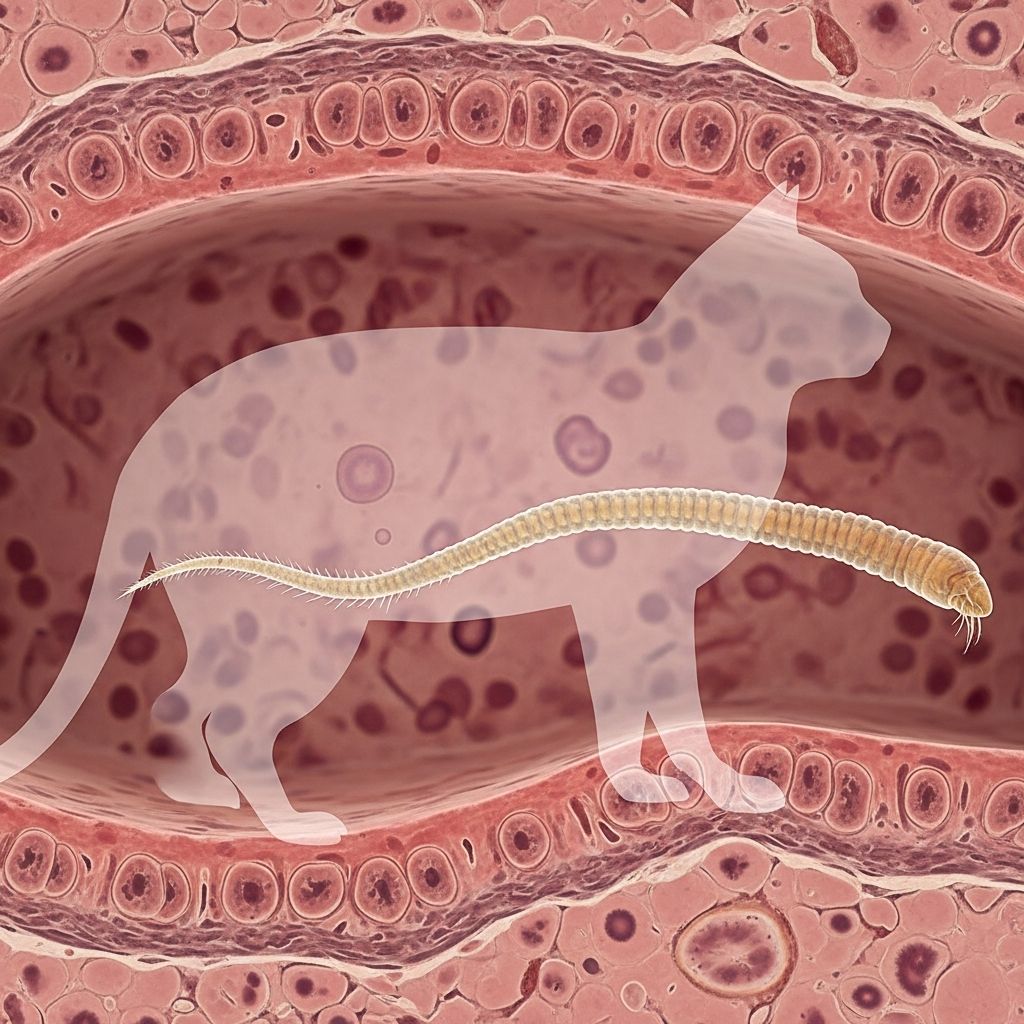
Whipworms are parasitic nematodes that inhabit the cecum and large intestine of infected cats. These microscopic organisms derive their name from their distinctive whip-like appearance, with a thin anterior end and a thicker posterior region. The scientific name for the feline whipworm is Trichuris felis, which may also be referred to as Trichuris serrata or Trichuris campanula. Unlike some other intestinal parasites that are readily visible to the naked eye, whipworms remain microscopic throughout their lifecycle in the cat’s body, making them impossible to detect without proper diagnostic testing.
Whipworm infections are relatively uncommon in domestic cats across North America, but they are significantly more prevalent in tropical and subtropical regions, including areas such as the Caribbean and South America. The rarity of whipworm infections in cats in temperate climates is largely attributable to the widespread use of broad-spectrum parasite preventative medications that provide protection against multiple parasitic infections simultaneously.
How Do Cats Get Whipworms?
Whipworm transmission occurs through the ingestion of mature whipworm eggs that have reached an infectious stage in the environment. The lifecycle of whipworms involves several critical stages that pet owners should understand to better protect their cats.
The Whipworm Lifecycle
When an infected cat passes feces containing whipworm eggs, these eggs enter the environment and begin a maturation process. The eggs require approximately 9 to 21 days of development in suitable environmental conditions before they become capable of infecting a new host. During this maturation period, the eggs become increasingly infectious, and any contact with contaminated soil, feces, or surfaces can lead to new infections.
A new host becomes infected by ingesting these mature eggs, typically through environmental contamination. Cats may acquire whipworms by walking through contaminated areas and subsequently grooming their paws, sniffing contaminated materials, or consuming food and water sources that have been contaminated with mature whipworm eggs. Kittens and outdoor cats face elevated risk of infection compared to indoor cats, as they have greater exposure to contaminated environments.
Symptoms of Whipworm Infection in Cats
One of the most perplexing aspects of whipworm infections in cats is that many infected animals display minimal to no clinical symptoms. Light infections typically produce no observable signs of illness, which can delay diagnosis if routine fecal screening is not performed.
Mild to Moderate Infections
Cats with light to moderate whipworm burdens may show subtle signs or remain completely asymptomatic. In these cases, the infection is often discovered incidentally during routine veterinary visits when fecal screening is performed for preventive health purposes.
Severe Infections
In high-risk cats or those with heavy parasitic loads, more pronounced clinical signs may develop. Symptoms of severe whipworm infection include:
- Gooey or mucoid diarrhea
- Blood in the feces, with or without visible mucus
- Intestinal inflammation
- Weight loss and failure to thrive
- Dehydration
- General malaise or lethargy
- Anemia (low red blood cell count)
The severity of symptoms correlates directly with the worm burden and the inflammatory response triggered in the cecum and colon. As parasitic infection intensifies, the inflammatory and occasionally hemorrhagic reaction in these regions becomes more pronounced, leading to the clinical manifestations described above.
Diagnosis of Whipworm Infection
Accurate diagnosis of whipworm infection requires laboratory testing and professional veterinary evaluation. Several diagnostic approaches are available to confirm the presence of whipworm infections in cats.
Fecal Examination
Microscopic examination of fecal samples remains the primary diagnostic tool for whipworm detection. The veterinarian will look for characteristic whipworm eggs within the fecal material using specialized flotation techniques with centrifugation. This method is cost-effective and provides rapid results in many cases. However, whipworms can be challenging to detect because they shed eggs inconsistently, and a single negative fecal test does not completely rule out infection.
Advanced Diagnostic Testing
When standard fecal flotation fails to identify whipworms but infection is still suspected, additional diagnostic methods may be employed. Fecal tests for specific parasite antigens can detect the presence of whipworm antigens in the stool. Additionally, PCR (polymerase chain reaction) testing uses genetic material to identify whipworm DNA and is particularly useful when whipworms are presumed but not confirmed by routine fecal examination. PCR testing typically requires sending fecal samples to specialized outside laboratories for analysis.
Additional Testing
Your veterinarian may also recommend a complete blood count (CBC) to assess for anemia, which can develop in cases of heavy parasitic infection due to blood loss from intestinal damage.
Treatment of Whipworm Infection
Once whipworm infection is confirmed through diagnostic testing, treatment is straightforward and highly effective. Several antiparasitic medications have proven efficacy against whipworms in cats.
Effective Antiparasitic Medications
Multiple drugs are available for treating whipworm infections in cats, including:
- Fenbendazole (Panacur®) — A widely used oral dewormer medication often prescribed for several days or longer as needed
- Milbemycin oxime (Interceptor®) — An effective broad-spectrum antiparasitic agent
- Moxidectin + imidacloprid (Advantage Multi®) — A combination product providing protection against multiple parasites
- Emodepside + praziquantel (Profender®) — An effective combination therapy for intestinal parasites
All of these medications require repeated treatments that are appropriately spaced to achieve complete clearance of the infection.
Treatment Protocol and Duration
Most whipworm treatments require an initial course of medication followed by repeated doses. Typically, two treatments spaced three to four weeks apart are recommended as the initial protocol. However, the most frustrating aspect of whipworm infections is the high rate of re-infection, as whipworm eggs are extremely hardy and persistent in the environment. Therefore, if a cat is diagnosed with whipworm infection, it is advisable to treat the animal again every three to four months to prevent recurrence.
Simplified Prevention Approach
A simpler alternative to repeated treatment protocols is to place the cat on a heartworm and flea preventative product that contains whipworm preventive coverage. This approach simplifies medication administration and reduces the burden of remembering quarterly treatments while providing continuous protection.
Recovery and Prognosis
The prognosis following treatment for whipworm infection is excellent in most cases. Cats typically respond well to antiparasitic therapy, and few side effects from the medication are expected. After treatment, it is important to have your cat’s stool reexamined after several weeks to ensure complete clearance of the infection. Another treatment may be recommended after a few months to prevent re-infection.
Throughout the recovery process, supportive care measures such as ensuring adequate hydration, proper nutrition, and monitoring for resolution of clinical signs are important. Most cats return to normal health rapidly following successful treatment.
Prevention of Whipworm Infection
Prevention is significantly more convenient than treatment, and several strategies can effectively reduce the risk of whipworm infection in cats.
Environmental Hygiene
The primary prevention method involves prompt removal and proper disposal of cat feces from the environment. Whipworm eggs are extremely hardy and can survive in soil and other environmental surfaces for extended periods. By maintaining strict fecal hygiene and removing feces promptly, the accumulation of infectious eggs in the cat’s environment can be minimized.
Regular Veterinary Testing
Regular fecal examinations performed by your veterinarian help identify infections early, often before clinical signs develop. These routine screenings are particularly valuable for cats at elevated risk of exposure, such as those with outdoor access or living in tropical or subtropical climates.
Parasite Prevention Products
Using veterinarian-recommended parasite control products that provide protection against whipworms offers comprehensive prevention. Many modern heartworm, flea, and tick preventatives include whipworm coverage, providing broad-spectrum protection with a single product.
Contagion Prevention
Whipworms are contagious to other cats. This transmission can be prevented by removing feces promptly from shared environments and testing cats for whipworms when applicable, particularly in multi-cat households.
Environmental Cleaning
If a cat is diagnosed with whipworms, thorough cleaning of the environment and removal of sources of fecal contamination is important to reduce the risk of re-infection and transmission to other cats.
Risk Factors for Whipworm Infection
Certain factors increase the likelihood of whipworm infection in cats. Outdoor cats face significantly elevated risk compared to indoor cats due to their exposure to contaminated soil and feces. Cats living in tropical or subtropical climates experience higher incidence rates of whipworm infection than those in temperate regions. Additionally, kittens may be at increased risk due to their developing immune systems and their tendency to explore their environment through oral investigation.
Contagiousness and Multi-Cat Households
If you have multiple cats and one is diagnosed with whipworms, it is essential to implement strict hygiene protocols to prevent transmission to other cats. Regular fecal testing of all cats in the household is recommended, along with prompt removal of feces and appropriate environmental cleaning. Some veterinarians may recommend prophylactic treatment of all cats in the household following diagnosis in one animal.
Frequently Asked Questions
Q: How common are whipworms in cats?
A: Whipworms are rare in domestic cats in North America but are more prevalent in tropical and subtropical climates such as the Caribbean and South America.
Q: Can I see whipworms in my cat’s feces?
A: No, whipworms are microscopic organisms that cannot be seen with the naked eye. Diagnosis requires microscopic examination or advanced laboratory testing of fecal samples.
Q: Will my cat need treatment multiple times?
A: Yes, due to the high rate of re-infection from environmental contamination, cats diagnosed with whipworms typically require repeated treatments every three to four months or may be placed on continuous preventative medication.
Q: Are whipworms dangerous to humans?
A: The species of whipworm that infects cats (Trichuris felis) is specific to cats and does not pose a significant threat to humans. However, maintaining good hygiene practices is always recommended when handling infected animals or their feces.
Q: How can I prevent whipworm infection in my cat?
A: Prevention strategies include prompt removal of feces, maintaining environmental hygiene, regular fecal examinations by a veterinarian, and using veterinarian-recommended parasite control products that provide whipworm protection.
Q: What should I do if my cat has been diagnosed with whipworms?
A: Contact your veterinarian for appropriate antiparasitic medication, follow the prescribed treatment protocol, have fecal reexaminations performed as recommended, clean your home thoroughly, and implement preventive measures to avoid re-infection and transmission to other cats.
References
- Whipworm Infection in Cats — VCA Animal Hospitals. 2025. https://vcahospitals.com/know-your-pet/whipworm-infection-in-cats
- Whipworms in Cats – Causes, Treatment and Associated Conditions — Vetster. 2025. https://vetster.com/en/conditions/cat/whipworms
- Whipworms in Small Animals – Digestive System — Merck Veterinary Manual. 2025. https://www.merckvetmanual.com/digestive-system/gastrointestinal-parasites-of-small-animals/whipworms-in-small-animals
- Trichuris vulpis – Companion Animal Parasite Council — Companion Animal Parasite Council (CAPC). 2025. https://capcvet.org/guidelines/trichuris-vulpis/
- Whipworms in Cats – Symptoms, Causes, Diagnosis, Treatment — PetMD. 2025. https://www.petmd.com/cat/conditions/infectious-parasitic/whipworms-cats
- Feline Whipworm Infection — The Drake Center For Veterinary Care. 2025. https://www.thedrakecenter.com/resources/materials/cats/feline-whipworm-infection
Similar Articles








Read full bio of Sneha Tete