

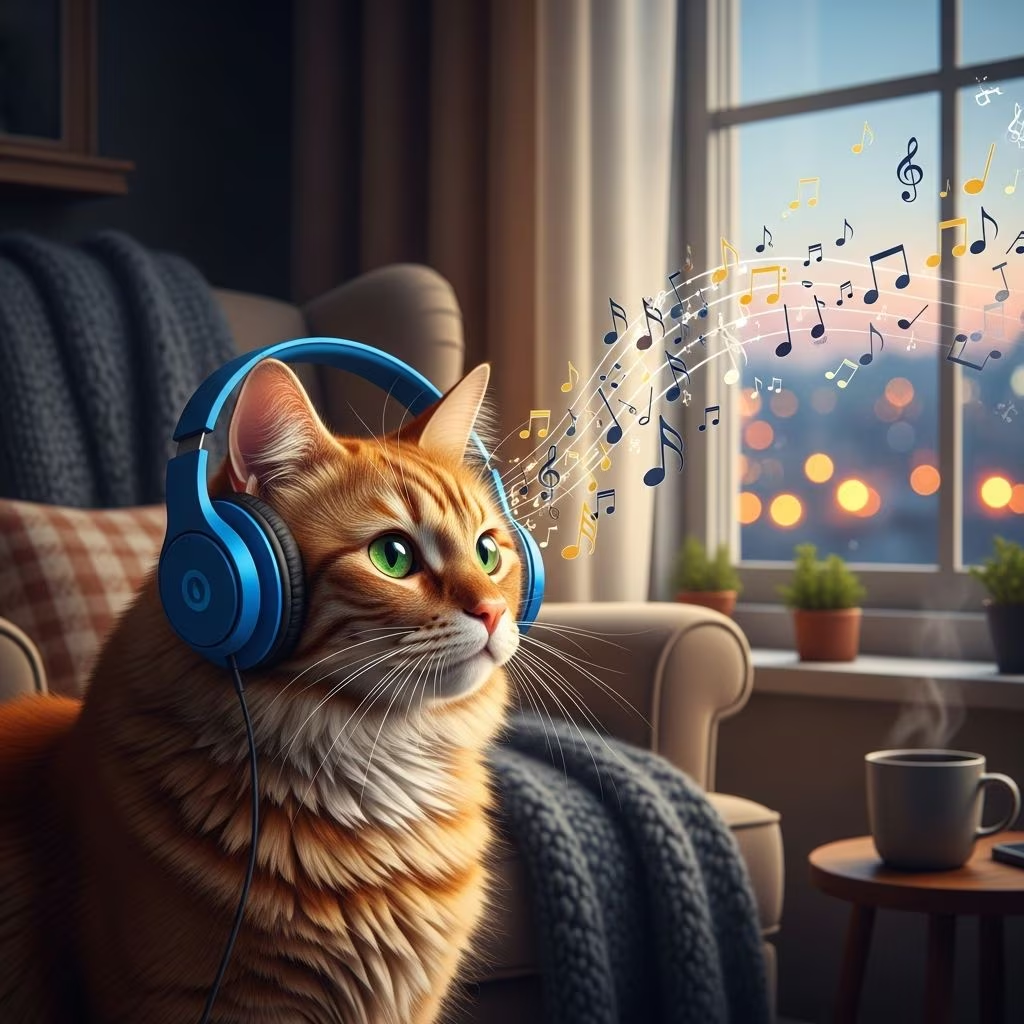
Cats, those enigmatic companions, have long captivated us with their independent spirits and subtle cues. While we humans groove to everything from rock anthems to soothing symphonies, our feline friends process sound differently. Recent scientific research reveals that cats don’t just tolerate music—they have distinct preferences. Unlike popular belief, classical music like Mozart isn’t their top pick. Instead, **cats prefer species-specific music** designed with frequencies, tempos, and timbres mimicking their natural vocalizations, such as purring and birdsong.
This discovery stems from pioneering studies showing cats respond positively—purring, approaching speakers, and rubbing against them—to tunes crafted for their auditory world. Human music often falls flat because it operates in lower frequency ranges irrelevant to cats, who vocalize an octave higher. Understanding these preferences opens doors to better enrichment, stress relief, and bonding. This article dives into the science, practical applications, and tips for playing the right beats for your cat.
Do Cats Like Music?
Yes, cats like music, but not just any kind. A landmark study from the University of Wisconsin-Madison tested 47 domestic cats in their home environments. Researchers played classical human music and cat-specific compositions. Cats ignored or showed neutral responses to classical tracks but displayed significant interest in cat music: approaching speakers faster (average 110 seconds vs. 171 seconds), purring, walking toward the source, and rubbing against it.
Positive responses averaged 1.5 per cat to cat music, totaling 141 across tests, compared to slower and fewer reactions to human music. Aversive behaviors like hissing or arching were rare and similar for both (8-9 instances each). This confirms cats are responsive to auditory enrichment when it’s tailored to their sensory system—pitch one octave higher, tempos matching purring (around 1380 beats per minute), and sliding frequencies from their vocalizations.
Prior assumptions that animals ignore music were debunked. Earlier experiments failed because they used human-centric frequencies below 4,000 Hz, which cats overlook. Cats’ acute hearing (up to 64 kHz vs. humans’ 20 kHz) demands music in their natural communication range.
The Science Behind Cat Music Preferences
David Snowdon, Professor Emeritus at the University of Wisconsin-Madison, and composer David Teie developed the first cat music based on ethological principles. Their 2015 study in Applied Animal Behaviour Science evaluated music through the lens of feline sensory biology: pitch, tempo, and timbre.
- Pitch: Cats vocalize higher than humans, so cat music uses elevated ranges.
- Tempo: One track mimics purring (25-150 Hz, fast pulse); another echoes nursing suckling sounds.
- Timbre: Incorporates sliding frequencies from meows, purrs, and distress calls for emotional resonance.
Sample: ‘Cosmo’s Air’ features a 1380 bpm pulse tied to purring and cat-like vocal slides covering 44% of the track. This mirrors how human music evokes emotions via familiar patterns—extended to species-specific designs. Snowdon’s prior work with cotton-top tamarins showed similar emotional responses in primates, suggesting a universal music principle.
In home tests, cats oriented, approached, and engaged positively more with cat music, validating the approach.
Cat Music vs. Classical Music: A Clear Winner
Classical music was once hailed as universally calming for animals, but data proves otherwise for cats. In the Wisconsin study, cats took longer to respond positively to classical (171 seconds) and showed fewer engagements.
| Metric | Cat Music | Classical Music |
|---|---|---|
| Avg. Positive Response Time | 110 seconds | 171 seconds |
| Positive Responses per Cat (Avg.) | 1.5 | <1.0 |
| Total Positive Responses (47 cats) | 141 | Lower (not quantified) |
| Aversive Responses | 8 | 9 |
No significant differences in aversive reactions, but cat music elicited quicker, stronger positives. Classical’s lower frequencies (often <4 kHz) are inaudible or unappealing to cats. Psychoacoustics expert Snowdon notes: animals need music matching their natural sounds for enrichment.
Benefits of Cat-Specific Music
Beyond preferences, cat music reduces stress. A 2023 study in Journal of Feline Medicine and Surgery (via PMC) tested 90 cats in veterinary clinics. Cats exposed to cat music for 10 minutes pre-exam showed significantly lower Cat Stress Scores (CSS) and Handling Scores (HS) compared to silence or classical.
- CSS (Post-Auditory & Exam): Lower for cat music vs. silence/classical (p<0.05).
- HS: Significantly reduced, easing exams.
- No NLR Change: Physiological markers unchanged, but behavioral stress dropped.
Behaviors: More relaxed postures, less aggression. Authors recommend cat music as environmental enrichment to improve welfare, client comfort, and vet accuracy. Home use counters separation anxiety; play during absences.
Further: Lowers shelter stress, aids multi-cat harmony.
How to Play Music for Your Cat
Introduce gradually at low volume during calm times. Observe reactions: ear perks, purring, approach = success; flattened ears, hiding = adjust.
- Sources: Apps/albums like Music for Cats by Teie (purring/nursing tracks).
- Volume: Conversational level (50-60 dB).
- Duration: 10-30 mins sessions, building tolerance.
- Placement: Near resting spots or carriers for travel.
- Combine: With toys/pheromones for max calm.
Track ‘Hyperbola’ (purring-based) suits anxiety; ‘Cozy’ (nursing) for soothing.
Examples of Cat Music
- Cosmo’s Air: Purring pulse (1380 bpm), vocal slides—top preference in studies.
- Hyperbola: Fast purring tempo for excitement reduction.
- Kitten Songs: Nursing suckles for comfort.
- Birdsong-Inspired: High frequencies mimicking prey calls for engagement.
These evoke emotions akin to human lullabies or anthems, but feline-tuned.
Frequently Asked Questions (FAQs)
What kind of music do cats like best?
Species-specific cat music with purring tempos (1380 bpm), high pitches, and sliding frequencies from vocalizations. Cats prefer it over classical.
Does classical music calm cats?
No, studies show no significant calming effect vs. silence; cats respond slower and less positively.
Can cat music reduce vet visit stress?
Yes, lowers behavioral stress scores (CSS/HS) during exams, improving care quality.
How long to play music for cats?
Start with 10 minutes pre-event; benefits seen in studies after this duration.
Where to find cat music?
Albums like Music for Cats by David Teie; streaming platforms with species-specific tracks.
Final Thoughts
Cat music isn’t a gimmick—it’s science-backed enrichment transforming how we care for felines. From home relaxation to vet calm, tailored sounds respect their biology. Experiment, observe, and watch your cat purr to their beat. Future research may explore long-term effects on health markers like glucocorticoids.
References
- Cats Have Music Preferences Just like Us! — The Cat Counsellor. 2025-07-28. https://thecatcounsellor.com/2025/07/28/research-shows-that-cats-have-music-preferences-just-like-us/
- Move over Mozart: Study shows cats prefer their own beat — Phys.org. 2015-03-18. https://phys.org/news/2015-03-mozart-cats.html
- Effects of music on behavior and physiological stress response in cats undergoing physical examination in a private veterinary clinic — NIH/PMC (Journal of Feline Medicine and Surgery). 2023. https://pmc.ncbi.nlm.nih.gov/articles/PMC10814571/
- Music for Cats — Wisconsin Academy. 2016. https://www.wisconsinacademy.org/magazine/winter-2016/essay/music-cats
- What Kind of Music Do Cats Like? New Study Offers Insights — Pet Health Network. N/A. https://www.pethealthnetwork.com/news-blogs/a-vets-life/what-kind-music-do-cats-new-study-offers-insights
- The Science — Music for Cats. N/A. https://www.musicforcats.com/the-science
- Does Music Affect Animals? Professor Emeritus Snowdon Shares His Research — University of Wisconsin Psychology. N/A. https://psych.wisc.edu/news/does-music-affect-animals-professor-emeritus-snowdon-shares-his-research-with-wpr/



