

What Colours Do Dogs See? A Complete Guide to Canine Vision
Many dog owners have heard the myth that their canine companions see the world entirely in black and white, much like an old television set. However, this common misconception doesn’t reflect the reality of how dogs perceive their surroundings. The truth is far more nuanced and fascinating. Dogs do see colours, but their visual experience differs significantly from how humans interpret the world around them. Understanding what your dog actually sees can help you better appreciate how they interact with their environment and may even improve how you engage with your pet during play and training.
The Myth of Black and White Vision
The persistent belief that dogs see only in shades of grey has been thoroughly debunked by modern science. This misconception likely arose from early research that wasn’t properly understood or was oversimplified in popular culture. In reality, dogs possess a functioning colour vision system, though it operates differently from human vision. The key difference lies in the biological structure of their eyes and how they process light information. While dogs certainly don’t see colours with the vibrancy and range that humans experience, dismissing their colour perception entirely is inaccurate and undermines our understanding of canine biology.
How the Human Eye Differs from a Dog’s Eye
To understand what dogs see, it’s essential to understand how their eyes differ from ours. The retina, located at the back of the eye, contains millions of light-sensing cells that form the foundation of vision. These cells come in two main types: rods and cones.
Rods and Cones: The Building Blocks of Vision
Rods are extremely sensitive cells that excel at detecting movement and function effectively in low-light conditions. They don’t contribute to colour vision but are crucial for night vision and detecting motion. Cones, on the other hand, work in bright light and are responsible for colour perception. Humans have approximately three times more cones than dogs, which gives us superior colour discrimination abilities.
The critical difference between human and dog vision lies in the types and numbers of colour-detecting cells present in their retinas. Humans are trichromatic, meaning they possess three types of cones that detect different wavelengths of light: blue, red, and green. Dogs, by contrast, are dichromatic, possessing only two types of cones: one sensitive to blue wavelengths and another sensitive to red and green wavelengths combined. This fundamental difference in retinal structure creates the distinct differences in how dogs and humans perceive colour.
What Colours Can Dogs Actually See?
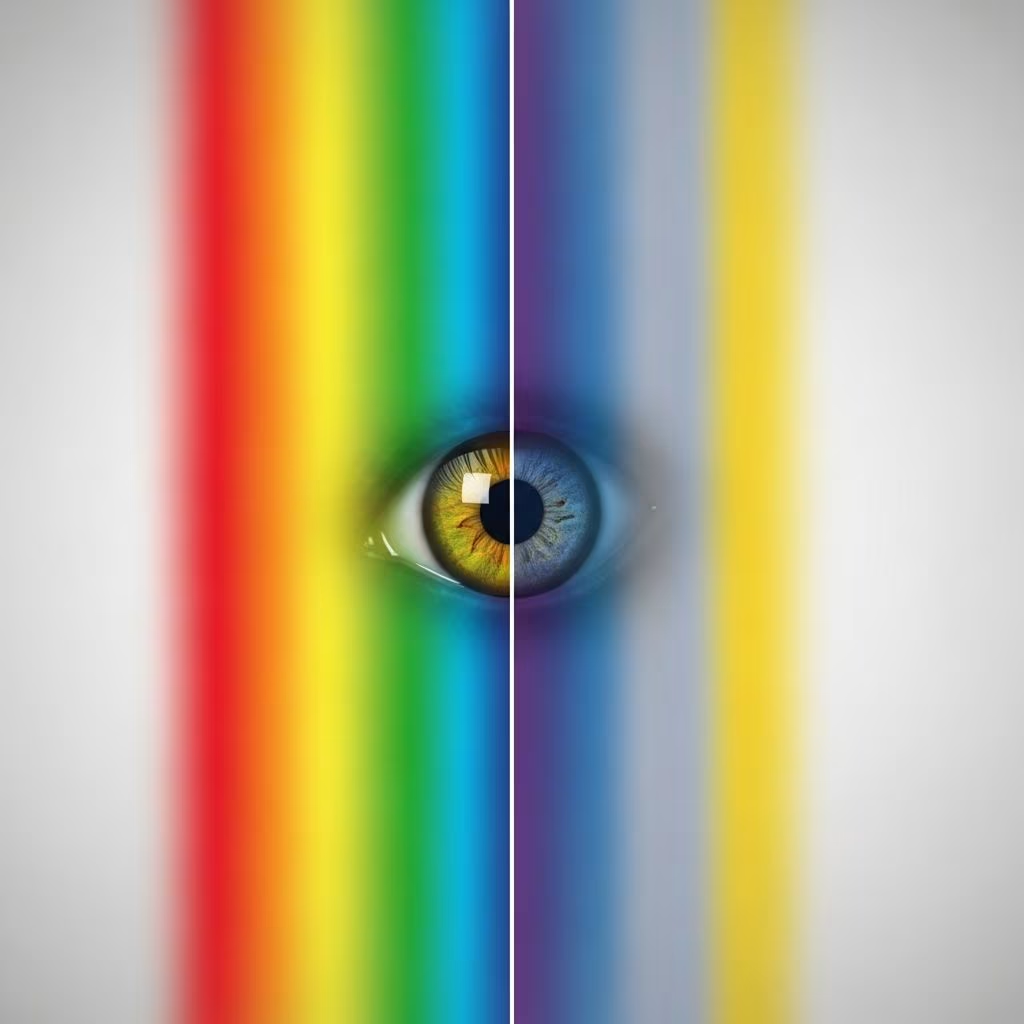
Given their dichromatic vision, dogs can reliably see two primary colours: blue and yellow. These colours appear vibrant and distinct to your dog’s eyes. However, anything outside this colour range appears to them as a shade of grey or brown. This means that reds, greens, and oranges—colours that humans find distinct and different—appear similar to dogs, much like how a person with red-green colour blindness perceives the world.
The Dog Colour Spectrum Explained
- Blue and Violet: Dogs can see these colours clearly, and they likely appear distinct from other hues to them.
- Yellow: This colour is highly visible to dogs and appears vibrant in their visual spectrum.
- Grey and Brown: These neutral tones make up much of what dogs see when looking at colours that humans perceive as red, orange, or green.
- Black: Dogs can see black, just as humans do, as it represents the absence of light.
Think of a dog’s colour vision as similar to that of a human with severe red-green colour blindness. Such individuals can distinguish between blue and yellow but struggle to differentiate between red and green, perceiving these colours as various shades of brown or grey. This analogy provides an accurate framework for understanding the canine visual experience.
The Science Behind Dichromatic Vision
The concept of dichromatic vision isn’t unique to dogs. Numerous animals share this type of visual system, and it’s surprisingly effective for survival and navigation in the natural world. Dichromatic vision has been proven through both neurobiological and molecular studies, which have confirmed that dogs possess exactly two classes of cone pigments in their retinas. One cone type is sensitive to long and medium wavelengths of light (around 555 nanometres), while the other responds to short wavelengths (approximately 429 nanometres).
Research conducted by leading vision scientists, including those at the Neitz Color Vision Lab at the University of Washington, has definitively established the similarities between canine and human red-green colour blindness. These findings have been supported by behavioural studies where dogs were tested with methods adapted from human colour blindness tests. In one notable study, dogs exhibited behavioural responses comparable to those of red-green colour-blind humans when tested with modified versions of the Ishihara test, a standard diagnostic tool used in human ophthalmology.
Additional Differences in Canine Vision
Colour vision is only part of the story when it comes to how dogs perceive the world. Several other factors contribute to their unique visual experience:
Visual Acuity
Dogs have significantly poorer visual acuity than humans. They see details four to eight times less clearly than we do. This means that while a human can read text from a distance, a dog would see the same text as a blurry, indistinct blur. Despite this limitation, dogs compensate remarkably well by relying on their superior motion detection and their acute senses of smell and hearing.
Brightness Discrimination
Dogs can discriminate between different levels of brightness, but their ability is approximately twice as poor as humans’. This suggests that while brightness is still important to dogs, they don’t rely as heavily on brightness cues as humans do when navigating their environment.
Night Vision Advantage
One area where dogs genuinely excel is night vision. With a higher concentration of rods in their retinas compared to cones, dogs are substantially better equipped for low-light vision than humans. This adaptation reflects their evolutionary history, when many canine ancestors were crepuscular or nocturnal hunters. The tapetum lucidum, a reflective layer behind their retinas, further enhances their ability to see in dim conditions.
Why Your Dog’s Colour Vision Actually Matters
Understanding your dog’s colour vision has practical implications for pet ownership. Since dogs can clearly distinguish blue and yellow, toys and accessories in these colours will be most visually stimulating for them. A red toy on green grass may blend together in your dog’s vision, making it harder for them to spot during playtime, even though it appears clearly distinct to you.
This knowledge can enhance training and play sessions. Using blue or yellow toys for fetch and training exercises ensures that your dog can see what you’re working with as clearly as possible. Additionally, recognising that dogs perceive the world differently shouldn’t diminish our appreciation for their capabilities—rather, it should increase our respect for how well they navigate a visual world that is literally different from ours.
Frequently Asked Questions
Q: Are dogs completely colourblind?
A: No, dogs are not completely colourblind. They have dichromatic vision and can see blue and yellow colours clearly. However, they cannot distinguish between red and green the way humans can.
Q: What colours should I choose for my dog’s toys?
A: Blue and yellow toys are ideal choices as these colours are most visible to dogs. Red and green toys may appear grey or brown to your dog and could be harder for them to locate during play.
Q: Do dogs see better in the dark than humans?
A: Yes, dogs have superior night vision compared to humans. They have more rods in their retinas and a reflective layer called the tapetum lucidum that enhances their ability to see in low-light conditions.
Q: Can dogs see the same colours as colour-blind humans?
A: Dogs’ colour vision is similar to that of humans with red-green colour blindness. Both can see blue and yellow but struggle to distinguish between red and green hues.
Q: How many types of cone cells do dogs have?
A: Dogs have two types of cone cells in their retinas, making them dichromatic. Humans have three types of cone cells, which is why our colour vision is more complex.
Q: Does this mean my dog sees the world in a worse way than I do?
A: Not necessarily. Dogs see differently, not worse. While their colour vision is more limited, they compensate with superior night vision, better motion detection, and keen senses of smell and hearing that far exceed human capabilities.
References
- Are dogs red–green colour blind? — PubMed Central/National Center for Biotechnology Information. 2018. https://pmc.ncbi.nlm.nih.gov/articles/PMC5717654/
- Can Dogs See Color? — American Kennel Club. 2024. https://www.akc.org/expert-advice/health/can-dogs-see-color/
- Are Dogs Really Colorblind? — PetMD. 2024. https://www.petmd.com/dog/general-health/are-dogs-really-colorblind
- How do dogs see the world? — BBC Science Focus Magazine. 2024. https://www.sciencefocus.com/nature/how-do-dogs-see-the-world



