

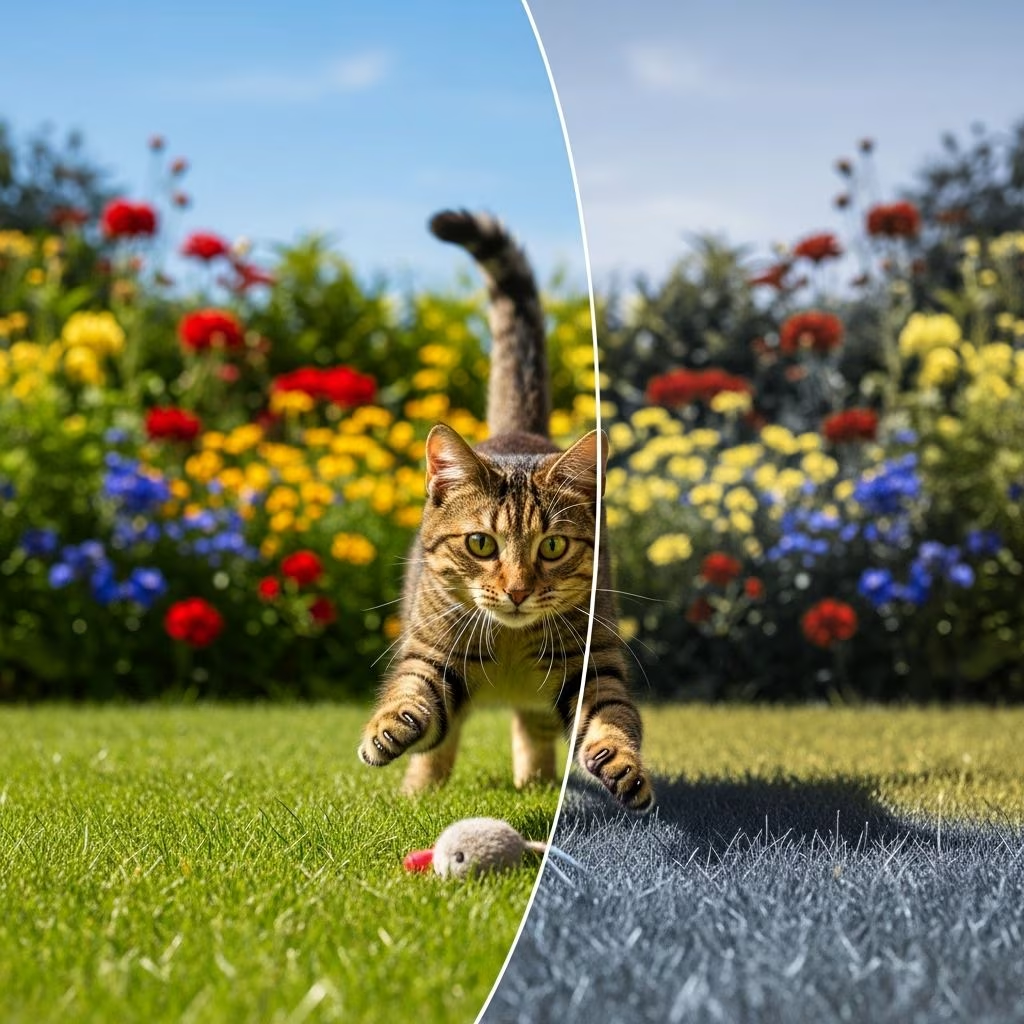
Cats possess a unique visual system adapted for hunting and survival, allowing them to see certain colours more vividly than others while excelling in low-light conditions. Unlike the common myth of complete colorblindness, cats experience dichromatic vision, primarily perceiving blues and greens, with reds appearing muted or grayish.
How Do Cats See Colour?
Cat vision relies on the retina, which contains rod and cone cells. Rods handle low-light vision and motion detection, while cones detect colour. Cats have fewer cones—only two types sensitive to blue-violet (around 460 nm) and yellow-green (around 560 nm)—resulting in dichromatic vision similar to human red-green colorblindness. Humans, with three cone types, enjoy trichromatic vision across a broader spectrum.
This structure prioritizes night vision: cats have six to eight times more rods than humans and a reflective tapetum lucidum layer behind the retina that amplifies light. Consequently, cats see in near-darkness up to six times better than humans but sacrifice color richness and visual acuity.
What Colours Can Cats See Best?
Cats distinguish blues and greens most effectively. Scientific studies confirm strong sensitivity to blue-violet hues (456-497 nm) and yellow-greens, making these colours vibrant in their world. A neutral point around 505 nm means cats cannot differentiate yellow-green from blue-gray at this wavelength, underscoring their dichromatic limits.
- Blue: Highly visible and distinguishable in various shades; cats excel at detecting blue-violet wavelengths.
- Green: Perceptible, though less vivid than blue; dominates their natural environment like grass and foliage.
- Yellow: Some studies indicate visibility, particularly yellow-greens, but not as sharply as blues.
Colours Cats Struggle With
Reds, oranges, pinks, and purples pose challenges. Lacking red-sensitive cones, cats perceive these as dull grays, browns, or even blues/greens. For instance, red appears grayish, akin to how red-green colorblind humans see it. This explains why red toys may not excite cats as much as blue or green ones.
- Red and Orange: Muted tones, often gray or brownish; low sensitivity near 560-700 nm.
- Purple: Likely interpreted as blue due to overlapping short-wavelength sensitivity.
Cat Vision vs. Human Vision
Cats and humans process the world differently due to eye anatomy. Cats’ higher rod-to-cone ratio (about 16:1 vs. humans’ 20:1) favors dim light over color detail. Their visual acuity is roughly 20/100 to 20/200 compared to human 20/20, but motion detection surpasses ours.
| Aspect | Cat Vision | Human Vision |
|---|---|---|
| Cone Types | 2 (blue, yellow-green) | 3 (red, green, blue) |
| Colour Spectrum | Blues/greens vivid; reds muted/gray | Full RGB spectrum |
| Night Vision | 6-8x better; tapetum lucidum | Standard; no tapetum |
| Acuity | 20/100-20/200 | 20/20 |
| Motion Detection | Superior (up to 1Hz flicker) | Good, but less sensitive |
This table highlights key differences: cats trade color vibrancy for survival advantages like nocturnal hunting.
Are Cats Colour Blind?
No, cats are not fully colorblind; the myth stems from their fewer cones and muted reds/greens. They exhibit partial color vision akin to deuteranopia (green-weak colorblindness in humans), with a neutral point at 505 nm confirmed by discrimination tests. Cats rely more on brightness, contrast, and movement than hue.
Why Does Your Cat’s Vision Matter?
Understanding feline color perception enhances cat care. Choose toys in blues, greens, and yellows for better engagement—red laser pointers work via motion, not color. Indoor environments benefit from these hues for stimulation. Cats’ vision suits crepuscular (dawn/dusk) activity, aiding wild hunting instincts.
For health, vision changes signal issues like hypertension or cataracts; regular vet checks are essential. UV sensitivity (absent in humans) may let cats see urine marks or patterns on prey.
Frequently Asked Questions
Do cats see colour?
Yes, but limited to blues and greens primarily; reds appear gray.
What is a cat’s favourite colour?
Blues and greens are most visible and preferred for toys and environments.
Can cats see in the dark?
Yes, far better than humans due to more rods and tapetum lucidum.
Why can’t cats see red?
Lack of red-sensitive cones makes reds indistinguishable from grays.
Are cats fully colorblind?
No, they have dichromatic vision, seeing some colours unlike total colorblindness.
Enhancing Your Cat’s Visual World
Toys with blue/green feathers or balls stimulate better than reds. Scratching posts or beds in visible hues encourage use. Window perches offer natural blue skies and green views, vital for indoor cats. Motion-activated toys leverage their superior detection.
Research continues evolving our knowledge; behavioral tests reinforce cone-limited vision. Cat owners can optimize homes accordingly, improving welfare and interaction.
References
- Decoding the Colors in a Cat’s World: Understanding Feline Vision — Pullnscoop. 2023. https://www.pullnscoop.com/blogs/blogs/decoding-the-colors-in-a-cats-world-understanding-feline-vision
- Cat Vision Explained: What Colors Can Cats Actually See? — Neakasa. 2024. https://neakasa.com/blogs/all/what-colors-can-cats-see
- Know What Colors Cats Can See: Understanding Feline Color Vision — Michupet. 2023. https://michupet.com/blogs/guide/what-colors-can-cats-see
- Can cats see colour? — Cats Protection (cats.org.uk). 2022. https://www.cats.org.uk/cats-blog/can-cats-see-colour
- Cat Eyes: A Fascinating Look at Feline Vision — Fulton County Vet Clinic. 2023. https://fultoncountyvetclinic.com/blog/cat-eyes/
- Neutral point testing of color vision in the domestic cat — PubMed/NCBI (peer-reviewed). 2016-10-14. https://pubmed.ncbi.nlm.nih.gov/27720709/
- Cat and Human Vision Differences — The Refined Feline. 2023. https://www.therefinedfeline.com/how-does-a-cats-vision-differ-from-a-humans/



