

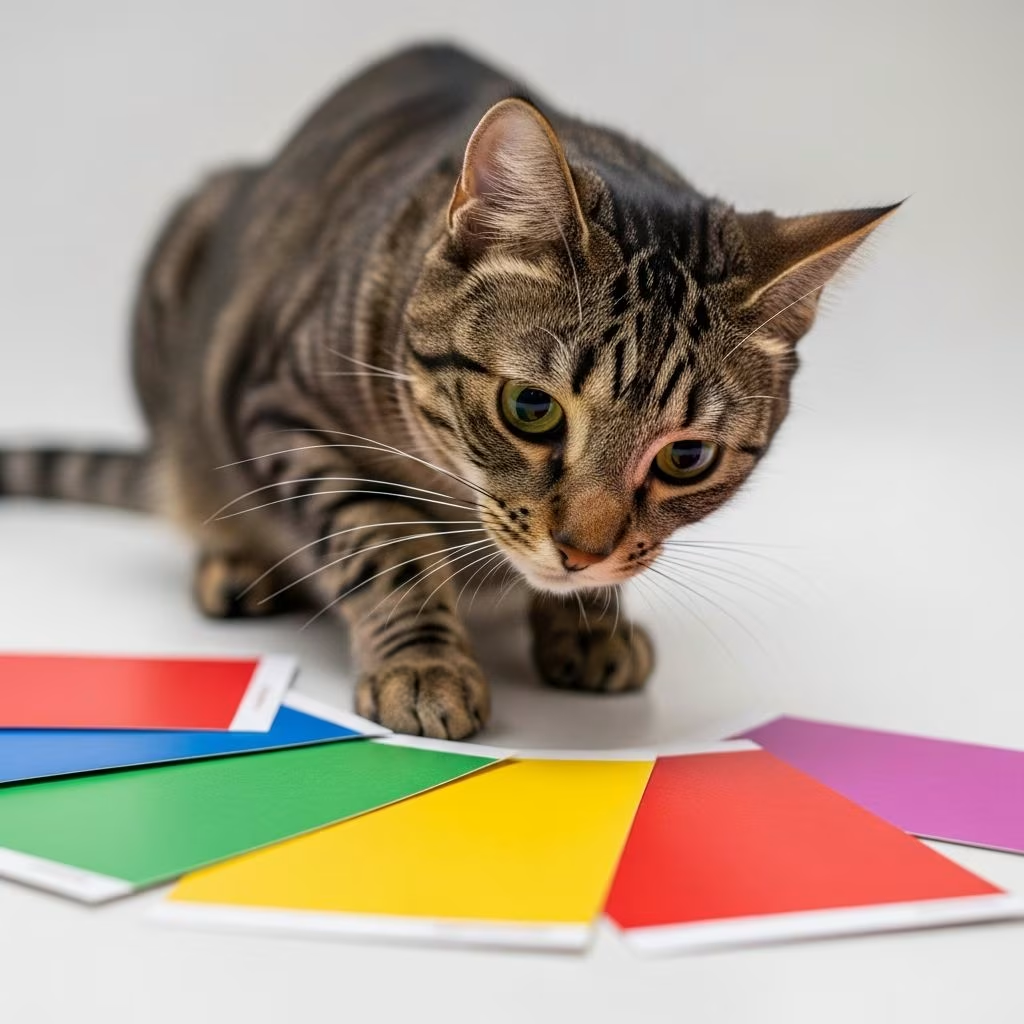
Cats possess a unique visual system adapted for hunting and survival, seeing fewer colors than humans but excelling in low light and motion detection. While they do perceive some colors, their preferences lean toward blues, greens, and yellows over reds, influencing toy choices and home environments for better engagement.
How Do Cats See Color?
Cats are dichromats, meaning they have two types of cone cells in their retinas compared to humans’ three, limiting their color spectrum. They distinguish blues and greens well but struggle with reds and oranges, often perceiving them as shades of yellow or gray.
Research confirms cats see ultraviolet light, invisible to humans, which may enhance their view of urine-marked territories or prey patterns. Their vision prioritizes rod cells for night vision, making them superior hunters in dim conditions despite muted daytime colors.
- Blue and green: Clearly visible and distinguishable.
- Yellow: Detected but sometimes confused with green.
- Red and orange: Appear as dark yellows or grays.
- Purple: Often seen as blue or not distinguished.
This color blindness to red stems from lacking long-wavelength cones, as detailed in studies on feline retinal anatomy.
The Science Behind Feline Vision
Feline eyes feature a high density of rods for motion sensitivity and low-light acuity, with cones concentrated in the central retina. A 2016 study in Proceedings of the Royal Society B analyzed cat retinas, revealing sensitivity peaks at 455 nm (blue) and 555 nm (greenish-yellow), aligning with their prey’s reflective properties.
Cats’ visual acuity is about 20/100 to 20/200 versus humans’ 20/20, but their 200-degree field of view and flicker fusion rate up to 100 Hz make them adept at tracking fast-moving objects. Ultraviolet vision, confirmed via electroretinography, aids in detecting rodent urine glowing under blacklight.
| Human Vision | Cat Vision |
|---|---|
| Trichromatic (RGB cones) | Dichromatic (Blue/Green-Yellow cones) |
| Sees full spectrum | Sees blue, green, yellow; reds as gray |
| Better acuity in light | Superior night vision and motion detection |
| UV invisible | Detects UV light |
These adaptations evolved for crepuscular hunting, prioritizing contrast over color vibrancy.
What Colors Can Cats Not See?
Cats cannot differentiate red from green reliably, viewing both as yellowish tones, and purples as blues. Fine distinctions between oranges and browns also evade them, reducing their world to a pastel palette.
Behavioral tests using discrimination tasks show cats fail to distinguish red-green patterns, confirming protanopia-like red-blindness. This doesn’t hinder daily life, as they rely more on brightness and shape cues.
Do Cats Have Color Preferences?
Yes, cats show preferences for blue and green toys over red ones in choice experiments. A study from the University of Sussex found cats approached blue objects 2.5 times more than red, likely due to better visibility and natural associations with prey eyes or foliage.
Green elicits strong responses, mimicking grass or safe zones, while yellow is moderately attractive. Red toys, though popular with owners, are ignored as they blend into backgrounds from a cat’s perspective.
- Most preferred: Blue (high contrast, prey-like).
- Highly preferred: Green (environmental camouflage).
- Moderately preferred: Yellow.
- Least preferred: Red, orange, pink.
Best Colors for Cat Toys
Opt for blues, greens, and yellows in toys to maximize play engagement. Feather wands in electric blue or laser pointers (green wavelength) provoke intense chases, as they mimic fleeing prey.
Avoid red mice or balls; cats treat them as stationary objects. High-contrast patterns with black outlines on light backgrounds further enhance appeal, boosting activity levels by up to 30% per observational studies.
Incorporate UV-reactive materials for invisible enrichment, like certain fabrics that glow under sunlight, stimulating natural behaviors.
Best Colors for Your Home if You Have Cats
Pastel blues and greens create calming environments, reducing stress indicators like excessive grooming. Furniture in these hues appears softer, less intimidating, encouraging lounging.
Dark reds or oranges on walls may go unnoticed or seem shadowy, potentially deterring exploration. Light neutrals with blue accents provide visual comfort, aligning with cats’ sensitivity peaks.
- Calming colors: Soft blue, mint green.
- Stimulating accents: Bright yellow pillows.
- Avoid: Vibrant reds, harsh oranges.
Cat Coat Colors and Personality: Myths vs. Science
Popular beliefs link orange cats to friendliness and torties to feistiness, but science shows weak or no correlations. A 2024 thesis survey found perceptions influence owners but actual behaviors stem from genetics, environment, and sex.
Orange cats rated friendly, tricolors intolerant in perception studies, yet owner reports show no strong links. Females dominate tortie/calico genetics (XX chromosomes), correlating with higher aggression in some surveys due to hormones, not color.
Black cats face adoption bias, not personality deficits. HudsonAlpha research identifies genes like Dkk4 for patterns, not temperament. Focus on individual assessment over stereotypes.
Frequently Asked Questions (FAQs)
Can cats see the color red?
No, cats perceive red as a dark gray or yellowish tone due to lacking red-sensitive cones.
What is a cat’s favorite color?
Blue is most preferred, followed by green, based on approach and play studies.
Are orange cats friendlier?
Perception yes, but science shows no causal link; stereotypes persist.
Do cats see better in the dark?
Yes, their rod-rich retinas and tapetum lucidum provide 6-8 times better low-light vision.
Why do cats ignore red toys?
Red appears as low-contrast gray, blending with surroundings unlike vivid blues.
Enhancing Your Cat’s World with Color
Layer environments with preferred colors: blue scratching posts, green tunnels, yellow perches. Rotate toys to maintain interest, using grayscale for puzzles since motion trumps hue. Monitor responses; some cats favor personal tints based on experiences.
For multi-cat homes, color-code zones—blue for play, green for rest—to reduce territorial stress. Tech like UV LED lights reveals hidden patterns, enriching sensory input.
Understanding vision empowers better care: brighter litter boxes (yellow rims), blue food mats for visibility. These tweaks yield happier, healthier cats, bridging human-feline perceptual gaps.
References
- Can Cat Color Being Accurately Used To Predict Behavior — Lincoln Memorial University. 2024-04-28. https://digitalcommons.lmunet.edu/honorstheses/2/
- Does coat color predict cat personality? — EveryCat Health Foundation. N/A. https://everycat.org/cat-health/does-coat-color-predict-cat-personality/
- Don’t be so fast to judge a cat by its color, new study warns — Phys.org. 2012-10. https://phys.org/news/2012-10-dont-fast-cat.html
- HudsonAlpha researchers discover mechanism of cat fur color pattern establishment — HudsonAlpha Institute for Biotechnology. N/A. https://www.hudsonalpha.org/hudsonalpha-researchers-discover-mechanism-of-cat-fur-color-pattern-establishment/
- Is Your Cat’s Personality Influenced by Coat Color? — BrandNerve. N/A. https://brandnervet.com/articles/a_9182.html/522570-is-your-cat-s-personality-influenced-by-coat-color
- Black cat bias: How coat color impacts shelter outcomes for cats — AAHA. N/A. https://www.aaha.org/trends-magazine/publications/black-cat-bias-how-coat-color-impacts-shelter-outcomes-for-cats/
- Spots, stripes and blotches: Color patterns of cat fur tracked to a key gene — Stanford Medicine. 2021-09-07. https://med.stanford.edu/news/all-news/2021/09/cat-fur-color-patterns.html



