

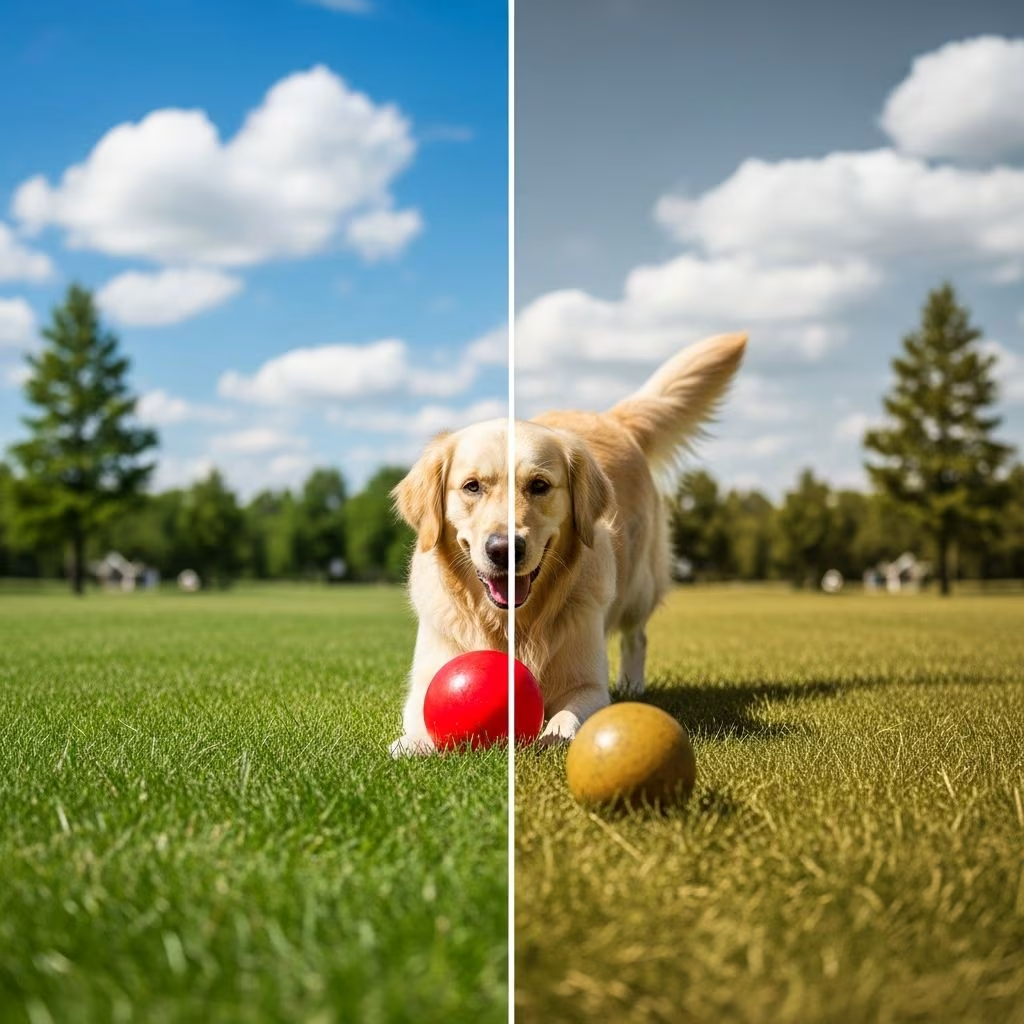
Dogs possess **dichromatic color vision**, seeing primarily blues, yellows, and shades of gray, unlike humans’ trichromatic vision that distinguishes a full spectrum of colors. This limited palette stems from having only two types of cone cells in their retinas, sensitive to short (blue) and medium-long (yellow) wavelengths.
How Dogs See Color
The myth that dogs see only in black and white persists, but research confirms they perceive colors, though muted and fewer than humans. Human eyes have three cone types—sensitive to red, green, and blue—enabling vibrant hues. Dogs, like most mammals, have two: one peaking at 429 nm (blue-violet) and another at 555 nm (yellow-green). This results in a world of yellows, blues, and grays; reds and greens appear as muddy yellows, browns, or grays.
Visual acuity in dogs is poorer—4-8 times worse than humans—due to fewer ganglion cell connections and optic nerve fibers. Brightness discrimination is also about twice as poor. Yet, colors matter: dogs rely on them over brightness for object discrimination.
The Science Behind Dog Color Vision
Early studies yielded conflicting results, but modern behavioral and neurobiological research solidifies dichromatic vision akin to human red-green colorblindness (deuteranopia).
- Neurobiological Evidence: Retinal studies show two cone pigments: blue-sensitive (429 nm) and yellow-sensitive (555 nm).
- Behavioral Tests: Russian researchers trained eight mixed-breed dogs to associate food with colored papers (dark/light yellow vs. dark/light blue). In discrimination trials, dogs chose color matches over brightness 70-100% of the time, proving color reliance.
- Ishihara Test Adaptation: Dogs showed orienting responses (eye/head movements) to moving stimuli mimicking human red-green blindness tests, confirming red-green confusion.
- Odd-One-Out Tasks: Dogs accurately picked differing colors from circles when hues were distinguishable, failing only on confusable ones.
These findings, from Proceedings of the Royal Society B (2013) and PMC studies, indicate color cues are informative for dogs’ daily activities.
What Colors Can Dogs Actually See?
| Human Color | Dog Perception | Reason |
|---|---|---|
| Blue | Light/Dark Blue | Strong short-wavelength cone response |
| Yellow | Dark/Light Yellow | Medium-long wavelength cone sensitivity |
| Green | Grayish Yellow/Dark Yellow | Overlaps yellow cone; confusable with red |
| Red | Grayish Brown/Dark Gray | No dedicated cone; appears as luminance variation |
| Orange | Muddy Yellow/Brown | Yellow cone dominant |
| Purple/Violet | Dark Blue/Blue | Blue cone response |
| White/Black | Shades of Gray | Rod-dominated low-light vision |
Dogs distinguish blue from yellow best; red-green differences are imperceptible, blending into brightness cues. Their spectrum resembles human protanopia/deuteranopia.
How Is a Dog’s Vision Different From Ours?
Dogs’ field of view is wider (240° vs. humans’ 200°), with superior motion detection and low-light vision thanks to more rods. However, they lack fine detail and full color range.
- UV Sensitivity: Dogs may detect ultraviolet light, invisible to humans, aiding scent trail tracking. (Inferred from mammal studies; canine confirmation ongoing.)
- Night Vision: Tapetum lucidum reflects light, enhancing dim conditions—but colors fade to grays.
- Acuity Trade-off: Focuses on movement over static details.
In practical terms, a red toy on green grass is invisible to dogs; they spot it via outline or motion.
Do Dogs See the Same Colors as Colorblind Humans?
Yes, strikingly similar to red-green colorblind humans (protan/deuteran types), who also lack one cone and confuse reds/greens as yellows/browns. Ishihara plate adaptations elicited identical responses in dogs and deuteranopic humans.
Neitz et al.’s wavelength matching in purebred dogs supported this, with computer models estimating spectral sensitivities matching human deuteranopia.
Does a Dog’s Breed Affect Its Color Vision?
No breed-specific variations confirmed; all canines share similar retinal cone distributions. Mixed breeds in studies performed consistently. Hunting breeds may leverage vision evolutionarily, but cone types remain uniform across domestic dogs.
Practical Tips for Dog Owners
Understanding canine vision enhances training, play, and safety:
- Toys & Training Aids: Use blue, yellow, or contrasting bright toys. Avoid red/green singles.
- Visibility: Fluorescent yellow/blue collars outperform red for dusk/low light.
- Training Cues: Trainers should incorporate color post-studies showing preference over brightness.
- Indoor Design: Blue/yellow accents help dogs navigate; red objects may blend.
- Health Checks: Vision changes signal issues; consult vets for cataracts or retinal problems.
Recent research (up to 2025) reinforces these; no major shifts in understanding.
Frequently Asked Questions (FAQs)
Can dogs see color at all?
Yes, dogs see colors but limited to blues, yellows, and grays due to two cone types.
What color do dogs see the best?
Blues and yellows; they distinguish dark/light variants effectively.
Are dogs completely colorblind to red?
Dogs perceive red as dark gray or brown, not true red.
Can dogs see green?
Green appears as yellow or grayish yellow.
Do all dog breeds see colors the same?
Yes, dichromatic vision is standard across breeds.
Should I buy blue toys for my dog?
Blue and yellow toys are most visible and preferred.
Is dog vision better at night?
Yes, superior low-light vision, but colors desaturate.
Conclusion
Dogs’ color vision enriches their world beyond grayscale myths, aiding discrimination and interaction. Owners leveraging blues and yellows strengthen bonds and safety. Ongoing research refines this knowledge, but core findings endure.
References
- New Study Shows That Dogs Use Color Vision After All — Smithsonian Magazine. 2013-07-10. https://www.smithsonianmag.com/science-nature/new-study-shows-that-dogs-use-color-vision-after-all-13168563/
- Are dogs red–green colour blind? — PMC / Royal Society Open Science. 2013-11-27. https://pmc.ncbi.nlm.nih.gov/articles/PMC5717654/
- Can Dogs See Color? And How Do We Know? — CattleDog Publishing. Accessed 2025. https://cattledogpublishing.com/blog/can-dogs-see-color-and-how-do-we-know/
- Colour cues proved to be more informative for dogs — Proceedings of the Royal Society B. 2013. https://royalsocietypublishing.org/rspb/article/280/1766/20131356/74793/Colour-cues-proved-to-be-more-informative-for-dogs
- Do Dogs See Color? — Owings Mills Veterinary Center. Accessed 2025. https://owingsmillsvet.com/blogs/do-dogs-see-color
- Dogs Are Not Actually Fully Colorblind — Psychology Today. 2022-05-01. https://www.psychologytoday.com/us/blog/canine-corner/202205/dogs-are-not-actually-fully-colorblind



