

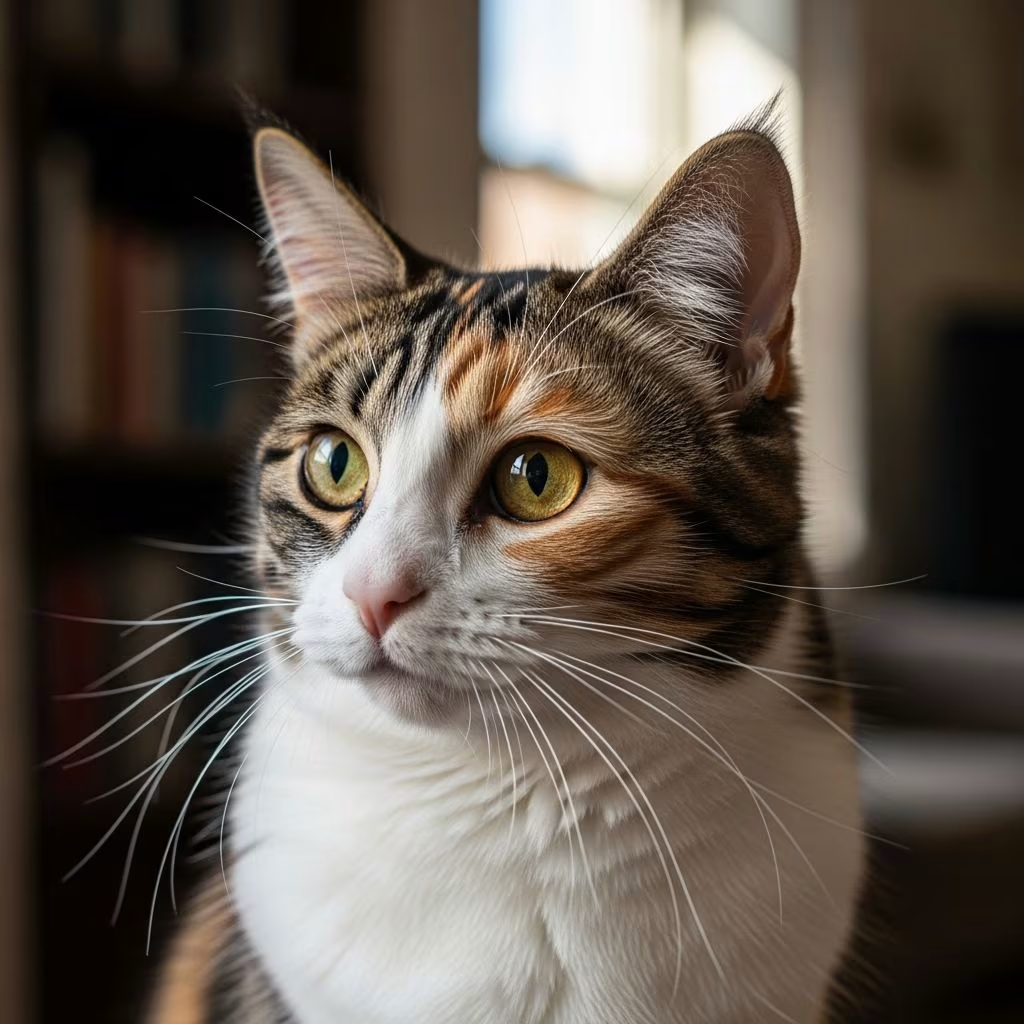
Determining the breed of your cat can be challenging, especially if it’s a mixed breed or a domestic shorthair. However, by carefully observing physical characteristics such as size, body build, face shape, ears, eyes, coat, colors, patterns, markings, tail, and even behavior, you can narrow down possibilities significantly. This guide provides a step-by-step approach to help you identify your cat’s breed without immediately resorting to expensive genetic testing. Whether your kitty is a purebred like a Siamese or a unique mix, these traits offer valuable clues. We’ll cover each feature in detail, suggest search strategies, and discuss advanced options like DNA tests for confirmation.
Size and Weight
Cat breeds vary widely in size and weight, making this one of the first traits to assess. Small cats might weigh under 8 pounds, while large ones exceed 15 pounds. Measuring your cat’s length from nose to tail base and noting its build helps differentiate breeds.
- Small Cats: Breeds like Singapura (4–8 lbs), Munchkin, or American Curl often have compact bodies. Dwarf breeds sharing Munchkin genetics, such as Skookum or Genetta, are notably petite.
- Medium Cats: Common in breeds like American Shorthair (8–12 lbs), British Shorthair, or Abyssinian, with balanced proportions.
- Large Cats: Maine Coon (up to 25 lbs), Norwegian Forest Cat, or Siberian feature muscular builds and impressive lengths up to 40 inches.
Example Breeds by Size:
| Size Category | Average Weight | Example Breeds |
|---|---|---|
| Small | 4–8 lbs | Singapura, Munchkin, Devon Rex |
| Medium | 8–12 lbs | Abyssinian, Oriental Shorthair, Scottish Fold |
| Large | 12–25 lbs | Maine Coon, Ragdoll, Norwegian Forest Cat |
Body Build
Body shape provides further insights. Slender, elegant builds point to oriental breeds, while stocky frames suggest others.
- Slender: Siamese, Balinese, or Sphynx have lithe, tubular bodies.
- Cobby (Stocky): British Shorthair or Exotic Shorthair feature broad chests and short legs.
- Muscular: Bengal or Savannah display athletic, wild-like physiques.
Face
Not all cats have distinctive face shapes, but certain breeds do, aiding identification.
- Round Face: Persian, Exotic Shorthair, or Scottish Fold have broad, flat features.
- Triangular/Wedge: Siamese or Oriental breeds show angular, elongated faces.
- Square: American Shorthair or Chartreux possess strong jawlines.
Ears
Ear shape, size, and placement are key identifiers.
- Large/Tall: Siamese, Abyssinian, or Savannah have prominent, upright ears.
- Folded: Scottish Fold uniquely features forward-folded ears due to cartilage mutation.
- Small/Rounded: British Shorthair or Persian have low-set, rounded ears.
Eyes
Eye shape and color can be telling, especially odd-eyed cats.
- Almond-Shaped: Siamese or Tonkinese often have vivid blue eyes.
- Round: Persian or British Shorthair display copper or green hues.
- Odd-Eyed (Heterochromia): Linked to white spotting genes, common in Turkish Van or some white cats.
Coat
Coat length and texture narrow options quickly.
- Short-Haired: American Shorthair, Bengal—sleek and low-maintenance.
- Long-Haired: Persian, Maine Coon—dense undercoats requiring grooming.
- Curly/Wirehaired: Selkirk Rex or American Wirehair.
- Hairless: Sphynx or Lykoi.
Colors, Patterns, and Markings
While not breed-specific alone, colors and patterns combine with other traits effectively.
1. Solid Color
Cats in one uniform color like black, white, or red. Breeds: British Shorthair (blue), Havana Brown.
2. Bi-Color
Two colors, often with white. Common in Domestic Shorthair or Turkish Van.
3. Tortoiseshell
Mixed black, red, brown without white—mostly females.
4. Calico
Tri-color with white; nearly all female. Seen in American Shorthair.
5. Colorpoint
Darker points on ears, face, paws, tail (e.g., Siamese, Himalayan).
Tail
Tail length is a standout trait.
1. Long Tails
Standard for most breeds like Persian or Abyssinian.
2. Short Tails
Bobtail breeds: American Bobtail, Japanese Bobtail, Kurilian Bobtail—naturally short, not cropped.
Behavior
Temperament offers clues, though environment influences it.
- Active/Vocal: Siamese, Bengal—playful, chatty.
- Calm/Lap Cat: Ragdoll, Persian—affectionate, relaxed.
- Independent: Russian Blue, Abyssinian.
How to Identify Your Cat’s Breed
Compile traits: e.g., “cat breed + calm + large + short fur + tan + colored points.” Breeds matching multiple traits are likely candidates. Use lists from each section for cross-referencing.
AI Tools for Cat Breed Identification
Modern AI classifiers simplify the process. Upload a photo to tools like Nyckel’s free cat breed identifier, trained on the Oxford Cats Dataset with 14 labels including Persian and American Shorthair. It provides confidence scores. Apps like Cat Scanner use image recognition for quick results. Useful for pet stores, vets, shelters.
Genetic Testing to Tell Your Cat’s Breed
For definitive answers, DNA tests analyze genetic markers against databases. Ideal for mixed breeds showing multiple traits.
| Test | Key Features | Breeds Covered |
|---|---|---|
| Basepaws | 21 breeds, wildcat index, 13 health risks, lifetime updates | Western, Eastern, Exotic, Persian categories |
| Wisdom Panel | Breed breakdown, health screening | Comprehensive database |
Accuracy depends on database size; consult vets for kits like Basepaws.
Frequently Asked Questions (FAQs)
Q: Can I identify my cat’s breed without DNA testing?
A: Yes, by observing traits like size, coat, and patterns, you can make educated guesses, especially for purebreds.
Q: What if my cat shows traits from multiple breeds?
A: It’s likely a mixed breed; genetic testing reveals ancestry percentages accurately.
Q: Are AI photo tools reliable for breed ID?
A: They offer quick estimates with confidence scores but work best combined with physical observation.
Q: Which breeds have short tails?
A: American Bobtail, Japanese Bobtail, and Kurilian Bobtail naturally have bobbed tails.
Q: How accurate are cat DNA tests?
A: Highly accurate for tested markers, depending on the provider’s database; Basepaws covers 21+ breeds.
References
- Identify Cat Breeds Using AI — Nyckel. 2023. https://www.nyckel.com/pretrained-classifiers/cat-breed-identifier/
- 3 Ways To Determine Your Cat’s Breed — YouTube (Vet Ranch). 2020-10-15. https://www.youtube.com/watch?v=tbEYFtjGfio
- What Breed Is My Cat? Vet Approved Identification Guide — Catster. 2024-05-20. https://www.catster.com/lifestyle/what-breed-is-my-cat/
- 4 Best Cat Breed DNA Tests in 2025 — DNA Weekly. 2025-01-10. https://www.dnaweekly.com/blog/best-cat-breed-dna-test/
- Cat Identification Guide — Alley Cat Allies. 2023. https://www.alleycat.org/resources/cat-identification-guide/
- Cat Scanner App — Apple App Store. 2024. https://apps.apple.com/us/app/cat-scanner/id1447491786



