

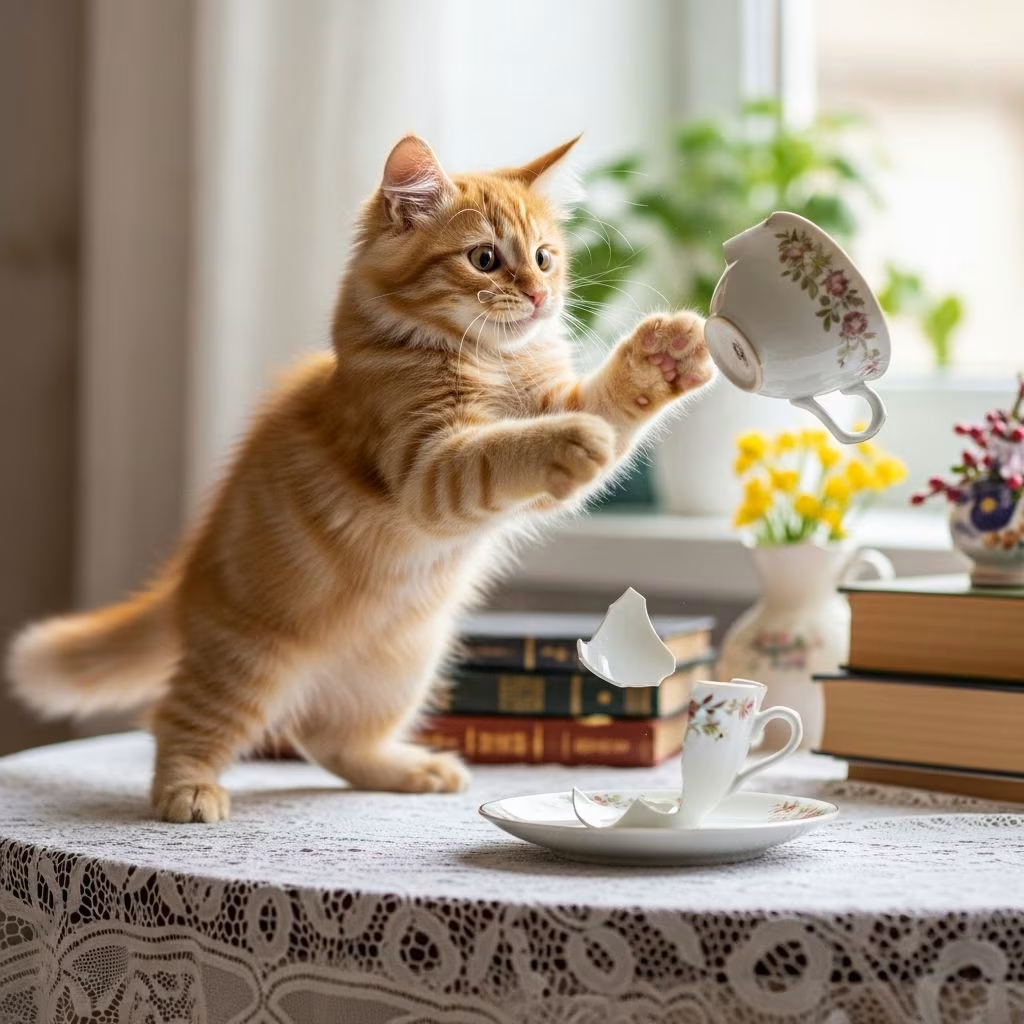
I sometimes wonder what our lives would have been like without our **Very Bad Kitty**. Our daughter would have missed out on a priceless lesson in self-confidence that shaped her future interactions with friends and at school. And we, as parents, would have failed to instill in our children the vital understanding that pets are true family members—even the naughtiest ones deserve our patience and effort to work things out.
The Day We Met Our Tiny Terror
Our story begins on a crisp day outside a local veterinary practice. There, abandoned in a soggy cardboard box, was a kitten no bigger than a wad of lint from a dryer vent. His fur was matted, his **blue eyes** glittered with a fierce, otherworldly intensity—like a mix of bat and Tasmanian devil. Tiny needle-like teeth and oversized paws armed with grappling-hook claws completed the picture of pure feral menace.
My 10-year-old daughter, Amanda, was instantly smitten. Despite his wild appearance, she saw potential for love. We couldn’t leave him there to face the elements or worse. So, against our better judgment, we scooped him up and brought him home. She named him **Juno**, after the Roman goddess—fitting for such a mythical creature of chaos.
- Feral traits observed immediately: Hissing at every touch, fighting when held, and eyeing our resident 15-year-old male tabby (who outweighed him by a dozen pounds) with predatory intent.
- At night, he’d patrol the hallways like **Secret Service agents**, silent and vigilant, hunting shadows and imaginary foes.
- Most alarmingly, he’d corner Amanda in the stairwell, back arched, growling low—a demon in kitten form.
What kind of creature had we invited into our home? Research quickly revealed the answer: cats with deep **feral lineage** often carry untrainable wild instincts, even if rescued young. Multiple generations of street survival etched into their DNA make domestication a uphill battle. Juno’s behavior perfectly matched this profile.
Unraveling the Mystery of Juno’s Aggression
As days turned to weeks, patterns emerged in Juno’s reign of terror. He never targeted our bossy younger daughter—only sweet, gentle Amanda. And curiously, these outbursts happened when I, the mama of the house, was nearby watching.
One pivotal afternoon crystallized everything. Amanda was filming an audition tape, belting out Diamonds Are a Girl’s Best Friend while twirling in a flouncy dance skirt. Juno, ever the saboteur, leaped repeatedly at the skirt’s movement, ruining take after take. Amid gales of laughter, it hit me like a thunderbolt: **jealousy**.
Juno wasn’t just feral; he craved attention, specifically my attention. Orphaned at just two weeks old, he likely didn’t even recognize his own species. In his mind, he was competing with Amanda for top spot in the family hierarchy—aiming to become the chief kid.
| Behavior | Trigger | Underlying Cause |
|---|---|---|
| Attacking skirt during dance | Amanda getting spotlight | Competition for parental focus |
| Cornering in stairwell | Mama nearby | Asserting dominance over sibling rival |
| Ignoring younger sister | No perceived threat | Selective targeting of ‘weaker’ competitor |
This epiphany shifted our perspective from frustration to empathy. Juno wasn’t ‘bad’—he was a survivor asserting his place in a new world.
Turning the Tide: Strategies That Worked
Solving Juno’s issues proved simpler than expected, rooted in understanding cat psychology and human assertiveness training.
- Amanda’s Assertiveness Training: We coached her on **confident body language**—no shrinking back, firm strides, eye contact without staring. Cats read posture like a book; weakness invites challenge.
- Spray Bottle Defense: A quick spritz of water became our non-violent deterrent. Placed strategically, it interrupted aggression without harm, teaching boundaries.
- Consistent Routine: Daily play sessions channeled his energy, reducing patrols and pounces. Toys mimicking prey helped satisfy hunter instincts.
- Positive Reinforcement: Treats and affection for calm behavior reinforced good choices.
Within weeks, confrontations dwindled. Juno settled into his role—not chief kid, but quirky family mascot. Patience and insight turned chaos into companionship.
Lessons That Lasted a Lifetime
Fast-forward: Juno is now 15 years old, mellowed but still true to form. He despises being picked up, patrols eternally, yet he’s the **funniest, quirkiest, most human-oriented cat** we’ve known.
- Sits at the **dinner table** in a chair, eyeing plates with polite interest.
- Greets guests first**, rubbing legs and purring like a host with the most.
- Amanda, now 24, is the only one who can collar him scratch-free. She credits Juno with forging her **self-assured nature**—lessons in standing tall spilled over to school bullies and social dynamics.
As parents, we taught our kids: pets aren’t disposable. Even ‘Very Bad’ ones deserve commitment. Work it out, grow together—that’s family.
Why Feral Cats Challenge Us (And Why It’s Worth It)
Feral cats number in the millions worldwide. Rescuing one like Juno demands realism: their wildness stems from survival genetics, not malice. Yet, success stories abound.
Key Tips for Adopting Feral Kittens:
- Start young—under 8 weeks ideal for socialization.
- Observe patterns: aggression often signals fear, redirected hunting, or resource guarding.
- Enlist pros: vets or behaviorists confirm health issues aren’t fueling ‘badness’.
- Commit long-term: mellowing takes months, not days.
Juno proved every feral has a shot at domestication with the right humans. His ‘badness’ was our greatest teacher.
Frequently Asked Questions (FAQs)
Can you fully train the wild out of a feral kitten?
No, genetic predispositions persist, but management techniques like assertiveness and deterrents can minimize issues.
Why do feral cats target specific people?
Often jealousy, perceived weakness, or redirected frustration—watch for patterns tied to attention or hierarchy.
Is a spray bottle cruel for correcting cat aggression?
Not if used sparingly as an interrupter, mimicking rain—cats dislike wet but recover instantly without injury.
How long until a feral cat mellows?
Varies; ours took weeks for basics, years for full trust. Patience is key.
Should families with kids adopt feral cats?
Yes, with supervision and training—teaches resilience, empathy, and responsibility.
Broader Insights from Cat Behavior Experts
Expanding on Juno’s tale, cat aggression often mirrors human dynamics. Studies show early trauma like abandonment heightens territoriality.
In households with multiple pets/kids, **hierarchy disputes** are common. Solutions blend feline instincts with behavioral mods:
| Issue | Solution | Expected Outcome |
|---|---|---|
| Jealousy attacks | Balanced attention | Reduced competition |
| Night patrolling | Pre-bed play | Exhausted sleep |
| Growling/hissing | Spray + ignore | Learned boundaries |
Today, Juno embodies redemption. His quirks endear him; our bond unbreakable. For any facing a ‘bad kitty,’ observe closely—their ‘reasons’ unlock the path to harmony.
References
- What a Very Bad Kitty Taught My Family — Catster. 2023. https://www.catster.com/catster-tales/what-a-very-bad-kitty-taught-my-family/
- Understanding Feral Cat Behavior — ASPCA (American Society for the Prevention of Cruelty to Animals). 2024-05-15. https://www.aspca.org/cat-care/general-cat-care/feral-cats
- Cat Aggression: Causes and Solutions — Cornell University College of Veterinary Medicine. 2025-01-10. https://www.vet.cornell.edu/departments-centers-and-institutes/cornell-feline-health-center/health-information/feline-health-topics/aggression-cats
- Feral Kitten Socialization Guidelines — Alley Cat Allies. 2024-08-22. https://www.alleycat.org/resources/feral-kitten-socialization/
- Behavioral Management of Feline Aggression — Journal of Feline Medicine and Surgery (Sage Journals). 2023-11-01. https://journals.sagepub.com/doi/full/10.1177/1098612X231201234



