Visual Communication: Teaching Your Dog Hand Signals
Master non-verbal training techniques to strengthen your bond with your canine companion.
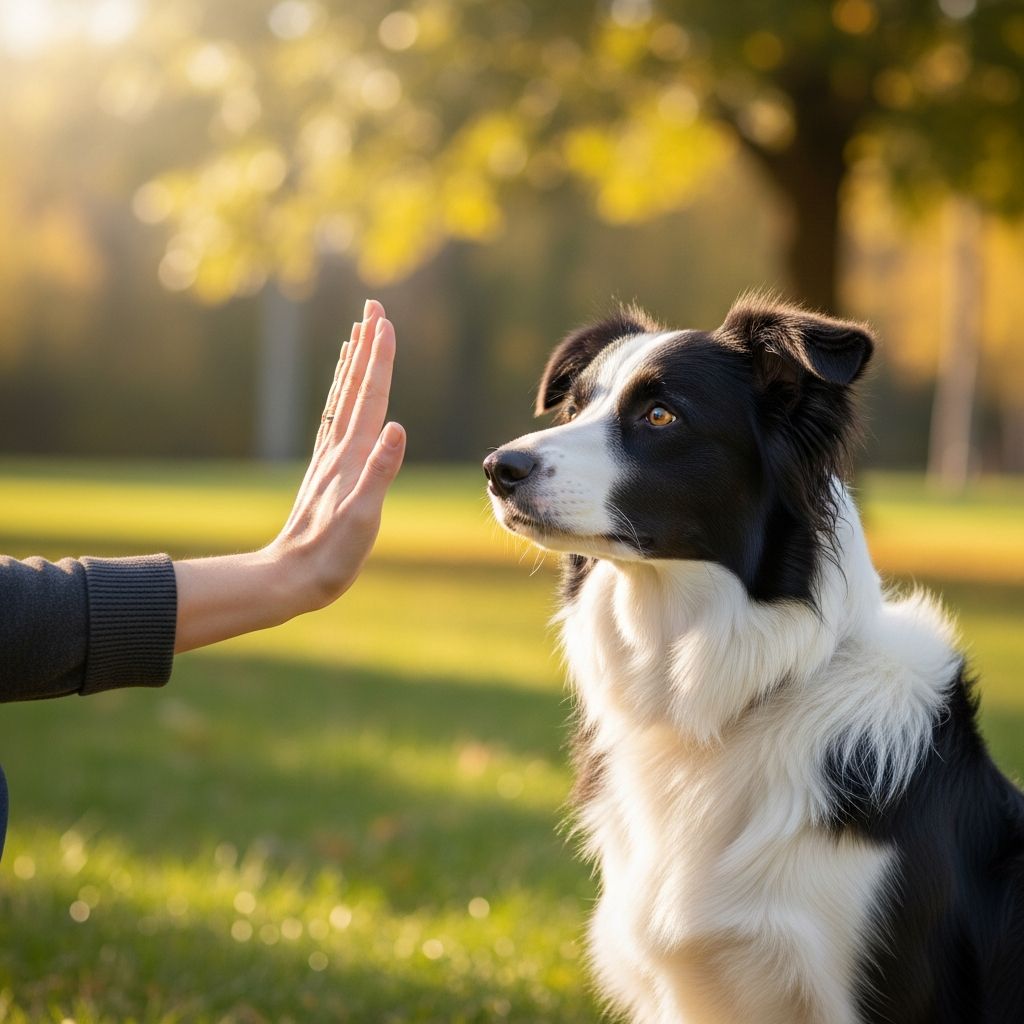
Effective dog training extends far beyond spoken words. While many owners rely exclusively on verbal commands, research demonstrates that canines possess a remarkable capacity to interpret visual information. Hand signals represent one of the most powerful tools in a trainer’s arsenal, offering a direct channel of communication that transcends the limitations of spoken language. Understanding how to implement visual communication techniques can fundamentally transform your relationship with your dog and accelerate the training process.
Why Dogs Respond More Effectively to Visual Cues
Dogs are inherently visual communicators who prioritize body language interpretation over auditory processing. When there is a conflict between what an owner says verbally and what their body demonstrates through gesture, the canine invariably gravitates toward the visual signal. A study published in Animal Cognition confirms this biological preference, revealing that dogs respond more readily to gestural requests than verbal ones. This natural predisposition stems from their evolutionary development as pack animals who relied on subtle physical cues to navigate complex social hierarchies.
The significance of this finding cannot be overstated. Dogs process body language instantaneously, registering minute variations in hand position, arm movement, and facial expression. These visual markers create distinct categories in the canine mind, reducing ambiguity and confusion that sometimes accompanies verbal communication. When owners incorporate hand signals into their training regimen, they effectively speak in a language that feels natural to their dogs.
The Foundation: Body Language Mastery
Before introducing specific hand signals, handlers must recognize that dogs are experts in deciphering body language. Every gesture carries meaning, and consistency proves absolutely critical. A palm held upward differs significantly from a palm oriented downward in the dog’s perception, even if the accompanying verbal command remains identical. This sensitivity to positional details means that trainers must develop precision in their movements and maintain unwavering consistency across all training sessions.
Subtle variations in hand placement create different interpretations. The angle of your palm, the extension of your fingers, the distance between your body and your dog—all these elements contribute to the clarity of your message. Dogs recognize these distinctions immediately and build strong associations between specific hand configurations and desired behaviors. By mastering your own body language, you eliminate one of the most common obstacles to successful training.
Implementing Hand Signals: Getting Started
Whether you are beginning training from scratch or adding visual components to existing verbal commands, the implementation process follows predictable patterns. The approach varies depending on your dog’s current training level and your own training experience.
Starting with an Untrained Dog
If your dog has not yet learned verbal commands, lure-and-reward methodology proves highly effective for establishing hand signal associations. This technique involves using a physical incentive—typically a treat or toy—to guide your dog into the desired position while simultaneously presenting the corresponding hand signal. For example, to teach the sitting position, hold a treat within your dog’s visual field and move it upward and backward over their head, allowing gravity and body mechanics to naturally lower their rear to the ground. As they complete the movement, immediately present your predetermined hand signal, followed by reward delivery.
This sequencing is essential: signal, behavior completion, reinforcement. Over repeated trials, your dog begins associating the hand configuration with the anticipated reward, creating a robust learned association. Patience and consistency prove invaluable during this phase, as dogs require multiple exposures to solidify new connections.
Transitioning Previously Trained Dogs
Many dog owners have already established verbal commands before discovering the advantages of hand signals. The transition process remains straightforward and surprisingly rapid. Begin by capturing your dog’s attention through eye contact, then present your chosen hand signal while simultaneously issuing the familiar verbal command. Upon successful behavior completion, provide enthusiastic rewards and praise. Repeat this pairing across numerous training sessions, gradually reducing your reliance on the verbal cue as the hand signal gains salience.
Most dogs adapt to this transition faster than handlers expect. Within several weeks of consistent dual-cue presentation, many dogs demonstrate clear preference for responding to the hand signal, effectively reversing their learned hierarchy of responsiveness. Eventually, the verbal component becomes unnecessary, and the hand signal alone triggers the desired behavior.
Practical Hand Signal Examples and Applications
Establishing a repertoire of hand signals enables nuanced communication across diverse situations and environments. The following examples represent commonly used signals, though trainers may adapt or create alternative signals based on personal preference, provided they maintain distinctiveness and consistency.
| Signal Name | Hand Configuration | Application |
|---|---|---|
| Sit | Palm facing upward, moved vertically upward toward body | Basic obedience, meal preparation, doorway management |
| Stay | Flat palm facing dog, held steady at body level | Duration control, safety situations, distance work |
| Come | Arm extended outward, then pulled inward toward body | Recall training, off-leash work, emergency situations |
| Down | Palm facing downward, moved from chest level toward ground | Settling, impulse control, extended rest periods |
| Leave It | Flat hand held laterally, moved side to side | Resource management, safety, impulse control |
| Positive Marker | Thumbs-up gesture or open hand flash (fist to open palm) | Reinforcement timing, deaf dog training, clicker alternative |
| Direction Changes | Pointed finger extending in desired direction | Navigation, trail work, multi-dog management |
Beyond these foundational signals, trainers often develop specialized hand configurations for situation-specific behaviors. A chin rest signal might involve a flat palm positioned horizontally beneath the dog’s chin, enabling grooming or examination protocols. A “paw” signal could utilize an open palm held upward near the front legs, encouraging the dog to place their foot in your hand. These variations demonstrate how hand signals extend far beyond basic obedience, creating sophisticated communication systems that reflect individual handler preferences and specific lifestyle needs.
Advanced Applications: Beyond Basic Commands
Hand signals demonstrate particular value in situations where verbal communication proves impractical or ineffective. Handlers who participate in distance activities such as trail running or hiking with multiple dogs benefit tremendously from directional signals that communicate turning decisions at trail junctions. A simple pointing gesture combined with a specific hand configuration enables dogs to understand whether they should turn left or right before reaching the decision point.
Similarly, trainers working with deaf dogs discover that hand signals become the primary language, removing the entire verbal component from the training equation. In these situations, visual markers such as thumbs-up gestures or hand flashes (rapid transitions from closed fist to open palm) replace traditional clicker markers, providing clear behavior-reinforcement timing.
Consistency and Precision: Critical Success Factors
The effectiveness of hand signal training hinges entirely on unwavering consistency. Every household member must employ identical hand configurations for identical behaviors. Subtle variations in hand position, distance from the dog’s body, or speed of movement can create confusion, requiring additional training sessions to clarify meaning. When multiple family members participate in training, establishing written or photographic documentation of each hand signal ensures uniformity across all interactions.
Precision extends beyond hand configuration to encompass timing and context. Always present signals from positions that maximize visibility and minimize ambiguity. Avoid presenting signals while your back is turned or from extreme angles. Ensure adequate lighting in your training environment so your dog can perceive fine details of hand position. These environmental considerations transform training efficiency and accelerate learning acquisition.
Integration Into Daily Life
Optimal results emerge when hand signals become integrated throughout daily routines rather than confined to dedicated training sessions. Request sits using hand signals before meals, ask for down positions using visual cues before opening doors, and utilize directional signals during walks. This distributed practice approach strengthens neural associations and ensures your dog regards hand signals as functional communication tools rather than artificial training exercises performed only during structured sessions.
Practice frequency and consistency matter far more than session duration. Brief, frequent repetitions prove more effective than extended training marathons. Multiple two-minute training interactions throughout the day establish stronger learned associations than a single thirty-minute session, while also preventing fatigue and maintaining the dog’s motivation and enthusiasm.
Addressing Common Challenges
Newly implemented hand signals sometimes generate temporary confusion in previously trained dogs. When an established verbal command suddenly becomes supplemented with an unfamiliar hand signal, the dog may initially exhibit hesitation or inconsistent responding. This represents a normal part of the learning transition and typically resolves within two to four weeks of consistent dual-presentation. Patience and unwavering consistency during this adjustment period prove essential.
Some handlers struggle with breaking their verbal communication habits, continuing to rely on spoken commands even as they attempt to transition to hand signals. This inconsistency inadvertently reinforces the dog’s preference for verbal cues. Handlers must consciously monitor their own behavior, deliberately eliminating verbal commands and exclusively using hand signals for an extended period to establish new communication patterns.
Frequently Asked Questions
Can hand signals work for dogs with vision impairment?
Dogs with partial vision loss may still respond to large, distinct hand signals positioned within their visual field. However, dogs with complete blindness require tactile or vibration-based communication methods instead. Consulting with a trainer specializing in blind dog training ensures appropriate technique selection.
Do certain dog breeds learn hand signals more readily than others?
All dog breeds possess the biological capacity to interpret hand signals effectively. Individual learning speed varies based on factors such as age, previous training experience, and individual temperament rather than breed predisposition.
How many hand signals can a dog realistically learn?
Dogs demonstrate remarkable capacity for learning numerous distinct signals. Professional service dogs often master twenty or more reliable hand signals. The limiting factor typically involves handler consistency rather than canine capability.
Should hand signals replace verbal commands entirely?
While hand signals prove highly effective, many trainers maintain dual communication systems for redundancy and flexibility. In situations requiring distance communication or high-noise environments, having both systems available provides practicalAdvantages.
Building a Customized Communication System
Your unique lifestyle, training goals, and personal preferences shape your ideal hand signal repertoire. Some handlers develop elaborate systems incorporating dozens of signals for precise behavioral control, while others maintain minimal systems encompassing only essential commands. Neither approach is inherently superior; the optimal system reflects your specific needs and circumstances.
Begin by identifying the behavioral responses most critical to your daily life, then create distinct, memorable hand signals for these essential commands. Gradually expand your repertoire as you and your dog become increasingly proficient. Document your signals through photographs or video recordings, establishing a permanent reference system that enables consistency across time and ensures new family members or pet sitters understand your communication vocabulary.
Hand signals represent an investment in clearer, more effective communication with your canine companion. By harnessing dogs’ natural visual processing strengths, you create a training system that feels intuitive to them while providing you with reliable tools for managing behavior and building a deeper partnership. The transition to hand signal training requires patience and consistency, but the resulting improvements in communication clarity and training responsiveness prove well worth the effort.
References
- Animal Cognition Journal — Study on canine responsiveness to gestural versus verbal requests. Research demonstrating dogs’ preference for visual cues over auditory commands. https://link.springer.com/journal/10071
- Karen Pryor Clicker Training — How to Communicate with a Deaf Dog. Guidelines for visual markers and communication techniques for deaf and hearing dogs. https://clickertraining.com/how-to-communicate-with-a-deaf-dog/
- LSU School of Veterinary Medicine — Hand Commands for Communicating With Deaf Animals. Official veterinary guidelines for hand signal implementation and deaf animal training protocols. https://www.lsu.edu/vetmed/deafness/hand-commands.php
- Unconditional Rescue — Training a Deaf Dog: Hand Signals, Tools, and Patience. Practical guidance on using hand signals, vibration collars, and visual markers for deaf dog training. https://www.unconditionalrescue.org/training-a-deaf-dog-hand-signals-tools-and-patience/
- Taste of the Wild Pet Food — A List of Dog Commands & Hand Signals for Beginners. Comprehensive guide to teaching hand signals to dogs with existing verbal training backgrounds. https://www.tasteofthewildpetfood.com/articles/training-and-behavior/list-of-dog-commands-hand-signals-for-beginners/
Similar Articles








Read full bio of medha deb