

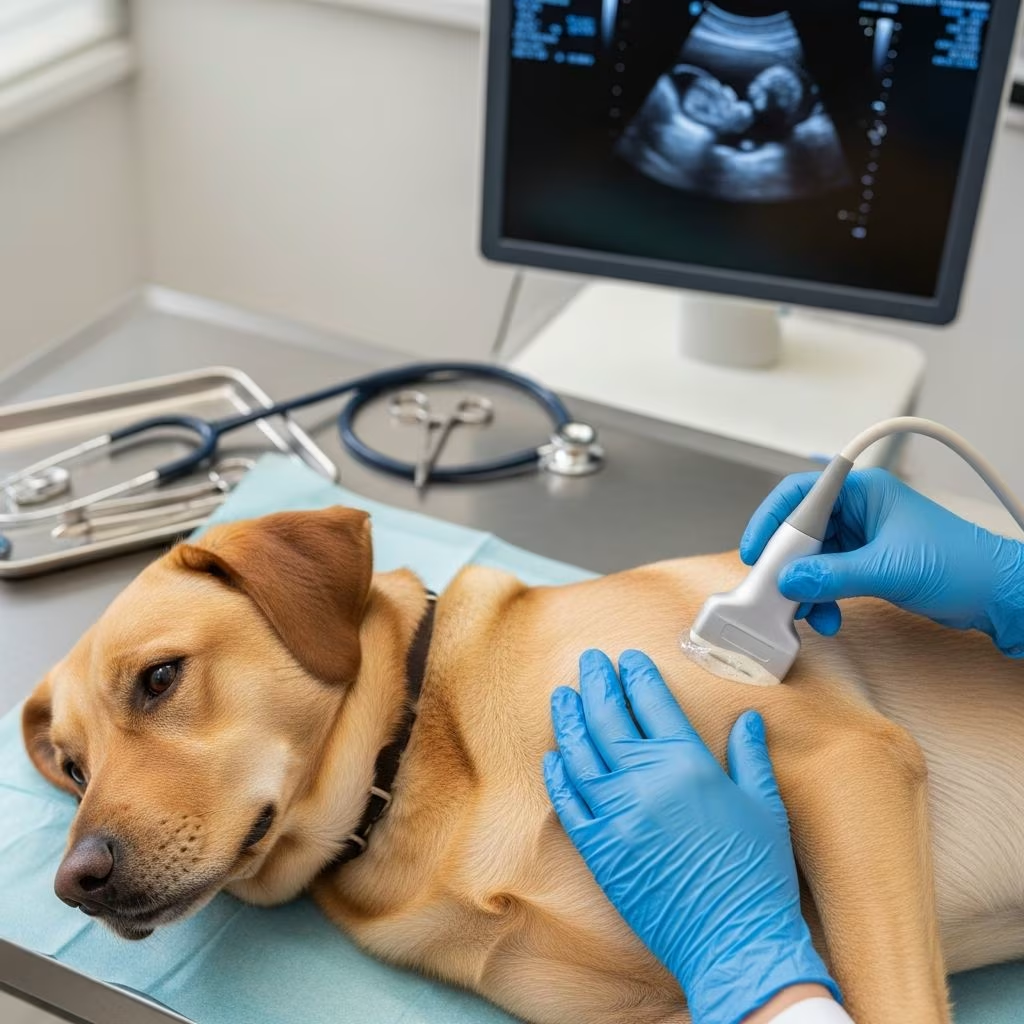
Veterinary ultrasonography represents a cornerstone of modern animal diagnostics, offering real-time, non-invasive visualization of internal structures using high-frequency sound waves. This technology enables veterinarians to assess organs, tissues, and blood flow with precision, often complementing or surpassing traditional radiography.
Core Principles of Ultrasound Imaging
At its heart, ultrasound operates on the pulse-echo principle: a transducer emits short bursts of sound waves that penetrate tissues and reflect back as echoes based on density differences. These echoes are captured, converted into electrical signals, and processed into grayscale images, with brighter areas indicating stronger reflections from denser tissues.
The speed of sound in soft tissue, approximately 1540 m/s, allows calculation of depth from echo return time. Modern systems sweep the beam rapidly, producing dynamic B-mode images that mimic anatomical cross-sections. Factors like frequency (1.5–18 MHz) balance resolution and penetration—higher for superficial structures, lower for deeper organs.
Transducer Technology and Selection
Transducers, containing piezoelectric crystals, generate and receive waves via electrical vibration. Key types include:
- Linear transducers: High-frequency (7–15 MHz) for superficial imaging like tendons, vessels, and small animal abdomens; rectangular field of view.
- Curvilinear/convex: Lower frequency (2–8 MHz) for broader abdominal views in medium to large animals.
- Phased array/sector: Compact footprint for cardiac imaging through intercostal spaces; deep penetration.
- Endocavitary: For rectal or vaginal exams, providing close-up views of prostate or uterus.
Gel coupling minimizes air interference, and clipping/shaving fur enhances contact. Operators must optimize gain, depth, and focus to reduce artifacts like reverberation or shadowing.
Image Modes Explained
| Mode | Purpose | Key Features |
|---|---|---|
| B-mode (Brightness) | Anatomical imaging | Grayscale, real-time 2D slices |
| M-mode (Motion) | Cardiac valves/motion | High temporal resolution, 1D graph over time |
| Doppler | Blood flow | Color/power for velocity/direction; detects regurgitation or stenosis |
Combining modes, like B-mode guided Doppler, refines cardiac assessments.
Preparing Animals for Optimal Scans
Patient preparation is crucial: fasting 8–12 hours aids abdominal clarity by reducing gas; water intake may distend bladder for better visualization. Sedation calms fractious pets without compromising safety. Positioning—dorsal recumbency for abdomen, right lateral for heart—optimizes acoustic windows.
Operator proficiency demands knowledge of species-specific anatomy, pathology, and artifacts to avoid misdiagnosis.
Abdominal Ultrasound Applications
Abdominal scanning excels in evaluating parenchymal organs. Kidneys appear as cortico-medullary pyramids; hyperechoic cortex suggests chronic disease. Liver assessment reveals masses, cysts, or portosystemic shunts via portal vein dilation.
- Spleen: Monitors splenomegaly or nodules, guiding fine-needle aspirates.
- Bladder/Prostate: Detects uroliths, tumors; guides cystocentesis.
- GI Tract: Identifies intussusceptions, foreign bodies via wall thickening.
- Reproductive: Pregnancy staging from day 20; ovarian cysts in queens.
In foals or calves, it monitors gut motility; in horses, colic diagnostics.
Cardiac Echocardiography Essentials
Echocardiography is the gold standard for heart evaluation, detailing chambers, valves, and function without stress. Right parasternal views assess mitral regurgitation via color Doppler; spectral Doppler quantifies gradients in stenosis.
Congenital defects like PDA or VSD show turbulent jets; hypertrophic cardiomyopathy in cats displays thickened walls. M-mode tracks valve motion precisely.
Musculoskeletal and Soft Tissue Imaging
Growing in popularity, musculoskeletal ultrasound detects tendon tears, ligament strains, especially in equine athletes and canine athletes. Compare contralateral limbs for symmetry; serial exams track healing.
Superficial structures like thyroids or popliteal lymph nodes benefit from linear probes.
Thoracic and Advanced Uses
Thoracic ultrasound identifies pleural effusion (anechoic free fluid), consolidations, or masses; lung sliding rules out pneumothorax. Guides thoracocentesis.
Emerging: contrast-enhanced ultrasound for vascularity; elastography for tissue stiffness in tumors.
Advantages, Limitations, and Artifacts
Pros: Real-time, no radiation, portable, repeatable; excels in soft tissue contrast.
Cons: Operator-dependent; gas/bone obscure views; obesity attenuates waves.
Common artifacts:
- Reverberation: Multiple echoes from gas/fluid interfaces.
- Shadowing: Behind stones/bone.
- Enhancement: Bright behind fluid.
Training and Quality Standards
Veterinarians need hands-on training in anatomy, physics, and pathology recognition. Guidelines emphasize optimizing controls, artifact mitigation, and knowing ultrasound’s role in multimodal diagnostics. DICOM storage ensures legal, shareable records.
Future Directions in Veterinary Ultrasound
Portable AI-enhanced units promise point-of-care assessments; 3D/4D imaging adds volume rendering. Tele-ultrasound connects rural vets to specialists.
Frequently Asked Questions (FAQs)
What is the cost of a veterinary ultrasound machine?
Entry-level portables start at $20,000; advanced cardiac units exceed $100,000.
Is ultrasound safe for pregnant animals?
Yes, non-ionizing; ideal for fetal viability and monitoring.
How long does an abdominal ultrasound take?
15–30 minutes for routine scans; longer for guided procedures.
Can ultrasound replace X-rays?
No, complementary: X-rays for bones/air, ultrasound for soft tissues/fluid.
What training is required for vets?
Certification courses (100+ hours) plus supervised practice.
References
- Imaging techniques in Veterinary Medicine. Part I: Radiography and Ultrasonography — PMC. 2021-10-01. https://pmc.ncbi.nlm.nih.gov/articles/PMC8529508/
- How Does Veterinary Ultrasound Work? — Antech Diagnostics. 2023-05-15. https://www.antechdiagnostics.com/equipment-resources/how-does-veterinary-ultrasound-work/
- Ultrasonography in Animals — MSD Veterinary Manual. 2024-01-10. https://www.msdvetmanual.com/clinical-pathology-and-procedures/diagnostic-imaging/ultrasonography-in-animals
- Physical Principles of Abdominal Ultrasonography Part 1 — Today’s Veterinary Practice. 2022-08-20. https://todaysveterinarypractice.com/radiology-imaging/physical-principles-of-abdominal-ultrasonography-part-1-basics-of-ultrasound-transducers-image-formation-2/
- Small Animal Veterinary Guidelines for Professional Ultrasound Practice — BMUS. 2023-03-12. https://www.bmus.org/media/resources/files/Small_Animal_Veterinary_Guidelines_for_Professional_Ultrasound_Practice_ummxk60.pdf



