
Veterinary Orbital Anatomy: 6 Key Structures
Comprehensive guide to the orbital cavity's structure, function, and disorders across species for optimal animal eye health.
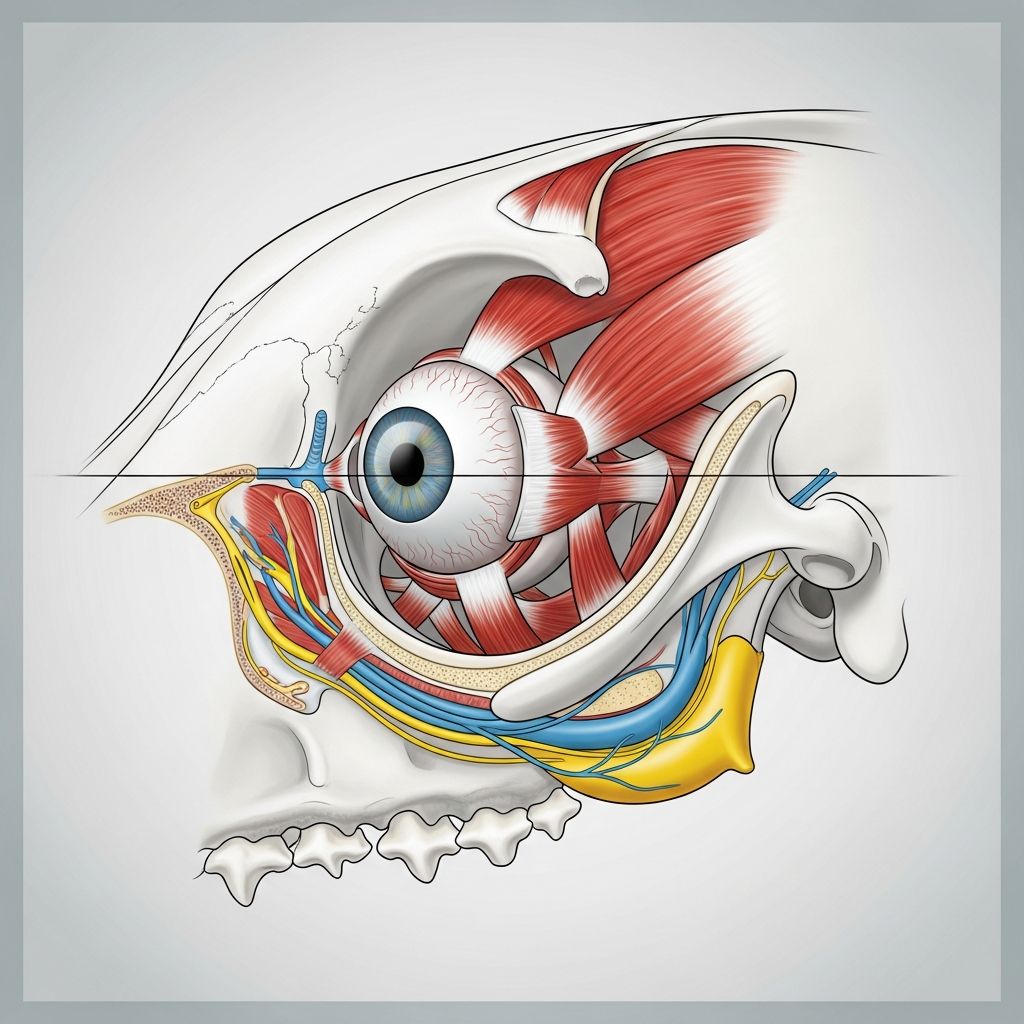
The orbital cavity serves as a vital protective enclosure for the eyeball in animals, varying significantly across species to suit their visual needs and lifestyles. Understanding its composition is essential for diagnosing and treating eye-related conditions effectively.
Structural Composition of the Orbit
The orbit consists of bony walls, soft tissues, muscles, and glands that collectively safeguard the globe. In many species, it forms a funnel-shaped cavity with openings for nerves and vessels. Domestic animals exhibit two primary configurations: a complete bony orbit in herbivores like horses and cattle, and an incomplete one in carnivores such as dogs and cats, where a robust ligament bridges the dorsolateral gap.
Bones contributing to the orbit include the frontal, zygomatic, lacrimal, sphenoid, palatine, and maxillary in most species. Key passages like the orbital foramen, optic canal, and various fissures allow neurovascular structures to enter. For instance, in cattle, the orbital and rotundum foramina merge, streamlining nerve pathways.
Species-Specific Variations
- Dogs and Cats: Feature an open orbit completed by the orbital ligament from the zygomatic process of the frontal bone to the frontal process of the zygomatic bone. The floor is soft tissue, making it prone to caudal swellings from pathology.
- Horses and Ruminants: Possess fully enclosed bony orbits for enhanced protection, with eyes positioned laterally for wide-field vision.
- Exotic Species like Painted Dogs: Display a funnel-shaped open orbit with a single ethmoid opening.
Orbital positioning influences vision: anterior in predators for binocular depth perception, lateral in prey animals for panoramic views.
Fascial Layers and Supporting Tissues
The periorbita, a thin membrane adherent to bone, thickens laterally in incomplete orbits. It extends to form Tenon’s capsule around the globe and connects to the orbital septum anteriorly and dura posteriorly. Orbital fat cushions between periorbita and muscles, with additional intraorbital fat among muscle layers. In open orbits, masticatory muscles provide posterior stability.
| Foramen/Fissure | Contents |
|---|---|
| Orbital Fissure | Abducent nerve, oculomotor branches |
| Optic Canal | Optic nerve, ophthalmic artery |
| Supraorbital | Supraorbital nerve and vessels |
| Round Foramen | Maxillary nerve |
Extraocular Muscles and Innervation
Six extraocular muscles control globe movement: four rectus (dorsal, ventral, medial, lateral) and two obliques (dorsal and ventral). The retractor bulbi pulls the globe posteriorly, while levator palpebrae elevates the upper lid. Innervation primarily from cranial nerves III (oculomotor), IV (trochlear), and VI (abducent).
| Muscle | Innervation | Primary Action |
|---|---|---|
| Medial Rectus | CN III | Adducts globe |
| Lateral Rectus | CN VI | Abducts globe |
| Dorsal Oblique | CN IV | Intorts and abducts |
| Ventral Oblique | CN III | Extorts and abducts |
| Retractor Bulbi | CN VI | Retracts globe into orbit |
These muscles originate from the orbital apex and insert on the sclera, enabling precise movements. Dysfunction leads to strabismus or restricted motility.
Glands Within the Orbit
Orbital glands produce tears and maintain lubrication. The lacrimal gland sits dorsolaterally, the zygomatic gland ventrolaterally, and the third eyelid gland ventromedially. In dogs and cats, these fill spaces around muscles and fat. Histologically, glands feature acini and tubules with serous secretions; measurements show varying capsule and septal thicknesses.
Diagnostic Approaches to Orbital Issues
Clinical signs include exophthalmos (proptosis), enophthalmos, periorbital swelling, or ophthalmoplegia. Imaging is cornerstone: CT excels for bony changes, MRI for soft tissues. Ultrasound aids retrobulbar assessment, while radiographs with contrast reveal filling defects from masses.
Fine-needle aspiration, biopsy, and cultures confirm infections or neoplasia. Oral exam is crucial in dogs/cats due to thin floor allowing abscesses to manifest intraorally.
Common Pathologies Affecting the Orbit
Orbital diseases span inflammation, infection, trauma, and tumors. Abscesses from retrobulbar cellulitis cause painful swelling; neoplasia like lymphosarcoma leads to exophthalmos and vision loss.
- Inflammatory: Orbital cellulitis, often bacterial, with ventral drainage in incomplete orbits.
- Neoplastic: Common in cats (lymphoma), dogs (osteosarcoma); imaging shows mineralized masses or bone lysis.
- Traumatic: Brachycephalics prone due to shallow orbits and lagophthalmos.
- Volume Changes: Fat atrophy or dehydration causes enophthalmos, third eyelid protrusion.
Advanced Imaging Insights
CT reveals bone erosion and mass density; MRI differentiates soft tissue invasion, as in cases compressing brain parenchyma. In one feline case, coronal MRI showed a mass displacing the globe and cerebrum.
Therapeutic Considerations
Treatment targets etiology: antibiotics for infections, surgical debulking or exenteration for irreparable masses. Prognosis varies; early detection improves outcomes. Species differences guide approaches—herbivores may tolerate conservative management better due to robust bony walls.
FAQs
What causes exophthalmos in dogs?
Typically orbital masses, abscesses, or inflammation expanding contents, forcing the globe forward.
How does orbital anatomy differ between cats and horses?
Cats have incomplete bony orbits with ligamentous closure; horses have fully bony enclosed orbits.
Can orbital diseases affect vision?
Yes, via optic nerve compression or muscle restriction, leading to blindness or restricted fields.
Is MRI necessary for all orbital evaluations?
No, but ideal for soft tissue; CT suffices for bone.
What role do salivary glands play in the orbit?
Zygomatic glands occupy ventral space, potentially involved in inflammatory expansions.
References
- Orbit – Veterian Key — Veterian Key. 2016. https://veteriankey.com/orbit-2/
- Ophthalmic anatomy and diagnostics (Proceedings) — dvm360. Accessed 2026. https://www.dvm360.com/view/ophthalmic-anatomy-and-diagnostics-proceedings
- Anatomical and morphometric evaluation of the orbit, eye tunics… — PMC (NCBI). 2021-04-22. https://pmc.ncbi.nlm.nih.gov/articles/PMC8055035/
- Orbit – Functional Anatomy — Veterinary Ophthalmology Web. Accessed 2026. https://vetophtho.org/orbit/orbit.html
- Eye Structure and Function in Dogs — Merck Veterinary Manual. Accessed 2026. https://www.merckvetmanual.com/dog-owners/eye-disorders-of-dogs/eye-structure-and-function-in-dogs
Similar Articles








Read full bio of medha deb


