
Veterinary MRI: Advanced 2025 Guide For Animal Imaging
Explore how MRI revolutionizes animal diagnostics with superior soft tissue imaging for neurology, orthopedics, and more across species.
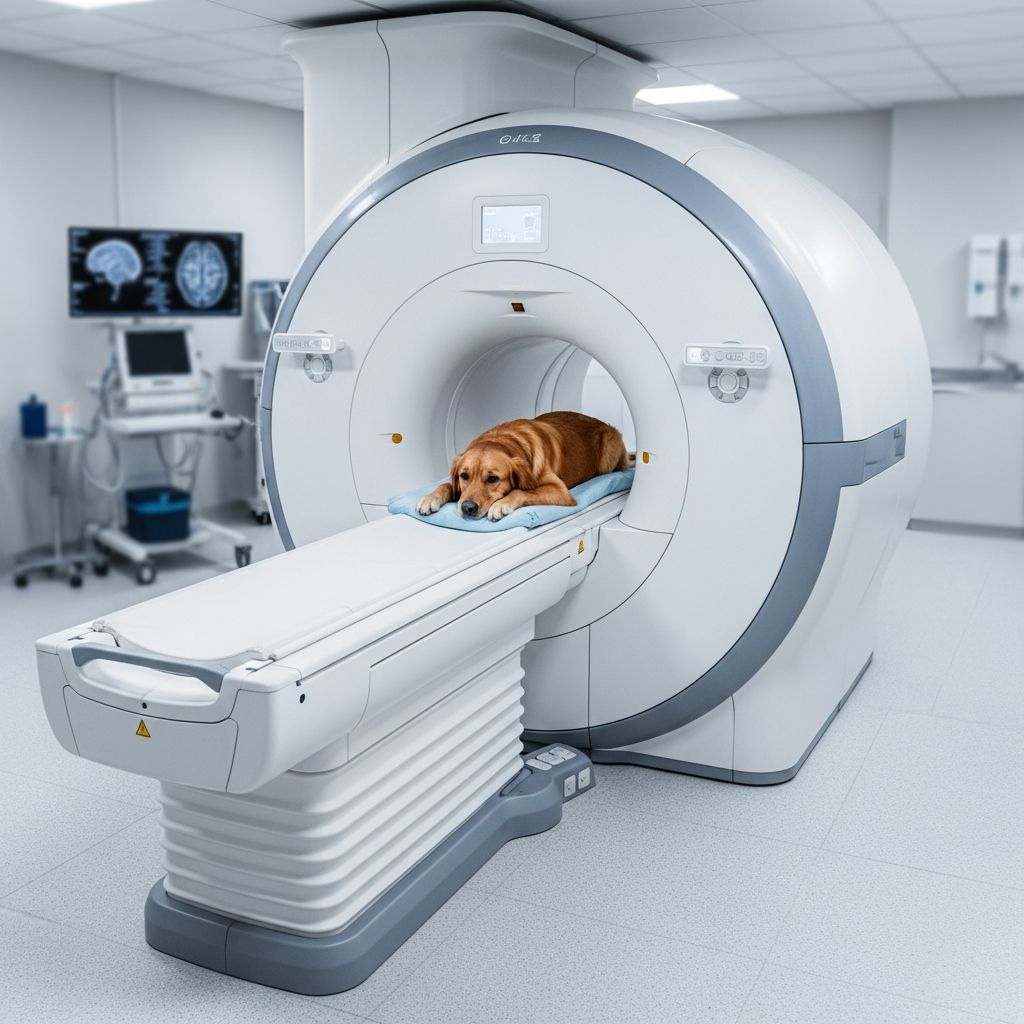
Magnetic resonance imaging (MRI) has become a cornerstone of modern veterinary diagnostics, offering unmatched detail in soft tissue visualization without ionizing radiation. This technology excels in revealing intricate structures like brain tissue, ligaments, and cartilage, enabling precise identification of conditions that other modalities might miss.
Fundamentals of MRI Technology in Animal Care
At its core, MRI uses strong magnetic fields, radiofrequency pulses, and gradient coils to generate detailed cross-sectional images of animal anatomy. Unlike X-rays or CT scans, it differentiates between tissue types based on hydrogen atom behavior in varying magnetic environments, providing high-contrast images of soft structures.
Veterinary MRI systems vary in field strength: low-field (0.2–0.5T) units are common for standing equine scans, while high-field (1.5T–3T) scanners deliver superior resolution for small animals under anesthesia. These systems support multiplanar imaging, allowing views in any orientation without repositioning the patient.
- Key advantages: No radiation exposure, excellent soft tissue contrast, and sensitivity to edema or inflammation.
- Limitations: Long scan times, high costs, and need for anesthesia in most cases.
Neurological Applications Across Species
MRI dominates veterinary neurology due to its ability to distinguish gray and white matter, detect tumors, inflammation, and vascular anomalies. In dogs and cats, it is the gold standard for brain and spinal cord evaluation.
For instance, midbrain masses or spinal cord compressions appear clearly, often enhanced by gadolinium-based contrast agents that highlight breakdown in the blood-brain barrier. These agents, while safe in most animals, require caution in renal-compromised patients.
| Condition | Common Species | MRI Findings |
|---|---|---|
| Brain tumors | Dogs, cats | Contrast-enhancing lesions with edema |
| Intervertebral disc disease | Chondrodystrophic dogs | Cord compression, herniation signals |
| Meningitis/encephalitis | Small animals | Meningeal enhancement, parenchymal changes |
In equine neuroimaging, MRI assesses complex head structures, aiding in diagnoses like ethmoid hematoma or pituitary pars intermedia dysfunction.
Orthopedic and Musculoskeletal Insights
MRI’s prowess in orthopedics stems from its depiction of cartilage, tendons, ligaments, and subchondral bone. In small animals, it evaluates elbow dysplasia, shoulder osteochondrosis, and stifle osteoarthritis, detecting cartilage flaps or loose bodies missed by radiography.
For horses, MRI is pivotal in chronic lameness, especially foot pathologies. Standing low-field systems image the distal limb, revealing deep digital flexor tendon tears or navicular bone edema without full anesthesia.
- Equine foot lameness: Visualizes hoof soft tissues in sagittal, transverse planes.
- Small animal joints: Assesses meniscal tears, cruciate ligaments.
Studies show MRI outperforms CT for non-osseous joint components, guiding surgical planning.
Adapting MRI for Diverse Animal Sizes
Small Companion Animals
Dogs and cats benefit from high-field MRI for intracranial and spinal issues. Scans under general anesthesia minimize motion artifacts, yielding images for pituitary disorders or inner ear infections.
Large Animals and Equines
Horses pose unique challenges; recumbent high-field MRI offers top resolution but requires anesthesia, while standing units enable sedation-only procedures for limb scans.
Exotics and Zoological Species
MRI adapts to birds, reptiles, and primates, exploring neurology or oncology with tailored coils for small anatomies.
Practical Protocols and Anesthesia Management
Successful veterinary MRI demands meticulous preparation. Patients undergo clipping, screening for metallic implants, and stabilization. Injectable or inhalant anesthesia ensures immobility; monitoring includes pulse oximetry, capnography, and blood pressure.
Scan protocols sequence T1-weighted (anatomy), T2-weighted (fluids/edema), FLAIR (suppresses CSF), and diffusion-weighted (stroke detection) images. Contrast administration follows for enhanced lesion characterization.
Comparing MRI with Other Imaging Modalities
| Modality | Strengths | Weaknesses | Best Use in Vet Med |
|---|---|---|---|
| X-ray | Fast, cheap, bone detail | Poor soft tissue | Initial screening |
| CT | Fast, bone/air contrast | Radiation, less soft tissue | Trauma, skull |
| Ultrasound | Real-time, no radiation | Superficial only | Abdomen, tendons |
| MRI | Soft tissue superior | Expensive, slow | Neuro, MSK |
MRI complements CT for spine trauma (CT for bone, MRI for cord) and radiography for joints.
Advances and Future Directions
Recent developments include dedicated veterinary 1.5T scanners, functional MRI for brain activity, and AI-enhanced image processing for faster analysis. Standing equine systems evolve with higher fields, improving lameness prognoses.
Research expands MRI into oncology, using advanced tracers alongside PET/CT hybrids for metastasis staging.
Challenges and Safety Considerations
High costs limit access; scans range $1,500 $4,000. Safety protocols mitigate risks like projectile effects from ferrous objects or quenching hazards.
Contrast agents pose nephrotoxicity risks, though rare in vets; pre-scan creatinine checks are standard.
Frequently Asked Questions (FAQs)
What conditions does veterinary MRI diagnose best?
Primarily neurological tumors, spinal diseases, and soft tissue orthopedic injuries.
Is anesthesia always required for animal MRI?
Yes for high-field small animal scans; standing low-field equine limb MRI uses sedation.
How does MRI benefit equine lameness evaluation?
It images deep hoof structures, distinguishing bone from tendon pathology.
Are there risks with MRI contrast in pets?
Minimal, but avoid in renal disease; gadolinium is generally safe.
Can MRI be used for exotics?
Yes, with custom coils for precise neuroimaging or tumor assessment.
Conclusion
Veterinary MRI transforms diagnostics, offering unparalleled insights that improve outcomes across species. Its integration with multimodal imaging solidifies its role in advanced practice.
References
- Veterinary MRI Applications for small animals and equine — Esaote. 2024. https://www.esaotevet.com/en-US/veterinary-mri/clinical-applications/
- Imaging techniques in veterinary medicine. Part II: Computed Tomography, Magnetic Resonance Imaging, and Nuclear Medicine — PMC (NCBI). 2022-12-20. https://pmc.ncbi.nlm.nih.gov/articles/PMC9768321/
- Magnetic Resonance Imaging in Animals — Merck Veterinary Manual. 2023. https://www.merckvetmanual.com/clinical-pathology-and-procedures/diagnostic-imaging/magnetic-resonance-imaging-in-animals
- Magnetic Resonance Imaging (MRI) — UC Davis School of Veterinary Medicine. 2024. https://vetmed.ucdavis.edu/hospital/diagnostic-imaging/small-animal/mri
- MRI FAQ — University of Tennessee College of Veterinary Medicine. 2024. https://vetmed.tennessee.edu/vmc/radiology/mri-faq/
Similar Articles








Read full bio of Sneha Tete


