

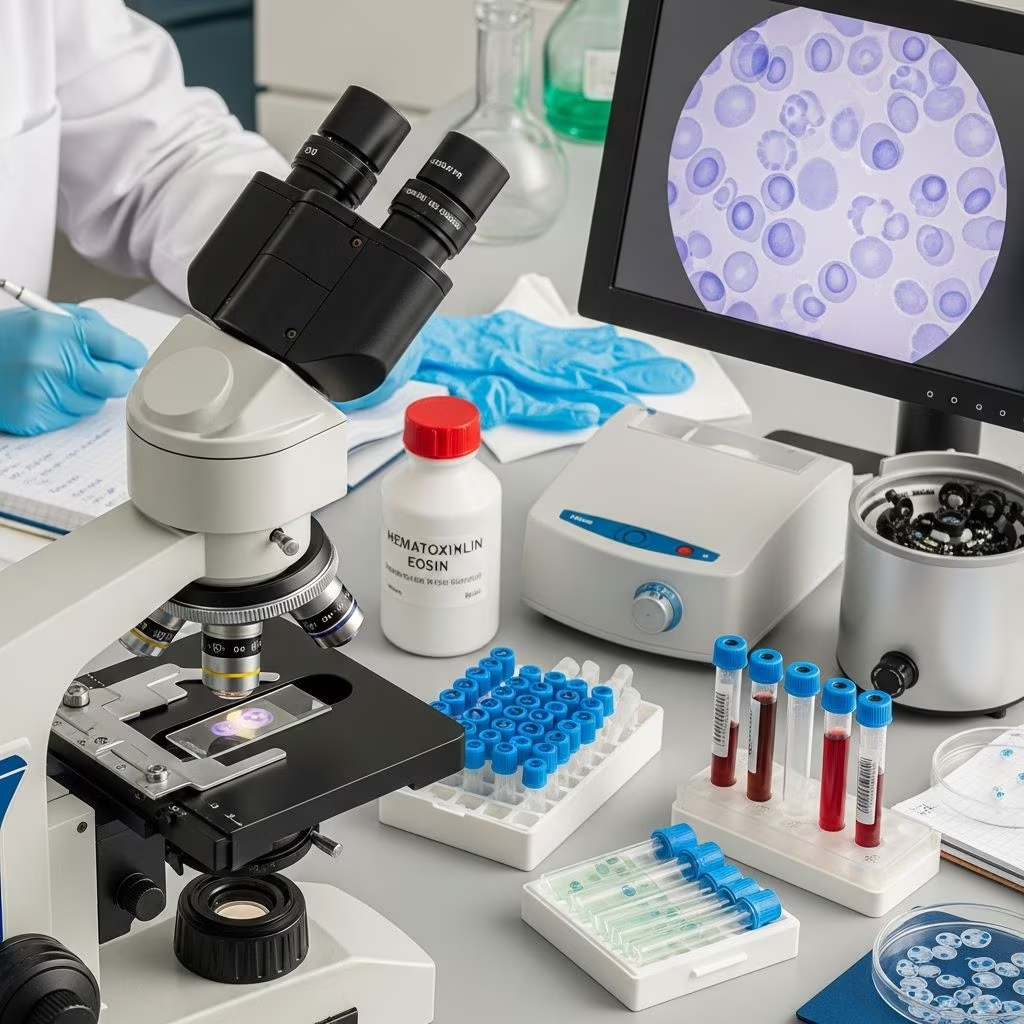
Cytology serves as a cornerstone diagnostic tool in veterinary medicine, enabling practitioners to examine individual cells from various body sites to identify infections, inflammation, and neoplasms quickly and cost-effectively. This approach provides rapid insights with minimal invasion, often guiding immediate treatment decisions in clinical settings.
Why Cytology Matters in Modern Veterinary Practice
In busy veterinary clinics, cytology offers a balance of speed, affordability, and accuracy. Unlike full biopsies, it requires little equipment and can be performed without anesthesia, making it ideal for first-line diagnostics. Studies show diagnostic success rates around 66% overall, with higher yields from fluids (up to 83%) and glandular tissues. This efficiency helps differentiate reactive processes from malignancies, influencing prognosis and therapy choices.
Cytology excels in evaluating lumps, effusions, and discharges, where traditional methods might delay care. For instance, fine-needle aspiration (FNA) of masses can reveal mast cell tumors or lymphoma, correlating well with outcomes. Its limitations, such as lower specificity for architecture-dependent diagnoses, are offset by its role as a triage tool before histopathology.
Key Sample Collection Techniques
Effective cytology starts with proper sampling. Practitioners select methods based on lesion type, location, and patient tolerance. Common approaches include:
- Fine-Needle Aspiration (FNA): Preferred for solid masses and organs. Use a 22-25 gauge needle attached to a 5-12 ml syringe. Insert into the lesion, apply suction, redirect 3-5 times, then release suction before withdrawing to avoid blood contamination.
- Impression Smears: For ulcerated or moist surfaces, gently press a clean slide onto the area to transfer cells directly. Ideal for skin lesions or surgical biopsies.
- Swab Cytology: Collect exudate from ears, eyes, or orifices with a sterile cotton-tipped swab, then roll onto a slide. Useful for infectious or inflammatory discharges.
- Scrapings: For scaly skin patches, use a blunt scalpel or spatula to scrape superficial layers onto a slide.
- Lavage: Flush cavities like nasal passages or joints with sterile saline, then aspirate the fluid for cell harvest. Less common but effective for hollow organs.
Aspiration versus non-aspiration techniques vary by preference; aspiration increases cellularity but risks hemodilution if overdone. Always include clinical history—signalment, lesion description, duration—to aid interpretation.
Preparing High-Quality Slides
Slide quality determines interpretability. After collection, expel material onto a clean glass slide and spread using the squash or touch-prep method: place a second slide atop the drop, pull apart smoothly for a monolayer of cells. Avoid thick piles or dragging, which cause artifacts.
Air-dry slides for Romanowsky stains (e.g., Wright-Giemsa) or fix in methanol for others. Stain promptly to preserve morphology. For fluids, concentrate via centrifugation: spin at 1,000-1,500 rpm for 5-10 minutes, resuspend sediment, and prepare smears from the buffy coat.
| Sample Type | Preparation Tip | Common Pitfall |
|---|---|---|
| Solid Masses (FNA) | Squash between slides | Excess blood dilution |
| Body Fluids | Centrifuge and buffy coat smear | Inadequate concentration |
| Skin Scrapes | Direct transfer, no spreading | Over-scraping trauma |
| Swabs | Roll gently, air-dry | Drying artifacts |
Label slides clearly with patient ID, site, and date. Ship fixed slides in rigid containers to prevent breakage.
Microscopic Evaluation: A Systematic Approach
Examine slides methodically. Begin with low power (10x) to assess cellularity, background (e.g., blood, debris, microbes), and distribution. Scan for large structures like macrophages or crystals. Switch to 40x-100x oil immersion for detailed morphology.
Evaluate key features:
- Cellularity: Adequate for diagnosis? Low numbers limit accuracy.
- Cell Types: Epithelial, mesenchymal, round (hematopoietic), or mixed? Quantify percentages.
- Morphology: Size, shape, nucleus:cytoplasm ratio, chromatin, nucleoli. Anisocytosis/anisokaryosis suggests neoplasia.
- Background: Clean, hemorrhagic, necrotic, or purulent?
- Secondary Changes: Inflammation, bacteria, fungi.
Blood smears complement cytology; manual review detects analyzer misses like toxic neutrophils or left shifts. For platelets, estimate via smear to confirm thrombocytopenia.
Recognizing Normal versus Abnormal Cells
Normal canine neutrophils show pale lavender cytoplasm with 3-5 lobes; cats have darker granules. Lymphocytes are small, round with scant blue cytoplasm. Reactive lymphocytes enlarge with open chromatin.
Abnormalities include:
- Neoplastic Cells: Pleomorphism, high N:C ratio (>0.7), prominent nucleoli, mitoses. Mast cell tumors show metachromatic granules grading from well-differentiated (low grade) to anaplastic.
- Infectious Agents: Bacteria (cocci/rods), yeast (Malassezia oval bodies).
- Inflammatory Patterns: Neutrophilic (bacterial), eosinophilic (parasitic/allergic), lymphocytic/plasmacytic (chronic).
Diagnostic Yields by Sample Site
Success varies by origin. A large feline study (n=3068) reported:
- Fluids: 83.48% diagnostic (high cellularity, preserved morphology).
- Glandular tissues: 76.67%.
- Mucous membranes: 75.81%.
- Organs: 67.79%.
- Cutaneous nodules: 62.16% (challenging due to fibrosis).
- Lymph nodes: 57.93% (reactive hyperplasia mimics lymphoma).
Non-diagnostic cases often stem from low cellularity, poor preparation, or hemorrhage. Repeat sampling or biopsy follows.
Common Pitfalls and Quality Control
Avoid these errors:
- Hemodilution: Minimize suction time in FNA.
- Crush Artifacts: Gentle spreading preserves nuclei.
- Staining Issues: Uneven Romanowsky leads to misread chromatin.
- Overinterpretation: Hyperplasia can mimic neoplasia; correlate clinically.
Labs emphasize submission details: history, differentials, photos. TVMDL stresses communication for optimal results. In-house staining ensures freshness but external review boosts accuracy via consensus.
When to Advance Beyond Cytology
Cytology categorizes but may not differentiate benign from malignant without architecture. Non-diagnostic or suspicious cases warrant biopsy for histopathology—the gold standard. For suspected cancers, stage with imaging before surgery. Cytology guides but rarely stands alone for prognosis.
Practical Applications in Small Animal Cases
Mass Evaluation: FNA of subcutaneous lumps triages mast cell tumors (granular, grading prognostic).
Effusions: Classify as transudate, exudate, or malignant; cell blocks aid further.
Dermatology: Scrapes/swabs detect demodex or pyoderma.
Hematology Tie-In: Smear reviews confirm analyzer flags, spotting Dohle bodies or rouleaux.
FAQs
What is the best needle size for FNA?
22-gauge for most; smaller for vascular sites to reduce bleeding.
How reliable is cytology for cancer diagnosis?
High sensitivity for round cell tumors; lower for carcinomas needing architecture. Overall 66% definitive in felines.
Can I do cytology in-house?
Yes, with basic stains; send complex cases to pathologists for consensus.
What if slides are non-diagnostic?
Repeat with ultrasound guidance or proceed to biopsy.
Does cytology replace biopsy?
No; it screens, biopsy confirms tissue relationships.
Future Directions in Veterinary Cytology
Advances like digital cytology and AI-assisted pattern recognition promise higher accuracy. Multimodal approaches—cytology plus flow cytometry—enhance lymphoma subtyping. Training via workshops improves private practice yields, making cytology indispensable.
References
- Cytology Archives – Today’s Veterinary Practice — Today’s Veterinary Practice. 2023. https://todaysveterinarypractice.com/clinical_topics/cytology/
- Cytology – General – VCA Animal Hospitals — VCA Animal Hospitals. 2023. https://vcahospitals.com/know-your-pet/cytology—general
- What Comes from Cytology Diagnosis – PMC – NIH — National Center for Biotechnology Information. 2024-10-15. https://pmc.ncbi.nlm.nih.gov/articles/PMC12298540/
- Cytology as a diagnostic application — Texas A&M Veterinary Medical Diagnostic Laboratory. 2023. https://tvmdl.tamu.edu/cytology-as-a-diagnostic-application/
- Collect and Ship Your Cytology Like a Pro — University of Illinois Veterinary Diagnostic Lab. 2023. https://vdl.vetmed.illinois.edu/pages/collect-and-ship-your-cytology-like-a-pro
- Solid Tissue Cytology – Hints to Avoid Poor Quality Samples — Michigan State University Veterinary Diagnostic Laboratory. 2020-09-01. https://cvm.msu.edu/vdl/client-education/newsletter/fall-2020/solid-tissue-cytology-hints-to-avoid-poor-quality-samples



