

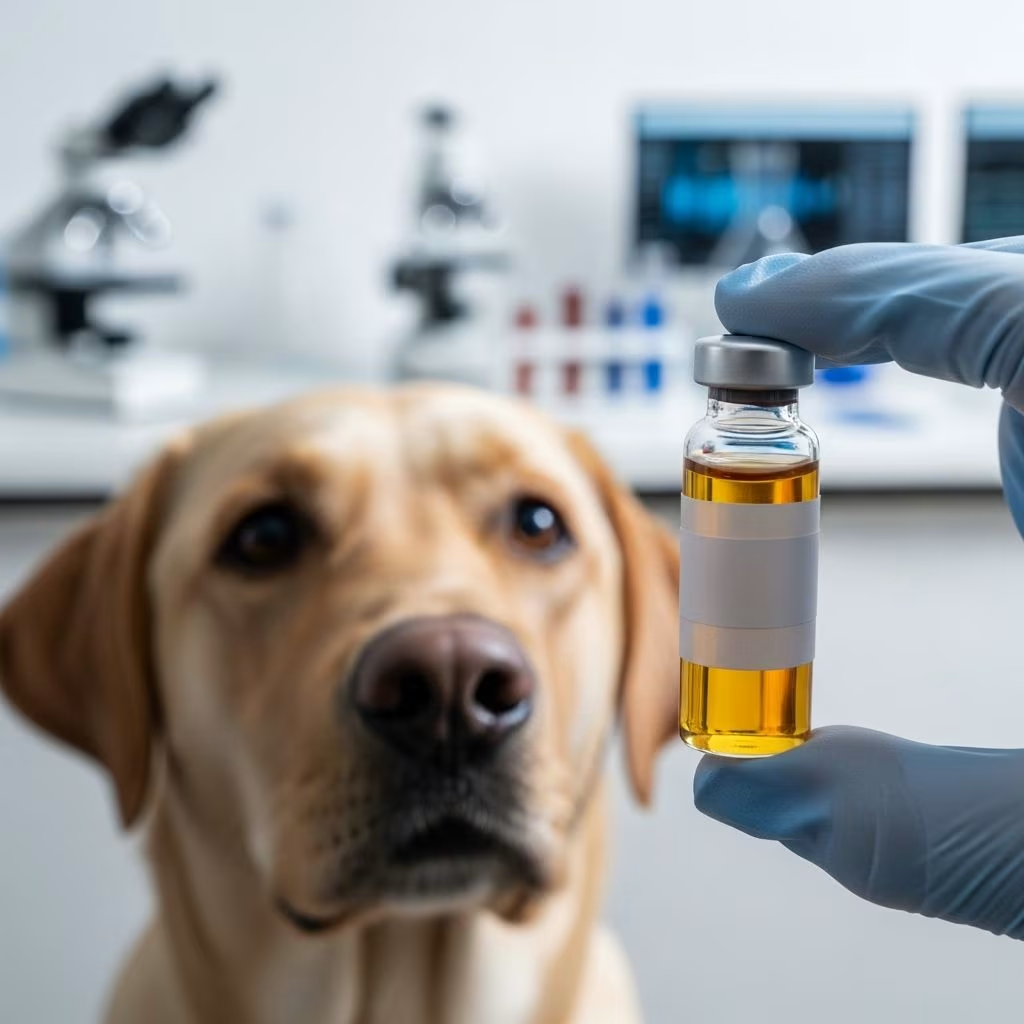
Vaccine titer testing measures antibody levels in a dog’s blood to determine existing immunity against specific diseases, allowing veterinarians to decide if booster shots are necessary.
Understanding Antibodies and Immunity in Canines
Antibodies, or immunoglobulins, are proteins produced by the immune system in response to antigens from vaccines or infections. A titer test quantifies these antibodies by diluting blood samples and testing their reaction to disease-specific agents, such as viruses. This process reveals whether a dog maintains protective immunity without needing additional vaccinations.
Immunity involves both humoral (antibody-based) and cell-mediated responses. While titers focus on antibodies, a positive result strongly correlates with overall protection for core canine vaccines, though negative titers do not always mean vulnerability due to cellular immunity.
Core Vaccines Suitable for Titer Assessment
Titer tests are most reliable for core vaccines protecting against life-threatening diseases prevalent in dog populations. These include:
- Canine Distemper Virus (CDV): A highly contagious virus affecting multiple systems; virus neutralization (VN) assays measure protective antibodies.
- Canine Parvovirus (CPV): Causes severe gastrointestinal issues; hemagglutination inhibition (HI) tests are standard.
- Canine Adenovirus Type 1 (CAV-1): Leads to infectious hepatitis; titers confirm long-lasting protection.
Rabies titers exist but are less commonly used due to legal vaccination requirements overriding test results in most areas.
Step-by-Step Process of Titer Testing
Obtaining a titer involves a straightforward veterinary procedure:
- Blood Draw: A small venous sample is collected, typically from the jugular or cephalic vein, during a routine exam.
- Laboratory Submission: The serum is separated and sent to accredited labs like KSU or CAVIDS for analysis using gold-standard functional assays.
- Testing Methods: Samples undergo serial dilutions to find the highest dilution still neutralizing the virus, reported as a numerical value (e.g., 1:16).
- Results Delivery: Turnaround is usually 3-7 days; vets interpret based on established protective thresholds.
| Disease | Common Test Method | Protective Threshold Example |
|---|---|---|
| CDV | Virus Neutralization (VN) | ≥1:16 or 1:32 |
| CPV | Hemagglutination Inhibition (HI) | ≥1:80 or 1:160 |
| CAV-1 | VN or HI | ≥1:16 |
Note: Thresholds vary by lab; always consult veterinary guidelines.
Ideal Scenarios for Requesting a Titer Test
Not every dog needs routine titers, but certain situations make them invaluable:
- Dogs with adverse vaccine reactions, like allergies or immune-mediated issues, to avoid unnecessary risks.
- Immunosuppressed pets or those with genetic non-responder status, where vaccines may fail to elicit immunity.
- Adult dogs with unknown vaccination history, such as rescues, to confirm protection before boarding or trials.
- Routine monitoring post-initial series (puppies get vaccines at 6-16 weeks, booster at 1 year) to extend intervals safely.
AAHA guidelines endorse titers for CDV, CPV, and CAV-1 as a reasonable immunity indicator, supporting every-3-year boosters only if needed.
Interpreting Titer Results: Positive, Negative, or Borderline
Results guide vaccination decisions:
- Positive (Above Threshold): Indicates sterilizing immunity; no booster required for 1-3 years or longer. Studies show many dogs retain protection for life after initial series.
- Negative (Below Threshold): Suggests low antibody levels; administer booster and consider re-test in 3-4 weeks to confirm response.
- Low Positive/Borderline: May reduce disease severity but not prevent infection; vaccination often advised for full protection.
Remember, titers assess humoral immunity; cell-mediated protection can persist despite low antibodies.
Financial Considerations and Accessibility
Titer costs range from $50-150 per disease per test, cheaper than multiple boosters over time. Labs like Hemopet or university services offer packages for multiple antigens. Pet insurance may cover if deemed medically necessary, but it’s often out-of-pocket. Compare to annual vaccines ($20-50 each), titers promote cost savings for immune dogs.
Limitations and Common Misconceptions
Titers aren’t perfect:
- Not for All Vaccines: Ineffective for non-core like Bordetella or Lyme due to lacking correlation studies.
- Lab Variability: Quantitative vs. qualitative tests differ; choose functional assays over ELISA for accuracy.
- False Negatives: Rare, but possible in non-responders; lifestyle adjustments may be needed.
Myth: “High titers mean lifelong immunity.” Fact: Duration varies; annual or triennial re-testing is prudent.
Integrating Titers into Your Dog’s Wellness Plan
Discuss with your vet: Start post-1-year booster. If positive, re-test yearly or every 3 years per AAHA. Combine with lifestyle risk assessment—high-exposure dogs (e.g., agility competitors) may need stricter protocols.
For puppies, titers post-series confirm seroconversion before high-risk periods. This personalized approach aligns with WSAVA and AVMA recommendations for evidence-based vaccinology.
Frequently Asked Questions (FAQs)
What does a positive titer mean for my dog?
It confirms sufficient antibodies for protection against tested diseases, potentially skipping boosters.
How often should I titer test my dog?
Annually after initial series or every 3 years if consistently positive, per veterinary guidelines.
Can titers replace all vaccines?
No, only for specified core viruses; legal vaccines like rabies must follow schedules.
Are home titer kits reliable?
No, professional lab functional tests are essential for accurate results.
What if my dog has a negative titer?
Booster immediately and re-test to verify immune response.
Expert Guidelines from Leading Organizations
AAHA (2022) supports titers for adult dogs to extend booster intervals judiciously. AVMA notes utility in risk-benefit analysis for sensitive cases. KSU VDL advocates post-series testing for core vaccines.
By leveraging titers, owners reduce over-vaccination risks like vaccinosis while upholding protection.
References
- To titer or to revaccinate — American Veterinary Medical Association. 2016-07-01. https://www.avma.org/javma-news/2016-07-01/titer-or-revaccinate
- Dog and Cat Vaccines and Titer Testing — Kansas State Veterinary Diagnostic Laboratory. Accessed 2026. https://www.ksvdl.org/laboratories/rabies-laboratory/dog-cat-vaccines-titer-testing.html
- Decoding Vaccine Titers — Today’s Veterinary Practice. 2020. https://todaysveterinarypractice.com/wp-content/uploads/sites/4/2022/03/TVP-2020-0910_Vaccine_Titers.pdf
- Vaccine Titer Testing for Dogs and Cats — Hemopet. Accessed 2026. https://hemopet.org/vaccine-titer-testing-for-dogs-and-cats/
- Frequently Asked Questions | CAVIDS Titer Testing — University of Wisconsin School of Veterinary Medicine. Accessed 2026. http://www.vetmed.wisc.edu/lab/cavids/frequently-asked-questions/
- Titer Tests for Dogs — PetMD. Accessed 2026. https://www.petmd.com/dog/general-health/titer-tests-dogs
- Understanding Titers: A Comprehensive Guide for Pet Owners — Pets First Veterinary Center. Accessed 2026. https://www.petsfirstvetcenter.com/understanding-titers-a-comprehensive-guide-for-pet-owners/



