

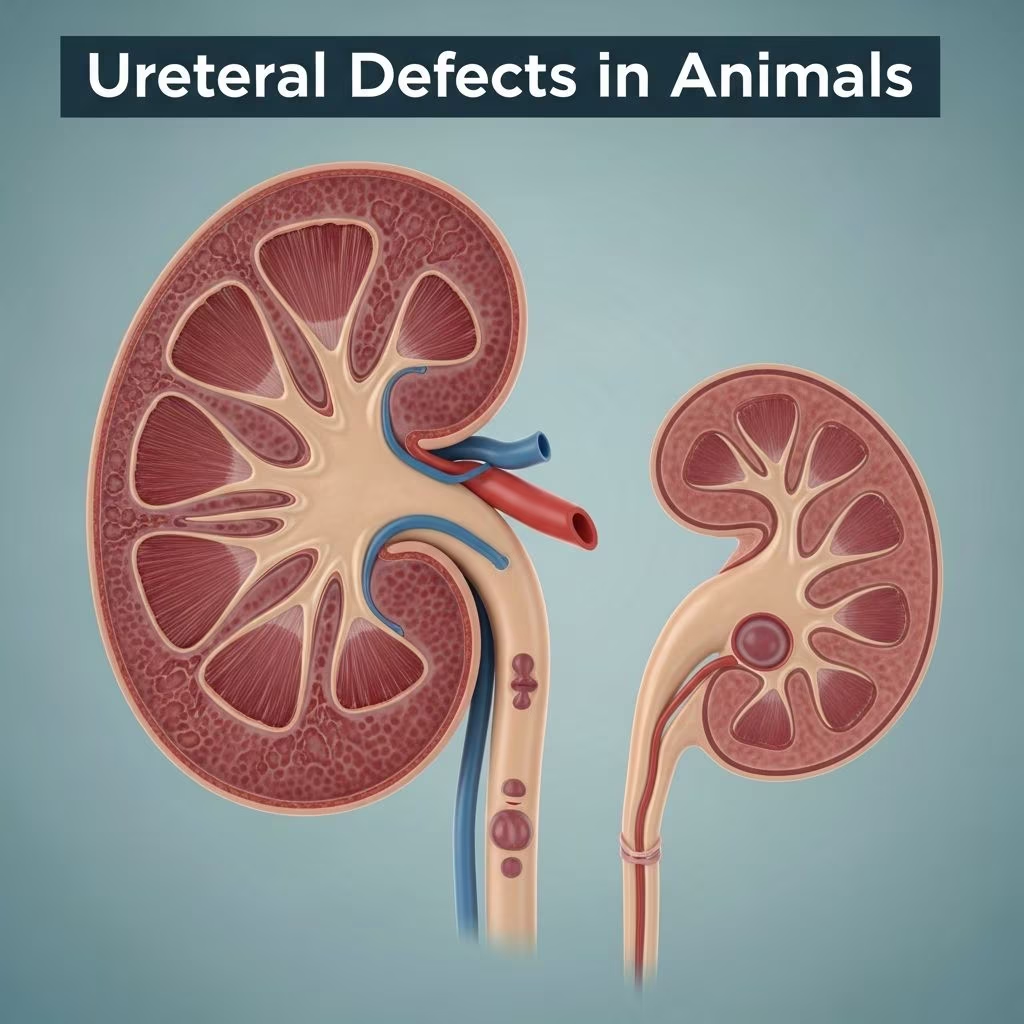
Congenital malformations of the ureters represent a significant challenge in veterinary practice, particularly in young dogs and occasionally cats. These defects disrupt normal urine flow from the kidneys to the bladder, often leading to persistent urinary incontinence and recurrent infections. Understanding these anomalies is crucial for timely intervention and improved quality of life for affected animals.
Understanding Ureteral Development and Common Malformations
The ureters form during embryonic development as tubes connecting the kidneys to the bladder. In typical anatomy, they insert at the trigone of the bladder, ensuring urine is stored until voluntary voiding. Disruptions in this process can result in ectopic ureters, where the ureters terminate abnormally in the urethra, vagina, or vestibule, bypassing the bladder’s sphincter mechanism.
Other notable defects include ureteroceles, which are cystic dilatations at the ureteral opening, and duplex ureters, involving duplicated systems. These conditions frequently coexist with hydronephrosis (kidney swelling due to urine backup), hydroureter (dilated ureter), and urethral sphincter incompetence.
Species and Breed Predispositions
Dogs, especially females, are predominantly affected by ureteral ectopia due to their shorter urethra, which exacerbates incontinence. Males may remain asymptomatic longer owing to urethral length. Breeds at higher risk include Golden Retrievers, Labrador Retrievers, Siberian Huskies, West Highland White Terriers, Newfoundlands, Miniature and Toy Poodles, Entlebucher Mountain Dogs, and Soft Coated Wheaten Terriers.
In cats, these anomalies are rarer but documented in domestic shorthairs, often presenting with incontinence or infections. Urethral anomalies like hypospadias or epispadias occur sporadically across species, with breed links in Boston Terriers for urethral agenesis.
- Dogs: 156 females vs. 19 males in one study of 175 cases; bilateral in 56%, left-sided in 50%, right-sided in 69%.
- Cats: Less common, typically unilateral or bilateral ectopia with duplex systems.
- Other species: Rare reports in horses and bulls for related fistulas.
Clinical Manifestations and Complications
The hallmark sign is urinary incontinence from birth or early puppyhood, characterized by constant dribbling despite normal conscious urination. Owners often note urine scalding on the hindquarters, abdomen, or limbs. Affected animals remain bright and alert, with normal vital signs, but staining is evident.
Recurrent urinary tract infections (UTIs) are prevalent due to bacterial ascent, facilitated by the lack of sphincter control. Signs include frequent small-volume urination, straining (dysuria), and abdominal discomfort. Concurrent issues like pelvic bladder, renal dysgenesis, or vestibulovaginal remnants compound problems.
| Symptom | Frequency | Associated Risks |
|---|---|---|
| Urinary Incontinence | Primary (nearly 100%) | Skin irritation, scalding |
| UTIs | High (frequent) | Pyelonephritis, sepsis |
| Hydronephrosis | Common (up to 70%) | Renal damage |
| Dysuria | Variable | Post-treatment complication |
Diagnostic Approaches: From Basics to Advanced Imaging
Initial evaluation includes complete blood count, serum biochemistry, and urinalysis with culture, preferably via ultrasound-guided cystocentesis to minimize contamination. These confirm infections and assess kidney function.
Traditional excretory urography (intravenous pyelogram) identifies ectopic orifices in 66-78% of cases, enhanced by fluoroscopy for peristalsis tracking. Abdominal ultrasound boasts 93.5% sensitivity for ectopia, evaluating upper tracts non-invasively without anesthesia, though operator-dependent and limited by pelvic bladders.
Cystoscopy is the gold standard, offering 100% sensitivity. It visualizes distal structures, detects concurrent anomalies, and enables immediate treatment for intramural ectopics. Challenges in males are overcome with flexible scopes or perineal access.
Computed tomography (CT) excels in mapping bilateral intramural ectopics and complex anatomy, often combined with cystoscopy. In practice, protocols integrate CT/fluoroscopy with cystoscopy for comprehensive assessment.
Treatment Strategies: Surgical and Minimally Invasive Options
Treatment targets ureteral repositioning to restore continence. For intramural ectopics (90-95% of cases), cystoscopic laser ablation transects the aberrant segment under visualization, preserving normal tunneling.
Extravesical or intravesical surgical transposition relocates ureters to the bladder trigone. Outcomes show 58% (65/112) cured, 23% improved, with 14% complications like hydronephrosis (post-extravesical) or dysuria (post-intravesical).
Adjuncts for persistent incontinence include colposuspension, cystopexy, or artificial urethral sphincters. Medical management with phenylpropanolamine aids sphincter tone.
Comparison of Treatment Modalities
| Method | Success Rate | Complications | Invasiveness |
|---|---|---|---|
| Laser Ablation (Cystoscopic) | High for intramural | Low | Minimally invasive |
| Neocystostomy (Surgical) | 58% cure | Hydronephrosis, dysuria | Surgical |
| Medical Adjuncts | Supportive | Side effects | Non-invasive |
Real-World Case Insights
A 13-week-old female Labrador Retriever presented with lifelong incontinence, dribbling despite conscious voids. Diagnostics revealed right intramural ectopic ureter via CT and cystoscopy. Laser ablation achieved partial continence; phenylpropanolamine resolved residuals two weeks post-procedure.
Another case involved a similar patient with bilateral ectopics. Postoperative persistence linked to pelvic bladder and USMI necessitated further interventions, highlighting prognostic factors like preoperative severity.
Prognosis and Long-Term Management
Continent dogs post-surgery have excellent long-term outlooks, even with medications. Non-responders face poorer prognoses, often requiring advanced surgeries. Early diagnosis mitigates renal damage; regular monitoring prevents UTIs.
Frequently Asked Questions (FAQs)
What causes ureteral ectopia in dogs?
It’s a congenital defect from abnormal embryonic ureteral budding, leading to misplaced openings.
Can cats have ectopic ureters?
Yes, though rare, often with duplex systems causing incontinence or infections.
Is surgery always needed?
For intramural cases, cystoscopic ablation suffices; extramural requires open surgery.
How effective is treatment?
Up to 81% achieve continence or improvement, varying by case complexity.
Which breeds are most affected?
Golden and Labrador Retrievers top the list, followed by Huskies and others.
Addressing ureteral anomalies demands a multidisciplinary approach, blending diagnostics, surgery, and supportive care to optimize outcomes.
References
- Ureteral ectopia in dogs – Veterinary Ireland Journal — Veterinary Ireland Journal. 2023. https://www.veterinaryirelandjournal.com/small-animal/377-ureteral-ectopia-in-dogs
- Urethral Anomalies in Animals – Urinary System — MSD Veterinary Manual. 2023. https://www.msdvetmanual.com/urinary-system/congenital-and-inherited-anomalies-of-the-urinary-system/urethral-anomalies-in-animals
- Canine ureteral ectopia: an analysis of 175 cases — PubMed. 1995-07-01. https://pubmed.ncbi.nlm.nih.gov/7610537/
- Ectopic Ureters in Dogs — VCA Animal Hospitals. 2023. https://vcahospitals.com/know-your-pet/ectopic-ureters-in-dogs
- Ectopic Ureter — MU Veterinary Health Center (.edu). 2023. https://vhc.missouri.edu/small-animal-hospital/small-animal-internal-medicine/diseases-and-treatments/ectopic-ureter/



