

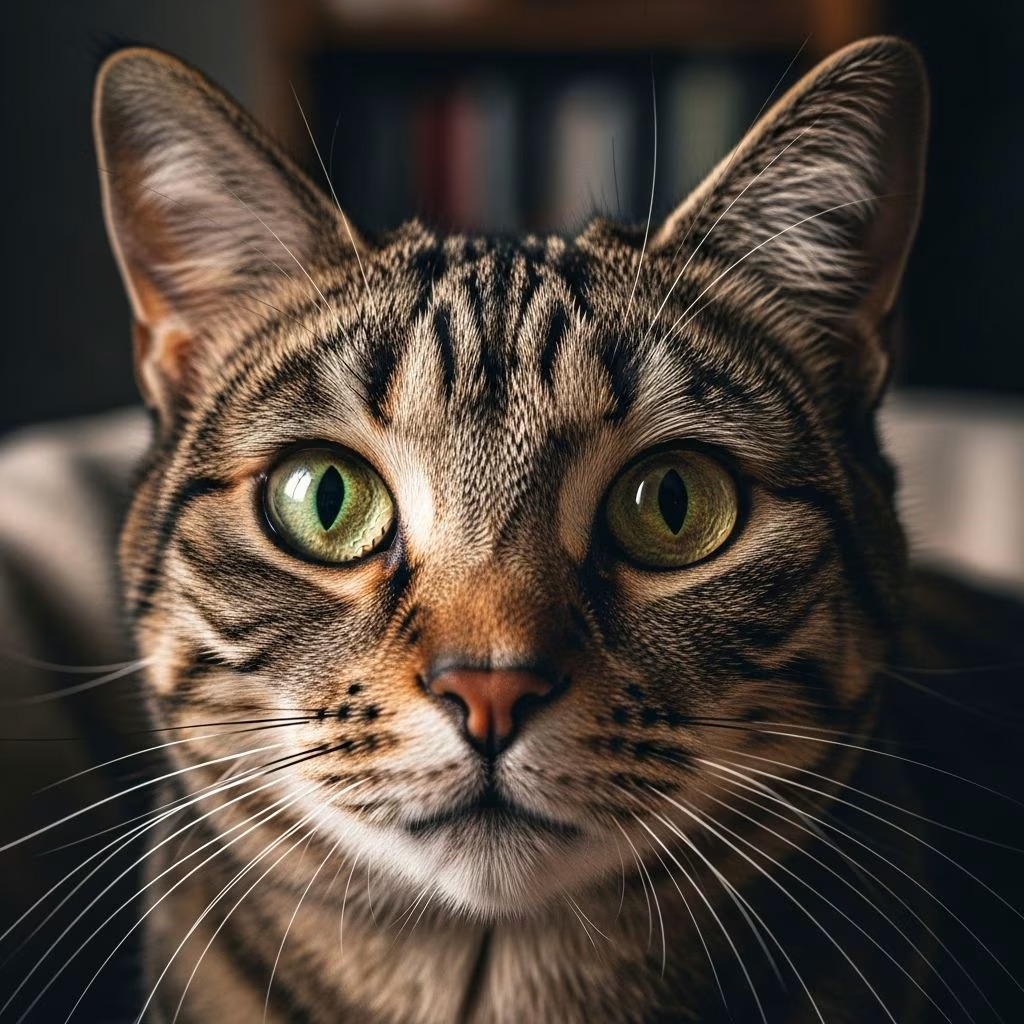
Cats possess a sophisticated level of intelligence that enables them to navigate complex environments, form bonds with humans, and solve everyday challenges with remarkable efficiency. Scientific studies reveal that their cognitive abilities often parallel those of a young child, blending keen perception, adaptive learning, and social awareness.
The Evolutionary Roots of Feline Smarts
The domestic cat’s journey from solitary wild hunter to sociable companion has profoundly shaped its cognitive landscape. Originating from the African wildcat, domestication fostered traits like group living and human attachment, expanding beyond instinctual survival skills. This evolution allowed cats to thrive in human households, displaying flexibility in social interactions and environmental adaptation.
Unlike their more pack-oriented canine counterparts, cats retain an independent streak, yet they exhibit neuroplasticity—the brain’s ability to reorganize based on experiences—which underpins their learning capacity. Early experiments, such as those by Edward Thorndike in the late 19th century, demonstrated cats escaping puzzle boxes through trial-and-error, gradually reducing escape times with repetition.
Brain Structure: A Hub of Cognitive Power
A cat’s brain, with approximately 250-300 million neurons in the cerebral cortex, supports intricate processing akin to human structures. This neuronal density surpasses that of dogs (around 160 million), suggesting enhanced complexity in perception and decision-making.
The feline brain operates as a interconnected network of specialized hubs, facilitating rapid sensory integration. Visual, auditory, and olfactory data converge, enabling cats to construct detailed mental maps of their surroundings. Studies confirm neuroplasticity in kittens, where visual stimuli alter RNA structures, enhancing adaptability.
| Aspect | Cat Brain | Dog Brain (Comparison) |
|---|---|---|
| Cortical Neurons | 250-300 million | 160 million |
| Key Strength | Sensory integration hubs | Social cooperation |
| Neuroplasticity | High, experience-driven | High, training-responsive |
Mastering Object Permanence and Spatial Awareness
Cats excel in object permanence, fully grasping that hidden items still exist—a sensorimotor skill humans develop later in infancy. In experiments with invisible displacements, cats consistently searched for concealed objects, showcasing mental representation capabilities.
Detour tasks using transparent barriers further highlight spatial intelligence. Cats adeptly switch strategies, recognizing obstacles as navigable from either side, demonstrating problem-solving flexibility comparable to dogs.
Memory: Short-Term Recall and Long-Term Retention
Feline memory combines robust working recall for immediate tasks and enduring long-term storage for learned behaviors. Research shows cats maintain working memory up to 10-30 seconds in visual displacement tests, with performance declining predictably over time.
- Short-term: Effective for 0-10 seconds in object tracking, dropping to near-chance at 60 seconds.
- Long-term: Allows recognition of voices, routines, and human gestures over years.
- Visual recognition: Cats remember encoded images, adapting cerebral pathways.
This memory prowess enables cats to remember prevented goals, persisting until successful, much like human toddlers.
Problem-Solving and Learning Mechanisms
Cats learn via observation, imitation, and experimentation, mirroring owner actions to master skills like door-opening or light-switching. Thorndike’s puzzle box trials illustrated instrumental learning, where repeated efforts refine efficiency.
In modern studies, cats tackle unsolvable tasks by gazing at humans for cues or persisting independently, revealing a balanced reliance on self and social hints. Quantity discrimination and time perception further evidence numerical and temporal awareness.
Social Cognition: Beyond Solitary Hunters
Though evolutionarily solitary, domestic cats form attachments, recognize owner voices, and respond to emotional cues. Behavioral responses—ear twitches, pupil dilation, tail flicks—intensify to familiar voices, confirming vocal discrimination.
Cats follow human gestures for rewards and detect mood shifts, fostering human-cat bonds. However, in challenges, they often solve alone rather than seek help, underscoring independence.
Nutrition’s Influence on Cognitive Vitality
Diet plays a pivotal role in sustaining cognitive health, particularly against age-related decline. Preliminary research links nutrients to brain function, mirroring needs in dogs but tailored to feline biology. Stress and aging subtly impair cognition, often mistaken for normal senescence.
Balanced nutrition supports neuroplasticity and memory, potentially mitigating declines. Future studies aim to pinpoint dietary impacts for enhanced welfare.
Cat Owners and Intelligence Correlations
Intriguingly, cat preference correlates with higher IQ and education levels. A Carroll University study of 600 participants found cat lovers scoring higher on intellectual curiosity, often holding degrees and favoring independent pets that suit busy lifestyles.
Cat people tend to be non-conformists who value independence, mirroring their pets’ traits.
Age-Related Cognitive Changes
As cats age, gradual shifts in cognition emerge, including memory lapses and reduced adaptability. Unlike overt dog dementia signs, feline changes are subtler, emphasizing early nutrition and enrichment interventions.
Enhancing Your Cat’s Mental Agility
Stimulate cognition with puzzle feeders, interactive toys, and training sessions. These mimic natural hunting, boosting problem-solving and bonding. Regular vet check-ups monitor cognitive health.
- Introduce novel toys weekly to encourage exploration.
- Use clicker training for commands, reinforcing memory.
- Provide vertical spaces for territorial awareness.
- Monitor diet for brain-supporting nutrients like omega-3s.
FAQs on Cat Intelligence
Are cats smarter than dogs?
Intelligence varies by metric; cats excel in independence and sensory processing, dogs in social obedience. Neuronal counts favor cats slightly.
Can cats learn tricks like dogs?
Yes, through positive reinforcement, cats master sits, highs-fives, and more, leveraging observational learning.
How do you test your cat’s IQ?
Observe puzzle-solving speed, object tracking, and response to cues. Formal tests include detour barriers and memory trials.
Do cats recognize their names?
Studies confirm cats distinguish their names from similar words, responding with head/ear movements.
Is cat intelligence fixed or improvable?
Highly plastic; enrichment and nutrition enhance it throughout life.
References
- Studies Show Preferring Cats is Associated With Higher Intelligence — PVH Society. 2023-10-07. https://pvhsociety.ca/preferring-cats-higher-intelligence/
- Feline Cognition and the Role of Nutrition: An Evolutionary… — PMC (NCBI). 2024. https://pmc.ncbi.nlm.nih.gov/articles/PMC11240355/
- Cat intelligence — Wikipedia (sourced from primary studies). N/A. https://en.wikipedia.org/wiki/Cat_intelligence
- What’s inside your cat’s head? A review of cat (Felis silvestris catus) cognition research — Oregon State University Institutional Repository. N/A. https://ir.library.oregonstate.edu/downloads/kk91fr19b
- How Intelligent Are Cats? Science Has an Answer — Cats.com. N/A. https://cats.com/cat-intelligence
- How Smart Are Cats? — PetMD. N/A. https://www.petmd.com/cat/general-health/how-smart-are-cats



