

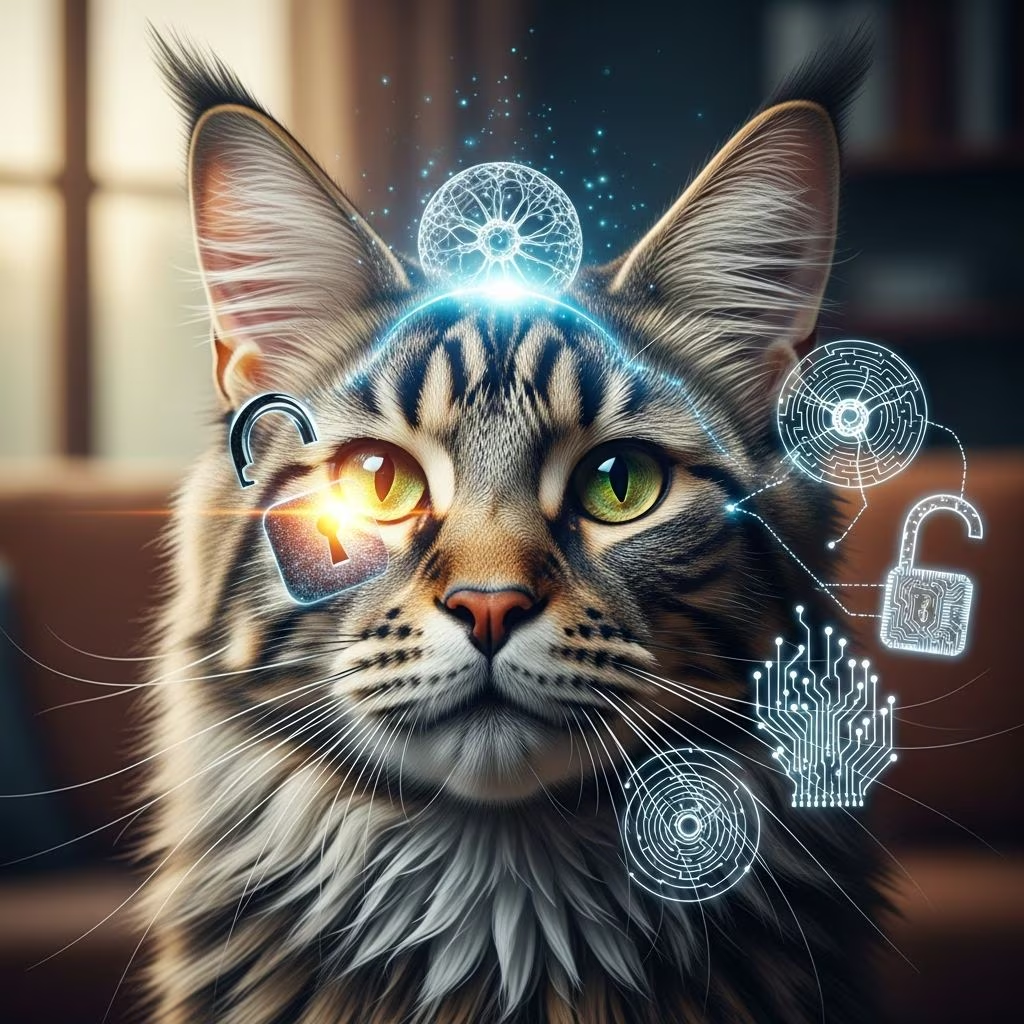
Cats possess remarkable cognitive abilities that often go underappreciated, with research showing they excel in abstract reasoning, social understanding, and problem-solving tasks comparable to more studied animals like dogs.
The Neural Foundation of Feline Brilliance
At the heart of a cat’s sharp mind lies its brain structure. Cats boast approximately 300 million cortical neurons, nearly double the 160 million found in dogs, providing a strong biological basis for advanced thinking. This higher neuron count correlates with enhanced processing power, enabling cats to navigate complex environments effectively.
These neurons support diverse mental functions, from sensory perception to decision-making. Unlike simplistic views of cats as instinct-driven, this neural density underscores their capacity for nuanced cognition, influencing everything from hunting strategies to household interactions.
Mastering Abstract Concepts: Beyond Simple Memory
Recent studies challenge long-held doubts about cats’ abstract thinking. In a breakthrough experiment, a cat learned to identify the ‘odd one out’ across multiple simultaneous problems, succeeding even with novel objects—proof of genuine concept formation rather than rote memorization.
Historical research yielded mixed results: a 1960 study showed one cat transferring oddity learning instantly to new items, while a 1966 experiment found cats failing after thousands of trials compared to primates. Modern methods, using concurrent multi-problem training, revealed cats can grasp relational rules like ‘different from others,’ reshaping views on their intellectual limits.
| Study Era | Method | Cat Performance | Key Insight |
|---|---|---|---|
| 1960s | Sequential single problems | Mixed; some success, later failures | Memorization possible but abstract transfer rare |
| 2025 | Concurrent multiple problems | Consistent success on novel stimuli | True oddity concept learning confirmed |
Social Intelligence: Cats as Attuned Companions
Cats demonstrate social smarts rivaling dogs in key areas. They prefer human interaction over food or toys, spend more time with attentive people, and distinguish owners’ voices from strangers. These behaviors indicate sensitivity to human attentional states, gestures, and emotions.
Emerging labs worldwide confirm cats perceive optical illusions like humans, form attachments through training, and exhibit fairness awareness—traits once thought exclusive to canines. Despite challenges like test reluctance (only 41% completion rates in some studies), results push back against ‘aloof’ stereotypes.
- Voice recognition: Cats differentiate familiar humans accurately.
- Interaction preference: Humans trump toys in appeal.
- Emotional attunement: Respond to owner attention levels.
Comparing Feline and Canine Minds
Direct comparisons highlight cats’ strengths. While dogs shine in human-directed tasks due to breeding, cats match them in social cognition tests without similar selection pressures. Neuron counts favor cats, and their independent nature may mask cooperative intelligence.
Cat lovers often score higher on IQ tests and show greater intellectual curiosity, per a study of 600 participants where feline preferrers outperformed dog enthusiasts. This human correlation might reflect cats’ appeal to analytical minds, mirroring their own problem-solving prowess.
Cognitive Development Across Life Stages
Kittens rapidly develop perception, memory, and causality understanding. Research reviews cover object permanence—tracking hidden items—and quantity discrimination, showing cats infer physical rules intuitively.
In adulthood, cats solve clinical puzzles, like escaping traps, indicating practical intelligence honed by evolution. Aging brings cognitive dysfunction syndrome (CDS), akin to Alzheimer’s, with amyloid-beta deposits mirroring human pathology—positioning cats as disease models. Nutrition influences this trajectory, with sensory studies linking diet to sustained cognition.
Enhancing Your Cat’s Mental Sharpness
Recognizing cats’ capacities calls for enriched environments. Beyond hunting toys, incorporate puzzle feeders, rule-based games, and multi-option challenges to foster abstract thinking.
- Concurrent puzzles: Rotate oddity tasks daily.
- Social training: Kitten classes boost attachment.
- Vertical mazes: Combine climbing with decisions.
- Novel objects: Introduce unseen items weekly.
Individual differences matter—genetics, health, and temperament vary performance, so tailor to your cat’s pace. Training leverages operant conditioning but elevates to conceptual levels for better behavior management.
Health Impacts on Feline Intellect
Intelligence ties to well-being. CDS impairs reasoning, underscoring early detection’s value. Sensory research shows nutrition bolsters perception, vital for cognition. PetMD notes evolutionary smarts for survival, preserved in domestics.
Hill’s Pet emphasizes understanding these abilities builds stronger bonds, using science to decode mysterious behaviors. Regular vet checks preserve cognitive health, preventing declines.
Future Frontiers in Cat Cognition
Ongoing questions include training scalability, CDS interventions, and clinic tools. Global labs expand tests, from Mexico to Japan, promising deeper insights. Cats’ model potential for neurodegeneration could yield dual human-vet advances.
This research dispels myths, affirming cats’ sophistication and urging refined care approaches.
Frequently Asked Questions
Are cats smarter than dogs?
Cats have more cortical neurons and excel in independent tasks, while dogs lead in human cooperation; both shine differently.
Can cats learn tricks like dogs?
Yes, via structured methods revealing abstract rule grasp, though patience accounts for their temperament.
How do you test cat intelligence?
Use oddity tasks, social preference trials, or object permanence games; observe daily problem-solving.
Do all cats have the same IQ?
No, variation exists due to genetics, environment, and health, like human spectrums.
Why study cat cognition now?
New methods overcome past biases, matching dogs in social tests and aiding welfare.
References
- Feline Cognition: New Evidence for Oddity Concept Learning in Cats — My Vet Candy. 2025-10-05. https://www.myvetcandy.com/blog/2025/10/5/feline-cognition-new-evidence-for-oddity-concept-learning-in-cats
- Studies Show Preferring Cats is Associated With Higher Intelligence — PVH Society. 2023-10-07. https://pvhsociety.ca/preferring-cats-higher-intelligence/
- Cats rival dogs on many tests of social smarts. But is anyone brave enough to study them? — Science.org. N/A. https://www.science.org/content/article/cats-rival-dogs-many-tests-social-smarts-anyone-brave-enough-study-them
- How Intelligent Are Cats? Science Has an Answer — Cats.com. N/A. https://cats.com/cat-intelligence



