

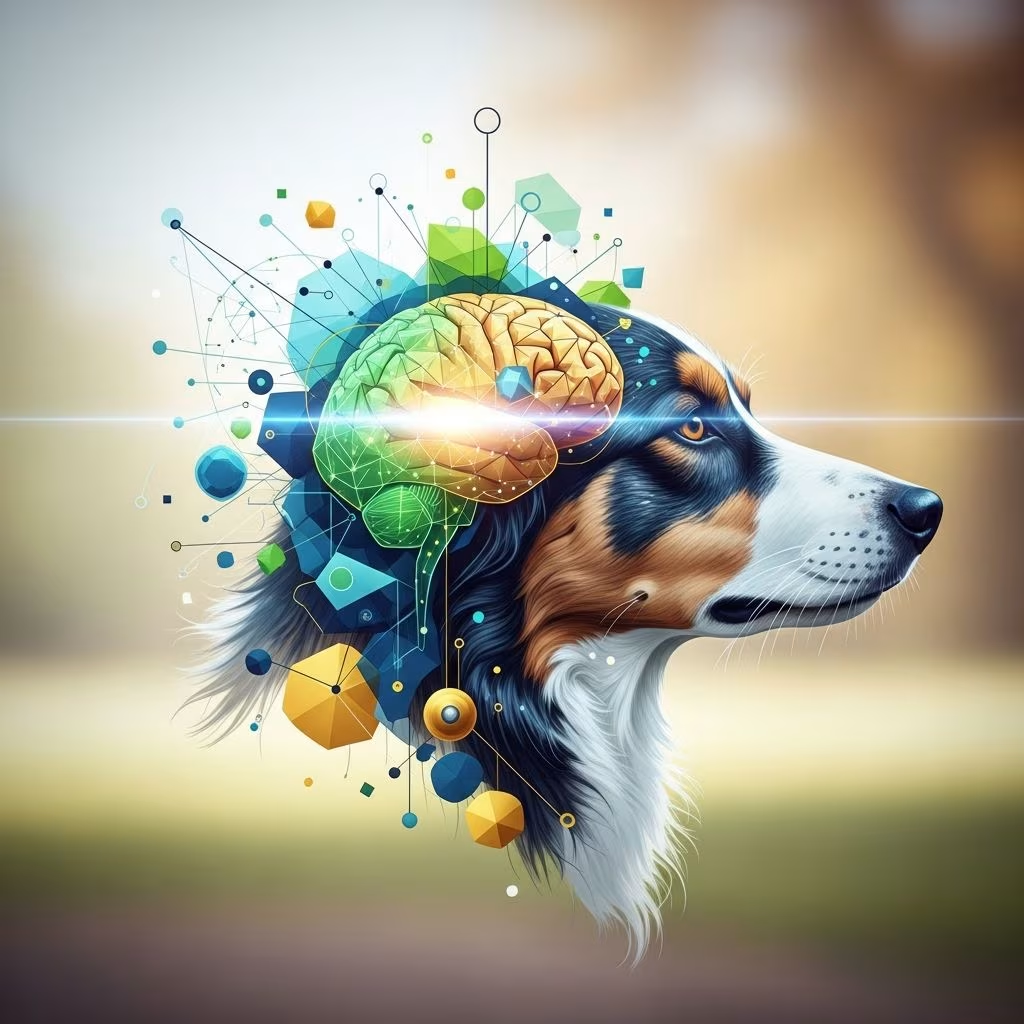
Dogs possess remarkable cognitive abilities that set them apart from many other animals, particularly in their capacity to understand and collaborate with humans. This article delves into the science of how dogs think, learn, and process emotions, drawing on recent research to provide practical insights for owners and trainers.
The Foundations of Dog Learning
At the core of canine behavior lies a sophisticated learning system shaped by evolution and environment. Dogs primarily develop habits through operant conditioning and classical conditioning, principles that form the backbone of modern training methods. Operant conditioning, pioneered by B.F. Skinner, involves associating actions with outcomes—rewards encourage repetition, while punishments deter unwanted behaviors.
The most effective approach focuses on positive reinforcement, where adding desirable stimuli like treats or toys increases desired behaviors. This force-free method minimizes stress and fosters enthusiasm for learning, making it ideal for everyday training. For instance, rewarding a sit command with a favorite toy not only reinforces the action but also builds a positive association with the trainer.
- Positive reinforcement: Add rewards to boost good behaviors.
- Negative punishment: Remove rewards to decrease unwanted actions.
- Avoid positive punishment: Adding discomfort can create fear and resistance.
Understanding these quadrants helps owners tailor sessions to their dog’s needs, promoting long-term success without conflict.
Social Intelligence: Dogs’ Unique Human Connection
Dogs excel in social cognition, often surpassing other species in reading human cues. Research from the Duke Canine Cognition Center highlights how dogs’ minds have evolved to align closely with human thinking patterns. This adaptability stems from domestication, enabling dogs to interpret gestures, gazes, and vocal tones with high accuracy.
Studies show dogs reared in human-centric environments rely heavily on owner guidance, following points or eye directions more readily than those from less interactive settings. This social reliance enhances training efficiency, as dogs naturally seek human input to solve problems.
One groundbreaking technique is the “do as I do” method, where dogs imitate human actions after a simple cue. Without prior shaping, dogs can replicate novel behaviors like spinning or placing objects, demonstrating spontaneous imitation skills. Such abilities underscore dogs’ potential for advanced learning beyond basic commands.
Cognitive Styles and Individual Differences
Not all dogs learn alike; cognitive styles vary widely, influencing how they perceive and interact with their world. Identifying a dog’s style—whether independent, social, or inventive—allows for personalized training strategies. For example, socially driven dogs thrive on human praise, while independent ones respond better to self-rewarding tasks.
Genetic factors play a key role, with genome-wide studies linking cognitive variability to genes involved in brain development. Heritability of emotional reactivity further suggests selective breeding could optimize traits for specific roles, like herding or detection. Environmental nurturing also matters: dogs from enriched homes show superior human-directed cognition.
| Cognitive Style | Characteristics | Best Training Approach |
|---|---|---|
| Social | Relies on human cues, seeks approval | Praise, joint problem-solving |
| Independent | Solves tasks alone, less gaze-following | Self-rewarding puzzles, minimal guidance |
| Inventive | Creative problem-solvers, persistent | Novel challenges, varied rewards |
This table summarizes styles based on cognitive research, aiding in customized training.
Emotions and Memory in Canine Minds
Dogs experience a rich emotional landscape, including joy, fear, and attachment, which profoundly impacts behavior. Courses like Dog Emotion and Cognition from Duke explore these feelings through evolutionary and experimental lenses, comparing dogs to apes and wolves.
Memory is another strength: dogs exhibit robust short- and long-term recall, aiding in command retention and habit formation. Research questions whether dogs grasp abstract concepts like time or numbers, with evidence suggesting rudimentary understanding. For training, respecting these emotions prevents shutdowns from stress, promoting engagement.
Working dogs, such as service or search animals, benefit immensely from cognitive assessments. Predictive models using cognition batteries forecast training success with up to 95% accuracy, even in puppies. This pre-selection boosts program efficiency, reducing dropout rates.
Practical Applications for Everyday Training
Applying cognition science transforms routine interactions. Start with short sessions leveraging positive reinforcement to build focus. Incorporate cognitive games, like hiding treats under cups, to sharpen problem-solving.
For working dogs, social learning models—observing peers or humans—outperform solitary trials, promising higher success rates. Breeders can now target cognitive traits via genetics, enhancing suitability for tasks.
Owners should observe their dog’s responses: quick learners may need complexity, while slower ones benefit from repetition. Tools from citizen science platforms allow testing at home, revealing insights into your dog’s mind[10].
Advanced Insights from Recent Research
The field of canine cognition is booming, with centers like Duke’s pioneering comparisons to primates. Peer-reviewed work confirms dogs’ imitation prowess and emotional heritability, opening doors to optimized breeding.
Training now emphasizes cognition over rote repetition, recognizing individual personalities. This shift, supported by APA insights, deepens the human-dog bond by aligning methods with natural intelligence.
Challenges and Future Directions
Despite progress, gaps remain in understanding long-term memory or abstract reasoning. Less nurturing environments can hinder social skills, emphasizing early socialization. Future research may refine predictive tools for broader applications, from pets to professionals.
Ethical breeding prioritizes welfare, avoiding over-selection for extremes. Integrating cognition into training promises healthier, happier dogs.
Frequently Asked Questions (FAQs)
How can I test my dog’s cognitive style?
Use online games or apps assessing problem-solving and social reliance, like those from Dognition[10]. Observe reactions to human gestures versus solo tasks.
Is positive reinforcement suitable for all dogs?
Yes, it’s versatile and low-stress, adaptable to any style via tailored rewards.
Can cognition predict working dog success?
Cognitive batteries predict up to 95% accuracy pre-training.
Do dogs feel complex emotions like guilt?
Evidence supports basic emotions; complex ones like guilt are debated but often misinterpreted appeasement.
How does environment affect dog cognition?
Enriched, human-interactive settings boost social skills.
References
- Is cognition the secret to working dog success? — PMC/NCBI. 2021-12-01. https://pmc.ncbi.nlm.nih.gov/articles/PMC8670203/
- Dog Psychology and Canine Cognition Introductory Guide — Sniffspot. 2025-04-15. https://www.sniffspot.com/blog/dog-training/dog-psychology-all-you-need-to-know
- Dog Emotion and Cognition — Coursera/Duke University. Accessed 2026. https://www.coursera.org/learn/dog-emotion-and-cognition
- Canine Cognition — Positively.com. Accessed 2026. https://positively.com/dog-training/article/dog-science-canine-cognition
- The Thinking Animal: Cognition and its Role in Behavior — IAABC Foundation. Accessed 2026. https://iaabcfoundation.org/courses/the-thinking-dog-cognition-and-its-role-in-behavior/
- Duke Canine Cognition Center — Duke University Evolutionary Anthropology. Accessed 2026. https://evolutionaryanthropology.duke.edu/research/dogs



