
Tumors Of Unknown Cause In Poultry: What Farmers Need To Know
Exploring mysterious tumors in chickens: causes, impacts, diagnosis, and management strategies for better flock health.
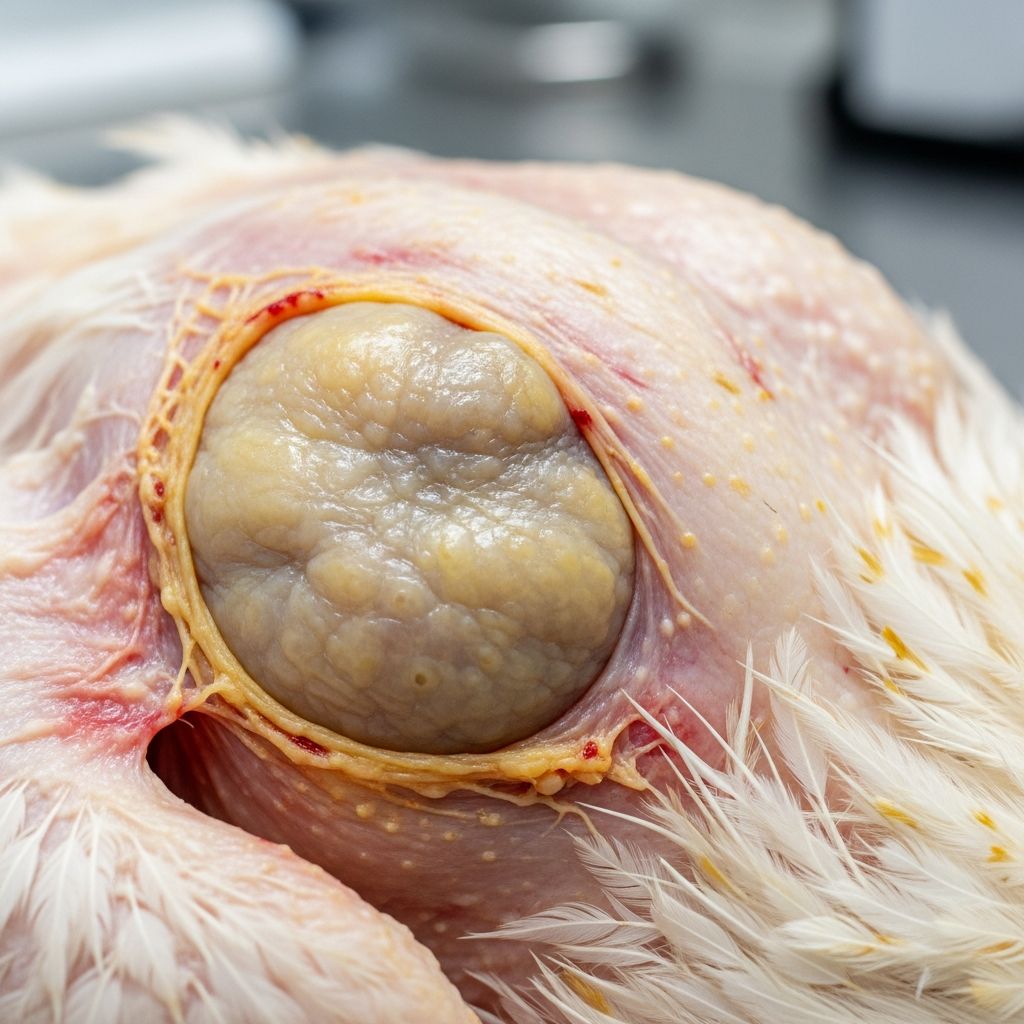
Poultry farming faces various health challenges, among which tumors of undetermined origins stand out due to their unpredictable nature and potential economic repercussions. These conditions, distinct from well-understood viral neoplasms like Marek’s disease, affect broiler and layer flocks sporadically, leading to carcass condemnations, reduced performance, and diagnostic uncertainties.
Understanding the Scope of Idiopathic Neoplasms
Idiopathic tumors in birds encompass a range of growths whose causative agents remain elusive despite extensive research. Unlike virus-linked cancers, these lack confirmed transmissibility or genetic markers, complicating prevention efforts. They manifest primarily in skin, visceral organs, and reproductive systems, often discovered during slaughter inspections or necropsies. Common types include proliferative skin lesions resembling squamous cell issues, widespread histiocytic proliferations, and glandular cancers in laying hens. Their low overall incidence belies significant localized impacts in affected flocks.
These neoplasms highlight gaps in poultry pathology knowledge. While viral tumors dominate economic losses globally, idiopathic ones contribute through processing losses and occasional mortality spikes. Factors like genetic predispositions, environmental stressors, or subtle infections may play roles, though evidence is circumstantial.
Skin-Based Proliferative Lesions
One prominent example involves crateriform ulcers in feather tracts, frequently noted in fast-growing broilers. These appear post-defeathering as raised-edged depressions filled with keratinous material and debris. In living birds, they present as inflamed, bacterium-laden sores that evade early detection.
Pathologically, these lesions stem from hyperplastic feather follicle expansions, mimicking aggressive epithelial growths but without proven malignancy. High prevalence in certain flocks triggers substantial condemnations, where severely affected birds are entirely discarded, eroding profitability. Trimming salvages milder cases, yet labor and yield losses persist. No etiological agent—viral, bacterial, or otherwise—has been pinpointed, and experimental transmissions fail, fueling debates on their true neoplastic status.
- Lesion characteristics: Crater-like with elevated borders, keratin plugs.
- Detection timing: Primarily at processing plants.
- Flock impact: Elevated in some broiler lines, sporadic elsewhere.
- Management: Visual inspection, culling suspects pre-slaughter.
Diffuse Organ Histiocytic Growths
Multicentric histiocytosis targets young meat birds, causing organ enlargement and nodular formations. Affected spleens and livers swell markedly, harboring millet-sized pale nodules; kidneys often follow suit. Microscopic views reveal spindle cells infiltrating lymphoid areas around vessels, with atypical nuclei suggesting reactive hyperplasia over outright sarcoma.
This condition’s etiology defies identification, distinguishing it from retrovirus-linked histiocytic sarcomatosis observed in lab settings. No consistent pathogens emerge from affected tissues, and field occurrences remain focal. Economic effects stem from condemnations and growth lags in symptomatic flocks, though mortality stays low. Differential diagnoses include early viral lymphomas, necessitating histopathology for confirmation.
| Organ | Nodule Size | Color | Histology |
|---|---|---|---|
| Spleen | 0.5-5 mm | White-yellow | Spindle cell expansion |
| Liver | 0.5-5 mm | White-yellow | Periarteriolar infiltration |
| Kidney | 0.5-5 mm | White-yellow | Diffuse histiocytes |
Reproductive Glandular Neoplasms
In mature layers, ovarian and oviductal adenocarcinomas rank as frequent incidental findings. These yield miliary implants across abdominal surfaces, often with fluid accumulation causing ascites. Non-transmissible and virus-independent, they rarely impair egg output until advanced.
Grossly, tumors appear as scattered peritoneal seedings, histologically confirming glandular origins. Prevalence rises with age, underscoring routine necropsies in cull hens. While not flock-debilitating, they contribute to processing losses and flag underlying physiological stresses.
Diagnostic Approaches for Mystery Tumors
Distinguishing idiopathic neoplasms from viral counterparts demands integrated diagnostics. Gross exams reveal patterns—skin craters, organ nodules, peritoneal studs—but microscopy proves decisive. Immunohistochemistry rules out leukosis antigens, while PCR screens exclude common retroviruses.
Challenges persist: lesions overlap with infectious mimics, and sampling biases skew incidence data. Flock history, age, and breed inform suspicions; broilers favor skin/histiocytic types, layers glandular ones. Emerging tools like gene sequencing probe for novel agents, yet yield no breakthroughs to date.
Economic and Production Ramifications
Though less devastating than Marek’s, these tumors erode margins via condemnations—whole carcasses for skin lesions, partial trims otherwise. Broiler integrators report flock-level losses up to several percent in outbreaks, compounded by processing downtime. Layers suffer subtle drops in persistency, with ascites signaling welfare issues.
Global trade amplifies risks; undetected carriers slip biosecurity nets, seeding new units. Mitigation hinges on slaughter surveillance, genetic selection for resilience, and nutrition optimizing immune vigor.
Potential Risk Factors and Research Gaps
Speculative triggers include trauma-induced skin proliferations, feed contaminants fostering histiocytosis, or hormonal shifts in layers. Genetic lines vary susceptibility—modern broilers overrepresent skin cases. Environmental husbandry, like litter quality or density, may exacerbate via chronic irritation.
Ongoing studies chase etiologies through metagenomics and cohort tracking. Comparative pathology with mammalian analogs hints at polyfactorial origins, urging multidisciplinary probes.
Management and Prevention Tactics
Lacking cures, strategies emphasize exclusion and monitoring. Rigorous biosecurity curbs introductions; all-in-all-out systems isolate cohorts. Pre-slaughter checks cull suspects, minimizing condemnations.
- Biosecurity protocols: Quarantine new stock, sanitize.
- Monitoring: Routine necropsies, histopathology.
- Genetic tools: Select low-susceptibility breeds.
- Nutrition: Balanced feeds bolstering immunity.
Vaccination gaps for virals indirectly aid by curbing coinfections that mask idiopathic cases. Future prospects include marker-assisted breeding and diagnostics for early flagging.
Comparing Idiopathic vs. Viral Neoplasms
| Aspect | Idiopathic Tumors | Viral Neoplasms |
|---|---|---|
| Etiology | Unknown | Herpes/retroviruses |
| Transmissibility | Not demonstrated | High |
| Incidence | Sporadic, flock-specific | Widespread |
| Control | Monitoring, culling | Vaccines available |
| Economic Loss | Processing condemnations | Mortality, poor gains |
FAQs on Poultry Tumors of Unknown Cause
What causes skin ulcers in broilers at processing?
These crater-like lesions arise from feather follicle hyperplasia, etiology unknown; common in certain flocks, leading to trims or condemnations.
How does multicentric histiocytosis affect young chickens?
It enlarges spleen, liver, kidneys with nodules of histiocytes; impacts growth but rarely kills directly.
Are ovarian adenocarcinomas contagious?
No, they occur incidentally in old layers, non-transmissible, with peritoneal spread.
Can idiopathic tumors be prevented?
Not specifically, but biosecurity, genetics, and surveillance reduce incidence.
How to differentiate from Marek’s disease?
Use histopathology and PCR; idiopathic lack viral markers, show unique patterns.
References
- Neoplasms of Unknown Etiology in Poultry — Merck Veterinary Manual. 2025. https://www.merckvetmanual.com/poultry/neoplasms-in-poultry/neoplasms-of-unknown-etiology-in-poultry
- Overview of Neoplasms in Poultry — MSD Veterinary Manual. 2025. https://www.msdvetmanual.com/poultry/neoplasms-in-poultry/overview-of-neoplasms-in-poultry
- Overview of Neoplastic Diseases in Poultry — VetZooSci. 2023. https://vetzoosci.com/index.php/pub/article/view/14
- Current Epidemiology and Co-Infections of Avian Neoplastic Diseases — PMC (NCBI). 2022-12-21. https://pmc.ncbi.nlm.nih.gov/articles/PMC9784009/
- Neoplasms of Unknown Etiology in Poultry — The Science World (PDF). 2023. https://www.thescienceworld.net/_files/ugd/fd0b41_e1d2c38de75e4738a8f737d95800037d.pdf?index=true
Similar Articles








Read full bio of Sneha Tete


